
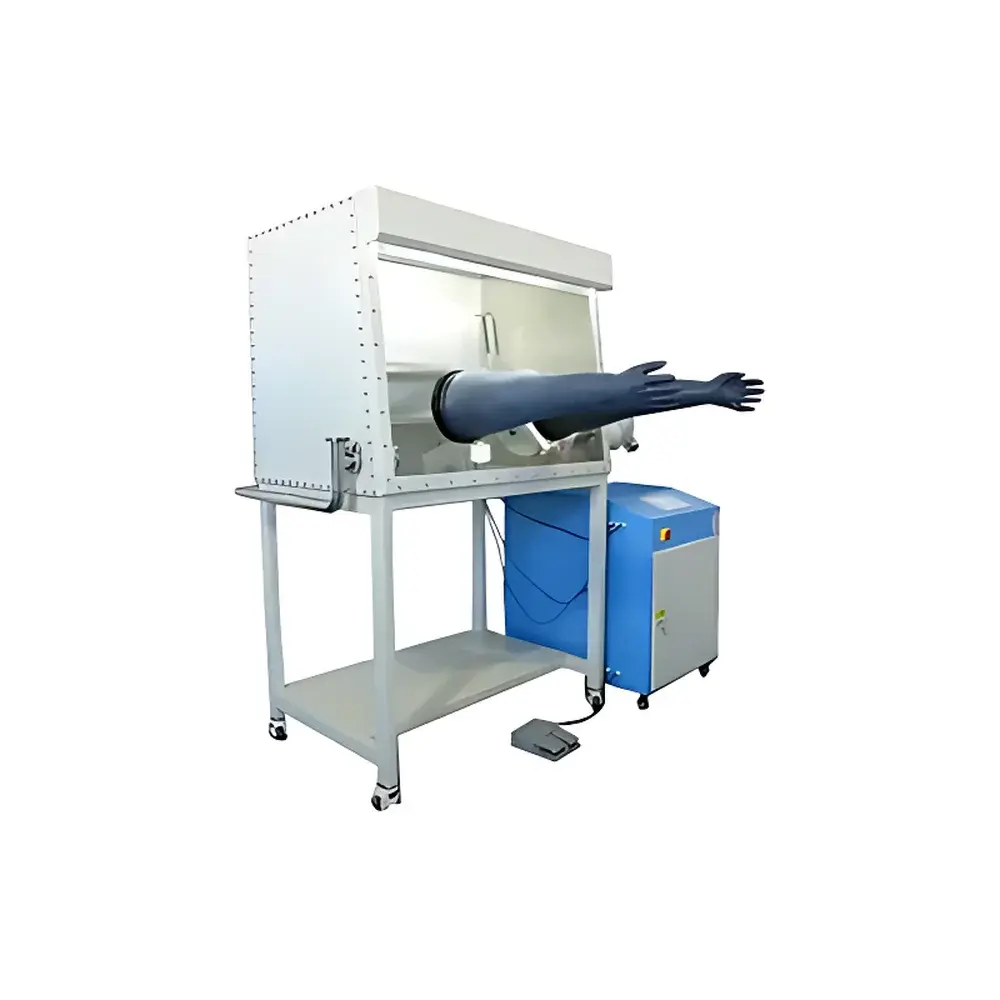
Hefei Kejing VGB-6 Inert Atmosphere Glove Box
| Brand | Hefei Kejing |
|---|---|
| Origin | Anhui, China |
| Model | VGB-6 |
| Chamber Volume | 3600 × 900 × 1000 mm (L × H × W) |
| Construction Material | 304 Stainless Steel (3 mm thickness) |
| Viewing Window | Dual-layer tempered glass |
| Glove Ports | Hard-anodized aluminum |
| Large Transfer Chamber | Ø360 × 600 mm |
| Small Transfer Chamber | Ø100 × 300 mm |
| Gas Purification | Regenerable 304 stainless steel columns for H₂O and O₂ removal (<1 ppm residual) |
| Purification Capacity | 1.3 kg H₂O / 30 L O₂ |
| Pressure Control Range | ±12 mbar (PLC-controlled) |
| Circulation System | Oil-free, vacuum-rated stainless steel loop (DN40) with microprocessor regulation |
| Regeneration Gas | 5–10% H₂ in working gas (N₂/Ar/He) |
| Vacuum Pump | Original equipment, 8 m³/h flow rate |
| Power Supply | 220 V AC, 50 Hz, single-phase |
Overview
The Hefei Kejing VGB-6 Inert Atmosphere Glove Box is an engineered solution for handling air-sensitive materials under rigorously controlled inert environments. Designed for reproducible operation in research laboratories, materials synthesis facilities, and battery development centers, the system employs a closed-loop gas circulation architecture combined with dual-stage purification to maintain oxygen and moisture levels below 1 ppm. Its operational principle relies on continuous recirculation of process gas (N₂, Ar, or He) through catalytic and adsorptive purification columns, followed by precise pressure regulation via a PLC-driven pneumatic control system. The chamber’s structural integrity—fabricated from 3 mm-thick 304 stainless steel with full TIG welding—ensures long-term compatibility with aggressive solvents and reactive chemistries while meeting ISO 14644-1 Class 5 cleanroom-compatible construction standards. The dual-layer tempered viewing window provides optical clarity and mechanical safety without compromising inertness.
Key Features
- 6-inch touchscreen HMI interface for intuitive navigation across system functions including pressure setpoint adjustment, cycle initiation, and regeneration scheduling
- Automated chamber purge and leak-check routines compliant with ASTM E505-21 guidelines for inert atmosphere validation
- Foot-operated pressure modulation switch enabling hands-free fine-tuning of internal over/under-pressure during glove manipulation
- Integrated data logging module recording real-time pressure, temperature, purification column saturation status, and regeneration cycle history
- Modular purification system with field-replaceable 304 stainless steel columns; desiccant and catalyst media are fully regenerable using in-situ H₂/N₂ mixtures
- Dual transfer chambers (large: Ø360 × 600 mm; small: Ø100 × 300 mm) featuring interlocked valves and independent vacuum/purge sequences per ASTM F209-22 protocols
Sample Compatibility & Compliance
The VGB-6 accommodates samples ranging from lithium metal anodes and organometallic catalysts to oxygen-sensitive perovskite precursors and pyrophoric reagents. Its solvent-resistant interior surfaces and non-reactive gas pathways ensure compatibility with THF, DME, acetonitrile, and chlorinated solvents. All wetted components—including circulation piping (DN40), transition fittings, and glove ports—are constructed from electropolished 304 stainless steel to prevent catalytic decomposition or trace metal leaching. The system supports GLP-compliant documentation workflows through timestamped audit trails and exportable CSV logs. While not certified to UL 61010-1 or IEC 61000-6-4 out-of-the-box, its electrical architecture adheres to international single-phase 220 V / 50 Hz supply specifications and includes integrated overcurrent and thermal cutoff protection.
Software & Data Management
The embedded control firmware enables persistent storage of up to 30 days of operational telemetry—including pressure deviation profiles, column regeneration timestamps, and cumulative gas consumption estimates. Data export is supported via USB 2.0 port in comma-separated format for integration into LIMS or ELN platforms. Optional RS-485 Modbus RTU interface allows centralized monitoring within facility-wide SCADA networks. All parameter changes are logged with operator ID (if network-authenticated), date/time stamp, and pre/post-value comparison—meeting baseline requirements for FDA 21 CFR Part 11 electronic record integrity where local validation protocols are implemented.
Applications
This glove box serves critical roles in solid-state battery electrode fabrication, where ambient moisture induces LiPF₆ hydrolysis and SEI layer instability; in Grignard and Schlenk-line chemistry requiring sub-ppm O₂ environments; in glove-based nanomaterial handling to prevent surface oxidation of quantum dots or MXenes; and in pharmaceutical intermediate synthesis involving hygroscopic or thermally labile compounds. Its large internal volume (3.24 m³) and ergonomic layout support multi-step manipulations using standard laboratory tools—including pipettes, spatulas, and analytical balances—without compromising environmental stability.
FAQ
What inert gases are compatible with the VGB-6 system?
Nitrogen, argon, and helium are fully supported as primary working gases. Hydrogen-enriched mixtures (5–10% H₂ in N₂/Ar) are used exclusively for column regeneration and must never be introduced during normal operation.
Is the purification system truly regenerable without component replacement?
Yes—the catalytic oxygen remover (copper-based) and molecular sieve desiccant are regenerated in situ using controlled H₂ flow and elevated temperature cycles. Media lifetime exceeds 200 regeneration cycles under typical usage conditions.
Can the glove box be integrated into an existing lab ventilation or exhaust management system?
The unit features dedicated exhaust ports rated for connection to dedicated acid/gas scrubbers or facility exhaust manifolds. Backpressure must remain below 50 Pa to avoid interference with pressure control stability.
Does the system include validation documentation for GMP environments?
Factory-installed IQ/OQ documentation templates are provided. Full PQ execution requires site-specific testing per ISO 14644-3 and user-defined acceptance criteria.



