
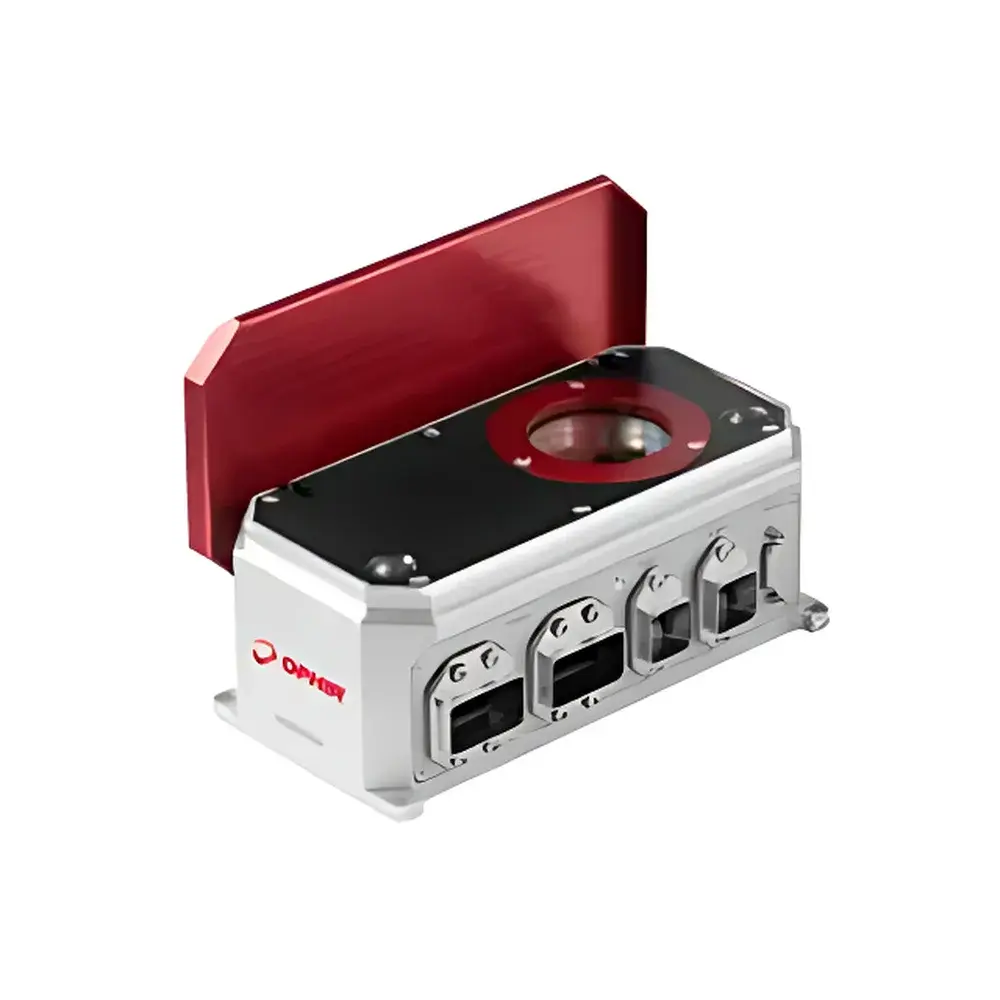
HELIOS Online Laser Power Meter by OPHIR
| Brand | OPHIR |
|---|---|
| Origin | USA |
| Model | HELIOS |
| Power Range | 200 W – 12 kW |
| Energy Range | 200 J – 5 kJ |
| Exposure Time | 0.3 s – 4 s |
| Wavelength Range | 750 nm – 1100 nm |
| Max Beam Diameter | 35 mm |
| Max Energy Density | 4 kJ/cm² |
| Accuracy | ±3% |
| Repeatability | ±1% |
| Response Time | 2.5 s |
| Measurement Interval | 12 s |
| Communication Interfaces | PROFINET, RS232 |
| Operating Temperature | 10–60 °C |
| Operating Humidity | 10–80% RH |
| Shutter Activation | Automatic upon measurement initiation |
Overview
The HELIOS Online Laser Power Meter is an industrial-grade, OEM-integrated optical sensor engineered by OPHIR — a globally recognized leader in laser measurement instrumentation and ISO/IEC 17025-accredited calibration services. Designed specifically for real-time, in-line power and energy monitoring within high-power laser manufacturing environments, the HELIOS operates on the principle of calibrated thermal absorption: incident laser radiation is uniformly absorbed by a precision-engineered thermopile-based sensor surface, and the resulting temperature gradient generates a proportional voltage signal processed via embedded analog-to-digital conversion. Unlike conventional water- or air-cooled power meters, the HELIOS eliminates external cooling infrastructure through its passive thermal management architecture — enabling direct integration into laser welding heads, cutting gantries, and beam delivery modules without compromising thermal stability or measurement fidelity. Its operational envelope targets continuous-wave (CW) and pulsed industrial lasers operating in the near-infrared spectrum (750–1100 nm), including fiber, disk, and diode lasers commonly deployed in automotive body-in-white fabrication, battery electrode welding, and sheet metal processing.
Key Features
- True in-line measurement capability with no optical re-routing or beam sampling required
- Passive thermal design: zero dependency on water chillers or forced-air systems — reduces system footprint, maintenance overhead, and failure points
- Automated shutter mechanism: hermetically sealed protective cover opens only during active measurement cycles, minimizing sensor contamination and drift
- Dual-mode operation: supports both continuous power monitoring (200 W–12 kW) and single-pulse or burst-mode energy accumulation (200 J–5 kJ)
- Industrial communication protocols: native PROFINET support enables seamless integration into Siemens, Beckhoff, and B&R PLC ecosystems; RS232 provides legacy serial compatibility for custom HMI or SCADA interfaces
- Ruggedized mechanical housing rated for factory-floor deployment: IP54 ingress protection, shock-resistant mounting interface, and thermal compensation algorithms validated across 10–60 °C ambient range
Sample Compatibility & Compliance
The HELIOS is optimized for collimated or mildly divergent laser beams up to 35 mm in diameter, with maximum tolerable fluence of 4 kJ/cm² — sufficient for multi-kilowatt CW sources and high-energy pulsed systems used in thick-section welding. It complies with key international standards governing laser safety and metrological traceability, including IEC 60825-1 (laser product safety), ISO 11554 (laser beam parameter measurements), and NIST-traceable calibration practices aligned with ISO/IEC 17025. While not a medical device, its measurement uncertainty budget (±3% accuracy, ±1% repeatability) meets typical requirements for process validation under ISO 9001 and IATF 16949 quality management systems. For regulated manufacturing environments, raw measurement logs can be exported with timestamp, sensor ID, and environmental metadata — supporting audit readiness per FDA 21 CFR Part 11 when paired with compliant data acquisition software.
Software & Data Management
OPHIR’s StarLab™ PC software (v4.0+) provides full configuration, real-time visualization, and statistical analysis of HELIOS measurement streams. Data export supports CSV, XML, and HDF5 formats, enabling direct ingestion into MES platforms such as Siemens Opcenter, Rockwell FactoryTalk, or custom Python-based SPC dashboards. The embedded firmware includes configurable alarm thresholds (e.g., power deviation >±5% over three consecutive readings), event-triggered logging, and non-volatile memory retention for last 1000 measurements — critical for root-cause analysis during process excursions. All communication packets include CRC-16 error checking; PROFINET implementation conforms to Conformance Class A per IEC 61784-2, ensuring deterministic cycle times (<10 ms) in synchronized automation networks.
Applications
- Real-time closed-loop control of laser power in robotic welding cells — enabling adaptive parameter adjustment based on measured output drift
- In-process verification of laser source stability during qualification runs for aerospace structural components (per AMS 2750E pyrometry correlation protocols)
- Energy-per-pulse validation in battery tab welding lines where thermal penetration depth correlates directly with accumulated pulse energy
- Preventive maintenance trending: long-term degradation analysis of laser diode arrays using normalized power decay curves
- Factory acceptance testing (FAT) documentation for OEM laser machinery — providing NIST-traceable evidence of delivered optical performance
FAQ
Does the HELIOS require recalibration after installation?
No — each unit ships with a factory calibration certificate traceable to NIST standards. However, annual recalibration is recommended for GMP-compliant production lines or when operating outside nominal environmental conditions for extended periods.
Can the HELIOS measure modulated or gated laser outputs?
Yes — provided the modulation frequency remains below 0.1 Hz (i.e., minimum on/off period ≥10 s), the device accurately captures average power and integrated energy per exposure window (0.3–4 s adjustable).
Is beam alignment critical for accurate measurement?
Within the specified 35 mm clear aperture, positional uniformity is maintained via diffuser-integrated thermopile geometry; centering tolerance is ±5 mm from optical axis without measurable impact on accuracy.
What happens if the protective shutter fails to open?
The device performs self-diagnostic checks at power-up and before each measurement cycle; a shutter fault triggers a hardware-latched error state and halts data acquisition until manual reset or firmware recovery sequence is executed.
How is measurement data time-stamped and synchronized across multiple HELIOS units?
PROFINET-synced units derive timebase from the network controller’s IEEE 1588 PTP clock; RS232 units rely on host-system timestamps — both methods embed UTC-aligned metadata in every exported record.



