
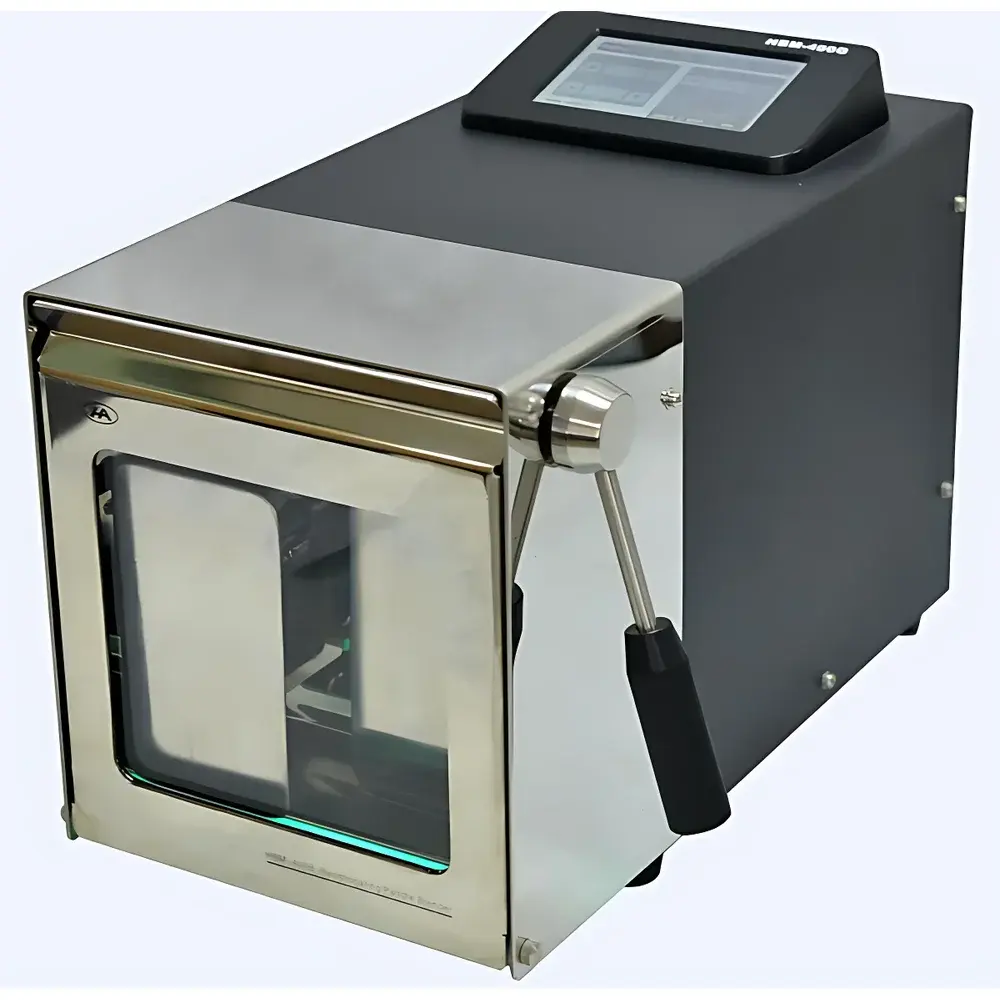
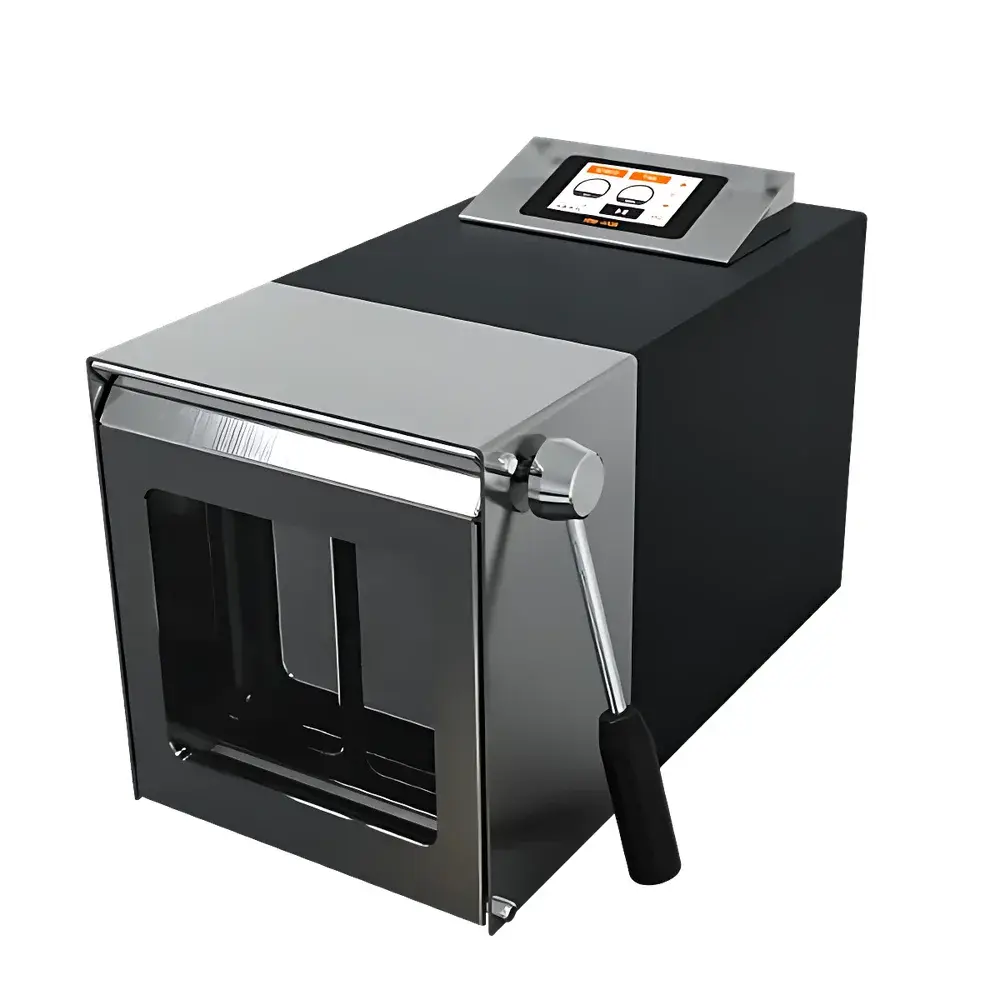
HengAo HBM-400B Pulsed-Action Homogenizer
| Brand | Tianjin HengAo |
|---|---|
| Origin | Tianjin, China |
| Manufacturer Type | Direct Manufacturer |
| Instrument Type | Pulsed-Action (Stomacher-Style) Homogenizer |
| Model | HBM-400B |
| Dimensions (W×D×H) | 410 × 270 × 290 mm |
| Sample Volume Range | 50–400 mL |
| Motor | Low-Noise, Electromagnetically Shielded DC Motor |
| Adjustable Parameters | Pulse Duration (s), Pulse Frequency (cycles/min) |
| Construction | Food-Grade 304 Stainless Steel Contact Surfaces |
| Safety Features | Interlocked Removable Door, Drip Tray, Leak Detection (Optional on HBM-400G) |
| Sterility Compliance | Compatible with Co-60 Irradiated Single-Use Filtered Stomacher Bags (ISO 11137 compliant) |
Overview
The HengAo HBM-400B Pulsed-Action Homogenizer is a laboratory-grade mechanical homogenization system engineered for reproducible, aseptic sample preparation in microbiological and food safety testing workflows. It operates on the principle of controlled mechanical pulsation—applying rapid, reciprocating pressure pulses between two parallel plates to disrupt biological matrices without generating excessive heat or shear-induced microbial lysis bias. This method ensures uniform dispersion of microorganisms from both surface-adhered and intracellular locations within heterogeneous solid or semi-solid samples (e.g., meat, leafy greens, cheese, soil, or environmental swabs), yielding statistically representative suspensions suitable for subsequent plating, PCR, or immunoassay analysis. Designed for compliance with standard methods including ISO 6887-1, FDA BAM Chapter 3, and APHA Standard Methods 9221, the HBM-400B delivers consistent homogenization efficiency across its full 50–400 mL operating range while maintaining structural integrity under repeated daily use in high-throughput QC laboratories.
Key Features
- Adjustable pulse duration (10–300 s) and pulse frequency (0–12 cycles/min), enabling method optimization for delicate pathogens (e.g., Listeria monocytogenes) or resilient spores (e.g., Bacillus cereus).
- Interlocked, tool-free removable stainless-steel door with integrated viewing window—facilitating visual monitoring and rapid cleaning between runs without disassembly.
- Manually adjustable plate gap (0–12 mm), calibrated via precision micrometer scale, allowing fine-tuned mechanical energy delivery for low-volume (50–100 mL) or high-viscosity samples.
- All wetted surfaces—including plate faces, door gasket channel, and drip tray—fabricated from electropolished AISI 304 stainless steel, meeting USP Class VI and EC 1935/2004 food-contact material requirements.
- Modular design supports optional accessories: micro-pulse plate kit (for 10–50 mL volumes), reinforced heavy-duty bags (up to 500 mL), and HDP-01A automated serial dilution module (patented, CN200820141799.6).
- Low electromagnetic interference (EMI) DC motor with thermal overload protection ensures stable operation in shared lab environments with sensitive instrumentation (e.g., qPCR thermocyclers or mass spectrometers).
Sample Compatibility & Compliance
The HBM-400B is validated for use with commercially available ISO 13408-compliant stomacher bags—including filter-integrated variants for particulate retention during homogenization. It accommodates samples ranging from soft produce (tomatoes, lettuce) to fibrous tissues (poultry skin, fish fillets) and hydrated powders (infant formula, spices). All processing protocols align with GLP documentation standards: each run logs timestamp, pulse settings, and operator ID when paired with optional USB data export. The system meets CE marking requirements for laboratory equipment (2014/30/EU EMC Directive, 2014/35/EU LVD) and supports audit readiness for ISO/IEC 17025-accredited labs through traceable parameter control and physical barrier validation (door interlock verification log).
Software & Data Management
While the base HBM-400B operates via tactile membrane keypad with LED status indicators, firmware supports RS-232/USB virtual COM port output for integration into LIMS or ELN platforms. Optional firmware upgrade enables CSV-formatted run logs (including start time, total pulses, duration, and error flags) compatible with 21 CFR Part 11–compliant systems when deployed with electronic signature-enabled host software. No proprietary cloud service is required; all data remains on-premise unless explicitly routed via user-configured network interface.
Applications
- Microbiological testing: Enumeration of Salmonella, E. coli O157:H7, Campylobacter, and aerobic plate counts per ISO 6887-1 and AOAC Official Method 2007.01.
- Food safety surveillance: Pesticide residue extraction support (pre-QuEChERS homogenization), allergen matrix disruption (e.g., peanut in baked goods), and mycotoxin liberation from cereal grains.
- Environmental monitoring: Processing of water concentrates, biofilm scrapings, and sediment cores for pathogen detection by culture or molecular methods.
- Academic research: Standardized sample prep for metagenomic DNA extraction, where mechanical lysis bias must be minimized relative to bead-beating alternatives.
- Pharmaceutical QC: Uniform suspension of topical ointments or lyophilized powder blends prior to sterility testing (USP ).
FAQ
What sterile bag specifications are recommended for optimal performance?
We recommend ISO 13408-certified stomacher bags with 0.45 µm hydrophilic filters (e.g., Seward BagFilter series) for microbiological applications; non-filtered bags (thickness ≥ 0.12 mm) are suitable for pesticide residue workflows.
Is calibration required before first use or after maintenance?
No routine calibration is mandated; however, users should verify plate gap accuracy annually using certified gauge blocks and confirm pulse timing accuracy via external stopwatch (±0.5 s tolerance per 60 s cycle).
Can the HBM-400B be used for RNA/DNA extraction protocols?
Yes—when operated at ≤60 s pulse duration and ≤6 cycles/min, it minimizes nucleic acid shearing while achieving sufficient cell wall disruption for Gram-negative bacteria and yeast; validation against your specific extraction kit is advised.
Does the instrument meet FDA or EU regulatory requirements for food testing labs?
It complies with the mechanical performance criteria outlined in FDA BAM Chapter 3 and ISO 6887-1 Annex A; full regulatory acceptance depends on lab-specific validation per ISO/IEC 17025 clause 7.2.2.
What maintenance intervals are recommended for sustained reliability?
Clean contact surfaces after each use with 70% ethanol; inspect door gasket and drip tray weekly; lubricate hinge pins quarterly with food-grade silicone grease; replace motor brushes every 5,000 operating hours (approx. 2 years at 8 h/day usage).



