
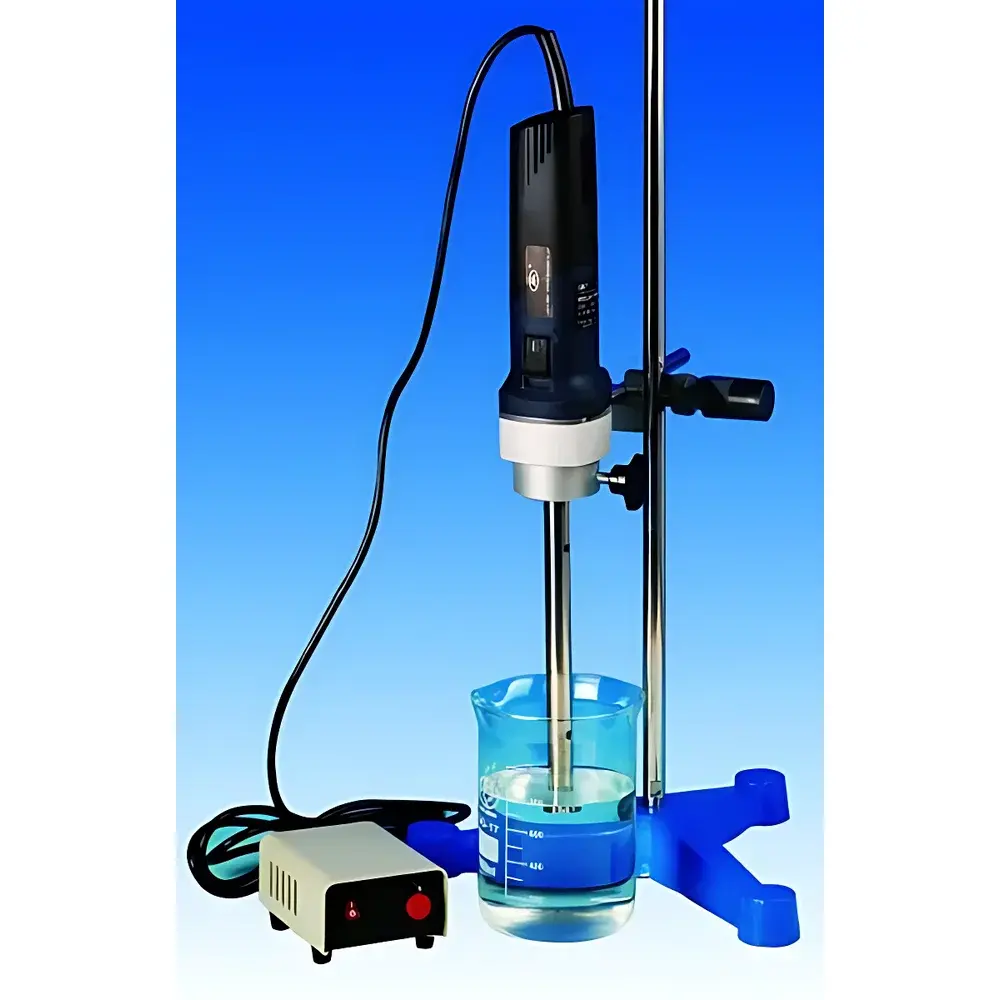
HengAo HFJ-18 Immersion Homogenizer (Tissue Homogenizer)
| Brand | Tianjin HengAo |
|---|---|
| Origin | Tianjin, China |
| Manufacturer Type | Direct Manufacturer |
| Product Category | Domestic |
| Model | HFJ-18 |
| Instrument Type | Handheld Homogenizer |
| Instrument Subtype | Tissue Disruption Homogenizer |
| Sample Volume Capacity | 5000 mL |
| Output Power | 550 W |
| Shaft Diameter | Φ18 mm |
| Speed Range | 10,000–31,000 rpm |
Overview
The HengAo HFJ-18 Immersion Homogenizer is a high-performance handheld tissue homogenizer engineered for rapid, reproducible mechanical disruption of biological samples in laboratory settings. It operates on the principle of high-shear rotor-stator homogenization: a precision-machined stainless-steel rotor rotates at controlled speeds inside a concentric stator, generating intense hydrodynamic shear forces and cavitation within the sample matrix. This mechanism effectively ruptures cell membranes—including those of fibrous plant tissues, animal organs, muscle, and connective tissues—while minimizing thermal degradation and oxidative stress. Designed for benchtop or portable use, the HFJ-18 delivers consistent particle size reduction, emulsification, and dispersion across viscous or heterogeneous suspensions, making it suitable for preparatory workflows in molecular biology, proteomics, metabolomics, and quality control laboratories.
Key Features
- High-speed variable-speed motor with digitally regulated speed control from 10,000 to 31,000 rpm, enabling precise optimization for diverse sample viscosities and cellular robustness.
- Interchangeable rotor-stator probe assembly featuring a Φ18 mm shaft diameter; all wetted components fabricated from ASTM-certified 316 stainless steel for superior corrosion resistance, cleanability, and compatibility with aqueous, acidic, and mildly organic media.
- Optimized stator geometry with angled cutting edges and tight rotor-stator clearance (<0.2 mm nominal), enhancing laminar-to-turbulent flow transition and maximizing localized shear stress for efficient subcellular disruption.
- Ergonomic handheld design with integrated cooling fins and thermally insulated housing, reducing operator fatigue and limiting heat transfer to the sample during extended operation.
- Quick-connect probe interface compliant with ISO 8573-1 purity class 4 for tooling exchange under non-sterile or Class II biosafety cabinet conditions; compatible with standard laboratory gloves and PPE protocols.
Sample Compatibility & Compliance
The HFJ-18 accommodates sample volumes up to 5000 mL in standard glass or polypropylene beakers, centrifuge tubes, or reaction vessels. It is validated for use with soft and moderately fibrous biological matrices—including liver, spleen, leaf tissue, root nodules, and cultured cell pellets—as well as food-grade emulsions and pharmaceutical suspensions. All materials contacting the sample meet USP Class VI biocompatibility requirements and are free of leachable heavy metals per EN ISO 10993-12. The device supports GLP-compliant documentation when operated with calibrated tachometers and traceable speed logs; optional integration with lab information management systems (LIMS) enables audit-ready record retention per FDA 21 CFR Part 11 guidelines.
Software & Data Management
While the HFJ-18 operates via analog speed dial without embedded firmware, its rotational output is fully compatible with external digital tachometry (e.g., laser photo-tachometers) and time-stamped video capture for process validation. Users may document operating parameters—including speed setpoint, duration, vessel type, and ambient temperature—in standardized SOP templates aligned with ISO/IEC 17025 accreditation requirements. For laboratories requiring electronic records, the device integrates seamlessly with third-party data acquisition platforms supporting RS-232 or USB-to-serial adapters for real-time RPM logging and deviation alerts.
Applications
- Pre-analytical tissue lysis for DNA/RNA extraction, Western blot sample prep, and enzyme activity assays.
- Homogenization of clinical biopsy specimens prior to histopathological analysis or biomarker quantification.
- Dispersion of nanocellulose, chitosan, or protein-based hydrogels in food science and nutraceutical R&D.
- Emulsification of oil-in-water formulations in cosmetic and pharmaceutical development.
- Routine QC homogenization of reference standards and certified reference materials (CRMs) per ASTM D7504 and ISO 11357-4 protocols.
FAQ
What is the maximum recommended continuous run time for the HFJ-18 at full speed?
For optimal thermal management and motor longevity, continuous operation at >25,000 rpm should not exceed 90 seconds per cycle, followed by a minimum 60-second cooldown interval.
Can the HFJ-18 be used in cold rooms or with ice-jacketed vessels?
Yes—its sealed motor housing and 316 SS probe are rated for operation between 4 °C and 40 °C ambient; however, condensation on electrical interfaces must be prevented per IEC 61000-6-3 EMC compliance.
Is sterilization of the probe possible between uses?
The rotor-stator assembly is autoclavable at 121 °C for 20 minutes (gravity displacement cycle); repeated autoclaving may require periodic calibration of rotor-stator gap tolerance.
Does the HFJ-18 comply with CE or UL safety directives?
As a Class I laboratory device manufactured to GB/T 22264.1–2008 (equivalent to IEC 61010-1:2010), it carries CCC certification for domestic China markets; CE marking requires additional notified body assessment for EU deployment.
How does the HFJ-18 compare to ultrasonic homogenizers in terms of nucleic acid shearing?
Unlike sonication—which introduces stochastic cavitation-induced strand breakage—the HFJ-18 provides mechanical shear with lower DNA fragmentation risk, particularly for high-molecular-weight genomic DNA isolation protocols.



