
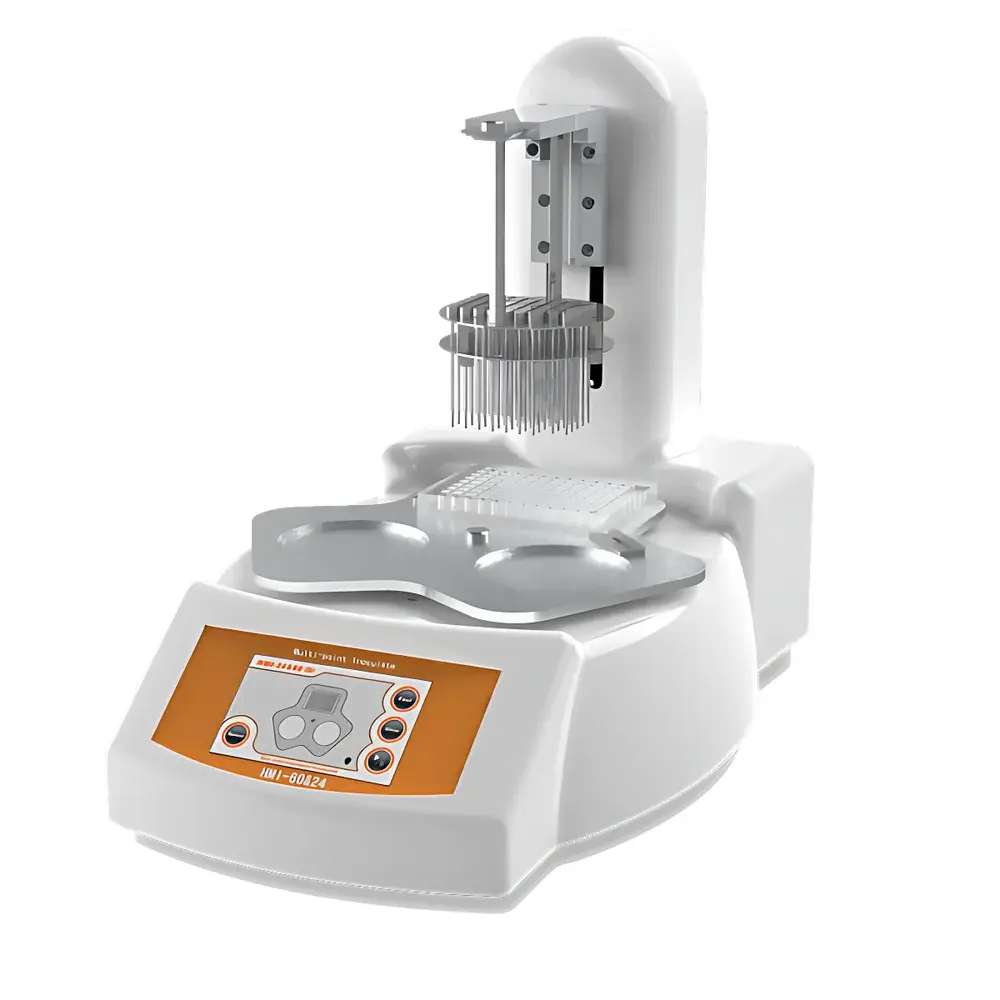
HengAo HMI-60/24 Automated Multi-Point Bacterial Inoculator
| Brand | Tianjin HengAo |
|---|---|
| Origin | Tianjin, China |
| Manufacturer Type | Direct Manufacturer |
| Model | HMI-60 & HMI-24 |
| Inoculation Method | Liquid-based capillary transfer |
| Instrument Type | Fully Automated |
| Cycle Time | 9–12 s per plate |
| Dimensions (W×D×H) | 335 × 250 × 415 mm |
| Power Supply | 220 V AC |
| Power Consumption | 120 W |
| Weight | 12 kg |
| Inoculum Volume | 5 µL (HMI-24) / 1 µL (HMI-60) |
| Compatible Petri Dish Diameter | 90 mm |
| Control Interface | Touchscreen with real-time animation |
| Positioning System | Motorized rotary sample stage with auto-alignment |
| Actuation | Footswitch-enabled start/pause |
| Reset Function | Hardware-initiated system reinitialization |
| Regulatory Status | Chinese National Patent Certified |
Overview
The HengAo HMI-60/24 Automated Multi-Point Bacterial Inoculator is an engineered solution for high-throughput antimicrobial susceptibility testing (AST), designed to replace manual streaking or replica plating in clinical microbiology and pharmaceutical R&D laboratories. It operates on the principle of precision liquid transfer via calibrated stainless-steel inoculation pins, enabling reproducible, contact-based deposition of standardized bacterial suspensions onto agar plates or microtiter wells. Unlike manual or semi-automated methods, the HMI series employs a closed-loop mechanical positioning architecture—comprising a motorized rotary stage, optical position verification, and synchronized pin actuation—to ensure spatial fidelity across all inoculation points. This architecture supports CLSI M02-A12 and EUCAST guidelines for uniform colony density and inter-plate consistency, making it suitable for MIC determination, gradient plate assays, and resistance phenotyping workflows.
Key Features
- Medical-grade 316L stainless-steel inoculation pins, electropolished and hydrophilically treated to eliminate surface tension-induced droplet retention and ensure consistent fluid release.
- Dual-mode operation: Selectable cycle times of 9 s (HMI-24) or 13 s (HMI-60) via front-panel push-button interface—no analog dials or calibration drift.
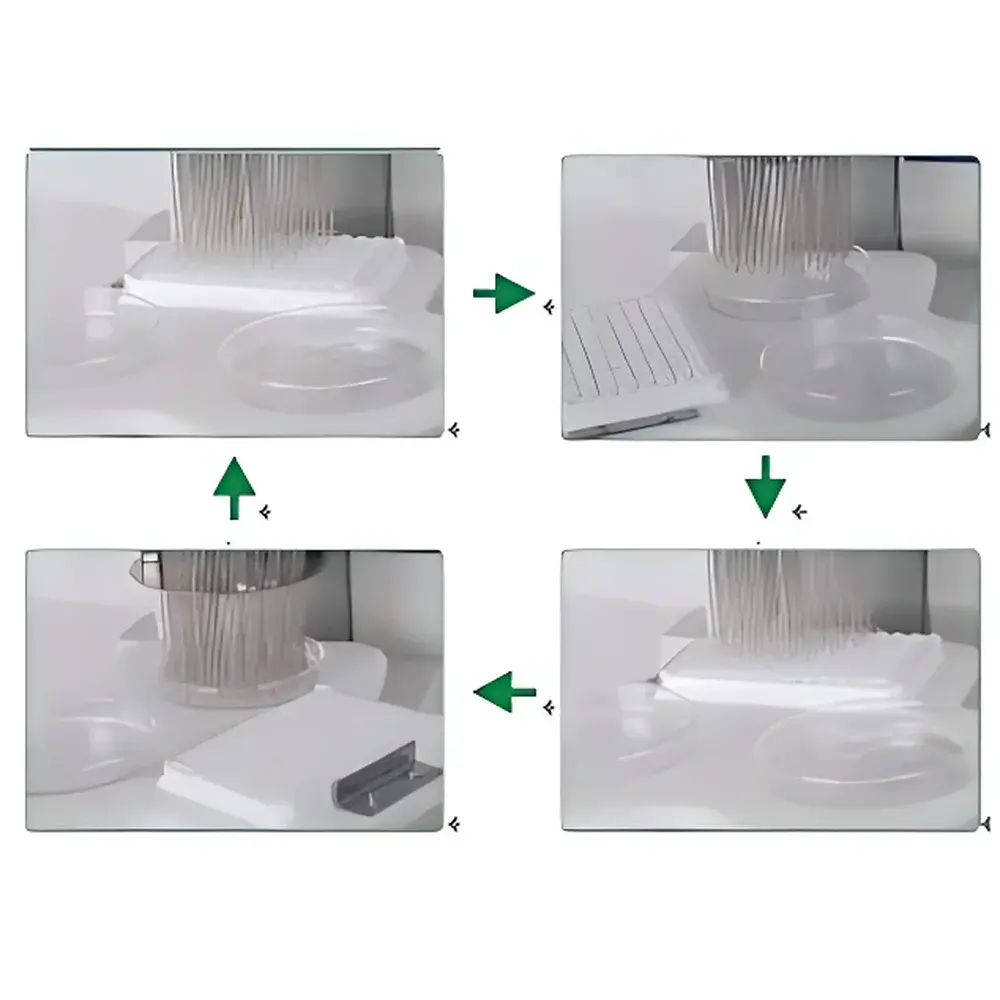
- Motor-driven, programmable rotary sample stage with automatic angular indexing; eliminates manual plate repositioning and reduces operator-induced variability.
- Integrated optical position-detection needle for real-time alignment verification—enables unambiguous colony location mapping relative to standard grid coordinates (e.g., 6×4 or 10×6 layouts).
- Footswitch-controlled start/pause functionality to maintain aseptic workflow integrity; prevents accidental contamination from hand-contact switches during biosafety cabinet use.
- One-touch hardware reset function that restores all positional, timing, and pin-lift parameters to factory defaults—critical for protocol recovery after unexpected interruption.
- Capacitive touchscreen interface with animated process visualization, including real-time pin descent sequence, stage rotation status, and cycle completion feedback.
Sample Compatibility & Compliance
The HMI-60/24 accommodates standard 90 mm Petri dishes and is compatible with common solid media formulations (e.g., Mueller-Hinton Agar, Columbia Blood Agar). Its fixed-volume inoculation (5 µL for 24-pin configuration; 1 µL for 60-pin) aligns with CLSI-recommended suspension densities (0.5 McFarland standard ≈ 1–2 × 10⁸ CFU/mL) when used with calibrated broth cultures. The instrument’s mechanical design conforms to ISO 13485-aligned manufacturing practices, and its operational repeatability supports GLP-compliant documentation requirements. While not FDA 510(k)-cleared, its functional equivalence to Class I microbiological devices permits use in non-diagnostic research settings under institutional biosafety protocols.
Software & Data Management
The HMI-60/24 operates without external PC dependency—embedded firmware manages all timing, motion control, and user input logic. All operational parameters (cycle time, pin count, pause state) are stored in non-volatile memory and persist across power cycles. Audit trail functionality is limited to timestamped cycle counters and error logs accessible via diagnostic mode. For integration into LIMS environments, optional RS-232 serial output provides basic event signaling (e.g., “start,” “complete,” “error code 07”). No proprietary software installation or cloud connectivity is required, minimizing cybersecurity exposure and ensuring long-term operational stability.
Applications
- Antimicrobial susceptibility testing (AST) using disk diffusion, E-test, or gradient agar methods.
- High-density colony array generation for comparative growth phenotyping under antibiotic pressure.
- Quality control of culture media performance across batches via standardized inoculation patterns.
- Preparation of master plates for replica plating in genetic screening workflows (e.g., transposon mutagenesis libraries).
- Standardized inoculum preparation for biofilm formation assays on polystyrene or glass surfaces.
- Supporting ISO 20776-1:2021 compliance in clinical microbiology labs performing routine AST.
FAQ
What is the minimum and maximum number of inoculation points supported?
The HMI-24 supports up to 24 discrete points per cycle; the HMI-60 supports up to 60 points. Both configurations maintain identical volumetric accuracy and positional repeatability.
Can the instrument be validated for GMP environments?
While not pre-validated, the HMI-60/24’s deterministic mechanical architecture, traceable cycle timing, and hardware reset capability support IQ/OQ protocol development per Annex 11 and USP guidelines.
Is calibration required before each use?
No daily calibration is needed. Pin volume delivery is factory-verified using gravimetric analysis per ISO 8655-7; users perform only periodic verification with dye solutions every 3 months.
Does the system support custom plate geometries beyond 90 mm Petri dishes?
No. The mechanical stage and pin carriage are dimensionally optimized for 90 mm circular agar plates only. Custom fixtures are not available.
How is sterility maintained between runs?
Sterilization is performed externally: pins are autoclaved at 121°C for 15 min; the instrument housing is wiped with 70% ethanol. No in-situ UV or heat sterilization is integrated.



