
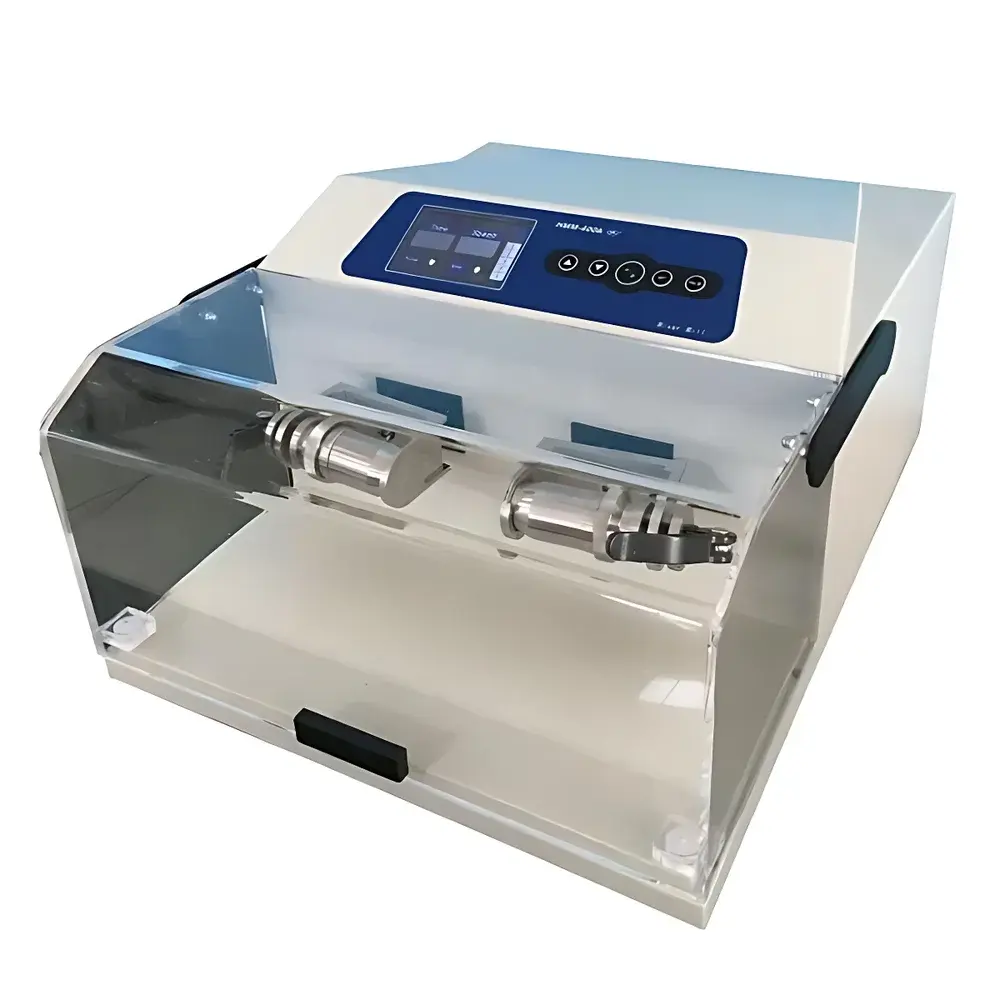
HengAo HMM-400A Planetary Ball Mill
| Brand | Tianjin HengAo |
|---|---|
| Origin | Tianjin, China |
| Manufacturer Type | Direct Manufacturer |
| Instrument Type | Planetary Ball Mill |
| Sample Type | Hard, Brittle, Fibrous, Elastic, and Composite Materials |
| Feed Size | ≤ 6 mm |
| Final Particle Size | ≤ 5 µm |
| Batch Capacity | 50 mL |
| Grinding Mechanism | High-Energy Planetary Motion with Dual Grinding Stations |
| Programmable Presets | 6 User-Defined Protocols |
| Sealed Grinding Vessels | Yes (Leak-Proof Spiral Cap Design) |
| Display | LED Interface with Real-Time Parameter Monitoring (Speed, Time, Pulse Mode) |
Overview
The HengAo HMM-400A Planetary Ball Mill is an engineered solution for high-efficiency, reproducible size reduction of challenging laboratory samples. It operates on the principle of planetary motion—where grinding jars rotate eccentrically around a sun wheel while simultaneously revolving on their own axes—generating centrifugal and Coriolis forces that accelerate impact energy transfer between grinding media and sample material. This dual-axis kinematic architecture enables rapid comminution of hard, brittle, fibrous, and heterogeneous materials to sub-5 µm particle sizes in controlled, repeatable batches. Designed for precision pre-treatment in analytical workflows, the HMM-400A supports downstream applications including X-ray fluorescence (XRF), inductively coupled plasma (ICP) analysis, scanning electron microscopy (SEM) sample preparation, and homogenization prior to extraction or dissolution. Its closed-vessel configuration ensures containment integrity during dry and wet grinding, minimizing operator exposure and eliminating cross-contamination between runs.
Key Features
- Dual independent grinding stations enable parallel processing of two samples under identical or distinct protocols—improving throughput without compromising parameter control.
- Six programmable memory presets allow full customization of rotational speed (rpm), grinding duration (seconds to hours), pause intervals, and pulse-mode operation—facilitating method standardization across users and shifts.
- Leak-proof spiral-seal grinding jars are available in multiple material options—including stainless steel, tungsten carbide, agate, zirconia, and PTFE-lined variants—to prevent chemical interaction or contamination when processing reactive, acidic, or ultra-trace samples.
- LED-integrated control panel provides real-time visual feedback on operational status: current speed, elapsed time, remaining cycle duration, and active pulse sequence—supporting GLP-compliant documentation practices.
- Robust cast-aluminum housing and precision-machined gear train ensure long-term mechanical stability and minimal vibration transmission—critical for maintaining instrument alignment and measurement repeatability over extended service life.
- Tool-free jar mounting system and ergonomic jar clamps simplify loading, unloading, and cleaning—reducing procedural downtime and enhancing lab safety during routine maintenance.
Sample Compatibility & Compliance
The HMM-400A accommodates a broad spectrum of sample matrices, including but not limited to: mineral ores (e.g., quartz, feldspar, hematite), metallurgical alloys, sintered ceramics, pharmaceutical tablets, botanical tissues (roots, leaves, seeds), animal bone and hair, polymer composites, soil aggregates, sludge sediments, and synthetic catalysts. Its ability to achieve consistent ≤5 µm final particle size meets preparatory requirements specified in ASTM D7348 (for coal ash analysis), ISO 13320 (laser diffraction particle sizing), and USP (pharmaceutical content uniformity testing). The sealed grinding architecture complies with OSHA 29 CFR 1910.1200 (Hazard Communication Standard) for containment of respirable particulates and volatile solvents used in wet milling.
Software & Data Management
While the HMM-400A operates via embedded firmware without external PC dependency, its parameter logging capability supports audit-ready traceability. All executed protocols—including speed, duration, jar material, and batch ID—are timestamped and retained in non-volatile memory for up to 1,000 cycles. Optional RS-232 or USB-to-serial interface (available upon request) permits integration with LIMS environments and automated report generation. The system adheres to FDA 21 CFR Part 11 principles through user-access controls (via password-protected setup mode) and immutable event logs—enabling compliance with GMP/GLP quality systems in regulated laboratories.
Applications
- Geochemical laboratories preparing rock and soil digests for ICP-OES/MS quantification.
- Pharmaceutical QA/QC labs homogenizing active pharmaceutical ingredients (APIs) and excipients prior to dissolution testing.
- Materials science facilities reducing ceramic precursors or battery electrode powders to narrow PSD distributions.
- Agricultural testing centers pulverizing grain, forage, or feed samples for nutrient profiling (NIR calibration, Kjeldahl digestion).
- Forensic toxicology units fragmenting biological matrices (e.g., hair, bone) for targeted analyte extraction.
- Environmental monitoring agencies processing sediment cores and sludge samples for heavy metal speciation analysis.
FAQ
What jar materials are compatible with the HMM-400A?
Stainless steel, tungsten carbide, agate, zirconia, and PTFE-lined jars are standard offerings; custom jar geometries and coatings can be supplied upon technical review.
Can the instrument perform cryogenic grinding?
Yes—when paired with liquid nitrogen-cooled jars and appropriate thermal insulation kits, the HMM-400A supports low-temperature milling of thermolabile polymers and biological tissues.
Is validation documentation available for GMP environments?
IQ/OQ documentation templates and factory-verified performance qualification (PQ) data packages are provided as optional add-ons for regulated users.
How is cross-contamination prevented between sequential runs?
Each grinding jar is fully sealed with a double-gasketed spiral cap; validated cleaning procedures (including ultrasonic and solvent-rinse protocols) are included in the operator manual.
What maintenance intervals are recommended?
Gear lubrication every 1,000 operating hours and torque verification of jar clamps every 200 cycles—both procedures are detailed in the maintenance section of the English-language user guide.
Related Products



