
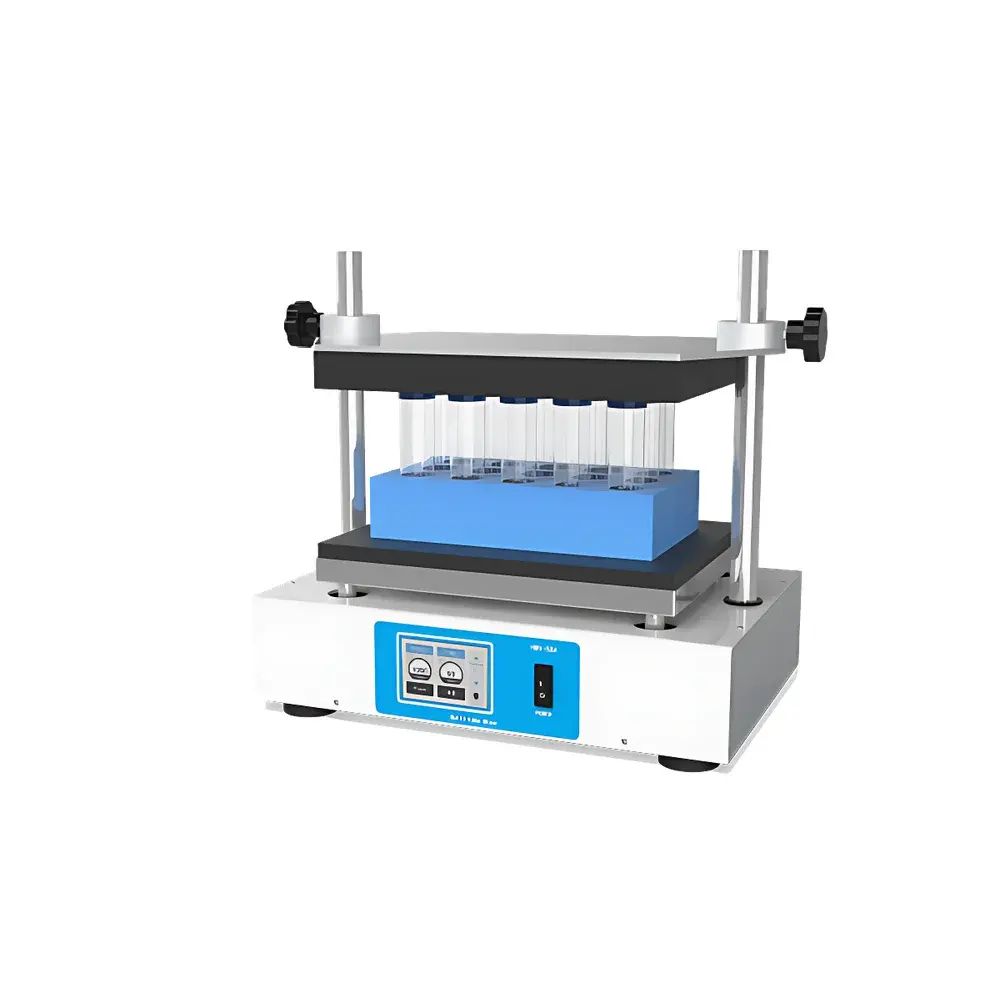
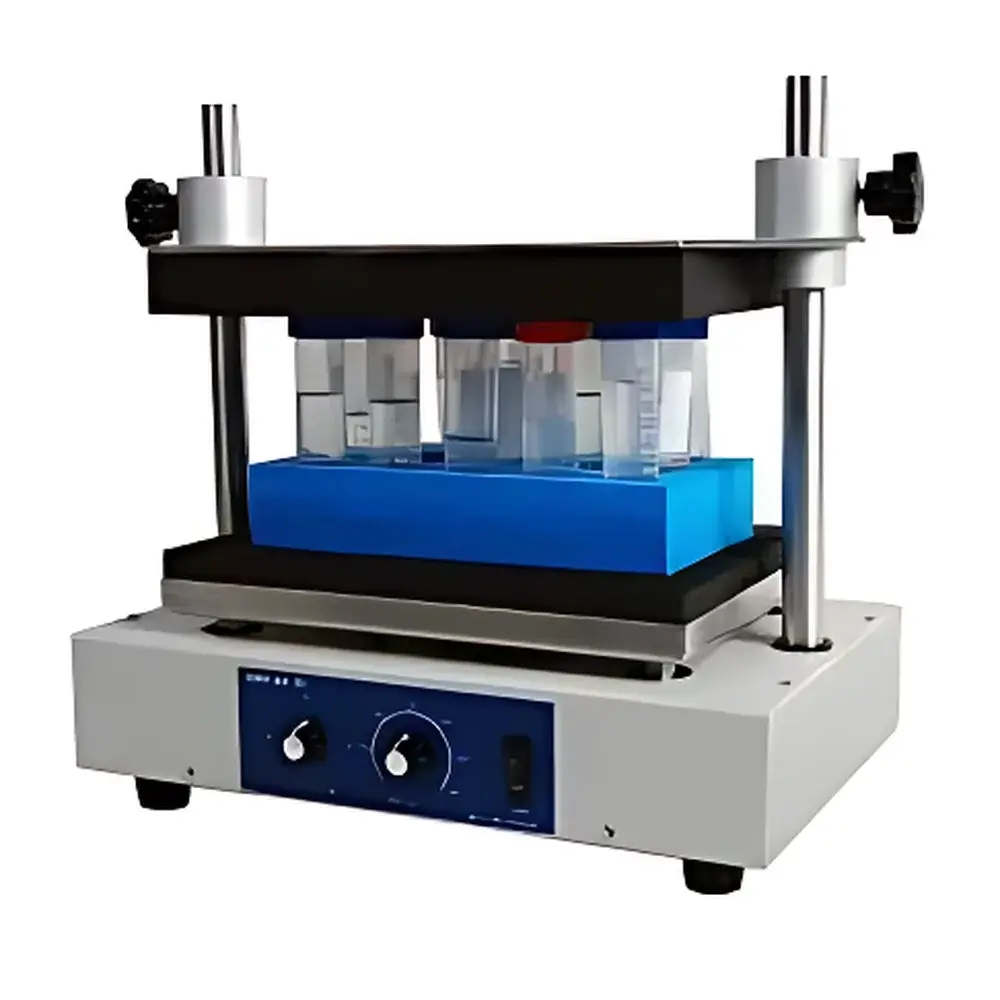
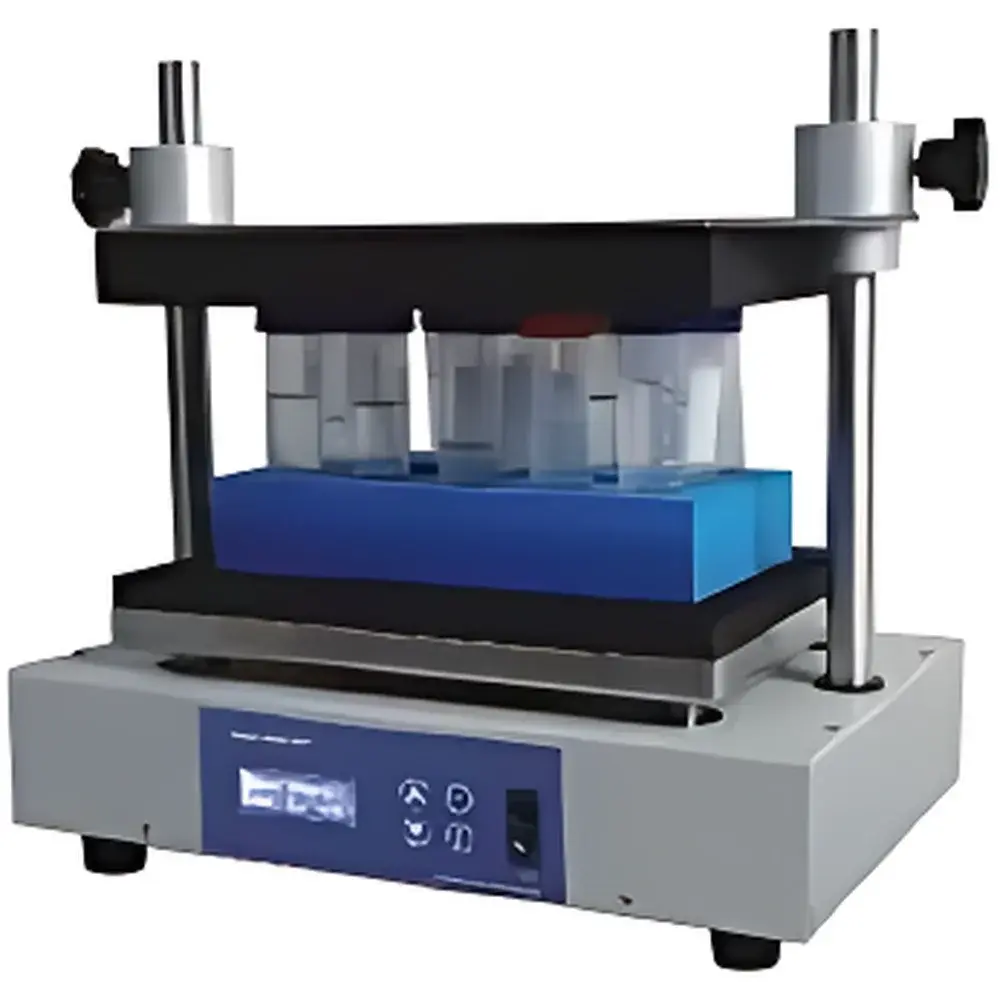
HengAo HMV Series Multi-Tube Vortex Mixer
| Brand | Tianjin HengAo |
|---|---|
| Origin | Tianjin, China |
| Manufacturer Type | Direct Manufacturer |
| Product Origin | Domestic (China) |
| Model | HMV Series |
| Price Range | USD 700 – 2,100 (FOB) |
| Speed Range | 500–2400 rpm |
| Operation Mode | Continuously Adjustable Speed Control |
| Oscillation Type | Reciprocating Horizontal Motion |
| Main Body Material | ABS Plastic |
| Amplitude | 5 mm |
| Display | LED Digital Display |
Overview
The HengAo HMV Series Multi-Tube Vortex Mixer is an engineered solution for high-throughput sample homogenization in research and quality control laboratories. Unlike conventional single-tube vortex mixers, the HMV platform employs a precisely balanced horizontal reciprocating motion—distinct from orbital or conical vortexing—to induce controlled turbulent mixing across multiple tubes simultaneously. This mechanism leverages consistent amplitude (5 mm) and variable rotational energy transfer to achieve uniform suspension, resuspension, and dispersion of particulates, cells, reagents, or viscous matrices without requiring tube cap removal or manual agitation. Designed for reproducible parallel processing, the system supports standardized workflows in regulated environments where inter-sample variability must be minimized—particularly in assay development, extraction protocols, and pre-analytical sample preparation.
Key Features
- Simultaneous processing of up to 48 samples using interchangeable, application-optimized tube racks and tray inserts (e.g., 0.5 mL, 1.5 mL, 2.0 mL, 15 mL, and 50 mL configurations)
- Microprocessor-based speed and timing control with real-time LED digital display of rpm and elapsed time
- Two operational modes: continuous mixing and programmable pulse mode (on/off cycling at user-defined intervals for heat-sensitive or shear-sensitive samples)
- Robust ABS polymer housing providing chemical resistance, electrical insulation, and mechanical stability under sustained operation
- Low-noise, brushless DC motor with thermal protection and consistent torque delivery across the full 500–2400 rpm range
- Compact footprint (420 × 260 × 380 mm) optimized for benchtop integration in biosafety cabinets, cold rooms, or shared instrumentation spaces
Sample Compatibility & Compliance
The HMV Series accommodates standard laboratory consumables including polypropylene, polycarbonate, and glass tubes—compatible with common centrifuge tube formats per ISO 8573-1 and ASTM D4169 packaging integrity guidelines. Its non-contact, vibration-driven mixing avoids cross-contamination risks associated with rotor-based shakers. While not certified to IEC 61010-1 for Class I medical device use, the unit meets GB/T 14710 (Chinese Environmental Adaptability Standard) and complies with CE-marked EMC and LVD directives when exported with appropriate documentation. For GLP/GMP environments, audit-ready operation logs can be manually recorded; optional RS-232 interface (available on HMV-50A variant) enables basic data export for traceability.
Software & Data Management
The base HMV models operate via embedded firmware with no external software dependency—ensuring reliability in resource-constrained labs or cleanroom settings where USB ports or network connectivity are restricted. The HMV-50A variant includes an RS-232 serial port supporting ASCII command protocol for integration into Lab Information Management Systems (LIMS) or custom automation scripts. Time-stamped speed and duration parameters may be logged externally for SOP adherence. No cloud connectivity, mobile app, or FDA 21 CFR Part 11-compliant electronic signature functionality is provided—consistent with its classification as a Class I general-purpose laboratory mixer per ISO 15197 and CLIA guidelines.
Applications
- Cell culture work: Resuspension of adherent cell pellets, uniform distribution of transfection reagents, and homogenization of primary tissue lysates
- Biopharmaceutical QC: Mixing of buffer-diluted monoclonal antibody formulations prior to size-exclusion chromatography or dynamic light scattering analysis
- Polymer science: Dispersion of nanofillers (e.g., carbon nanotubes, silica nanoparticles) in solvent-based polymer solutions
- Environmental testing: Extraction of semi-volatile organic compounds (SVOCs) from soil/sediment matrices using EPA Method 3540C-compatible protocols
- Clinical diagnostics: Preparation of whole blood aliquots for hematology analyzers or PCR master mix assembly in molecular pathology labs
FAQ
What is the difference between reciprocating motion and orbital vortexing in multi-tube mixers?
Reciprocating motion delivers linear back-and-forth displacement at fixed amplitude, generating uniform shear across all tube positions. Orbital vortexing induces circular motion that varies in intensity radially—potentially causing inconsistent mixing near rack edges.
Can the HMV Series accommodate cryogenic tubes or deep-well plates?
Yes—custom aluminum or silicone-coated tray inserts are available for low-temperature applications down to –20°C; however, prolonged exposure below –10°C requires verification of ABS housing brittleness per ASTM D790.
Is calibration required, and does it support NIST-traceable verification?
Speed accuracy is factory-verified against optical tachometer standards (±2% tolerance). Users may perform periodic verification using a handheld laser tachometer; formal recalibration is not mandated under ISO/IEC 17025 unless integrated into accredited test methods.
How does pulse mode improve reproducibility in enzymatic assays?
By alternating active mixing with rest intervals, pulse mode reduces localized heating and prevents denaturation of thermolabile enzymes—critical for kinetic assays where reaction initiation timing must be tightly controlled.
Are replacement racks and adapters available for non-standard tube formats?
Yes—HengAo provides OEM-compatible accessories including PCR strip holders, microcentrifuge tube combs, and 96-well plate clamps, all machined to ±0.1 mm dimensional tolerance per DIN ISO 2768-mK.



