
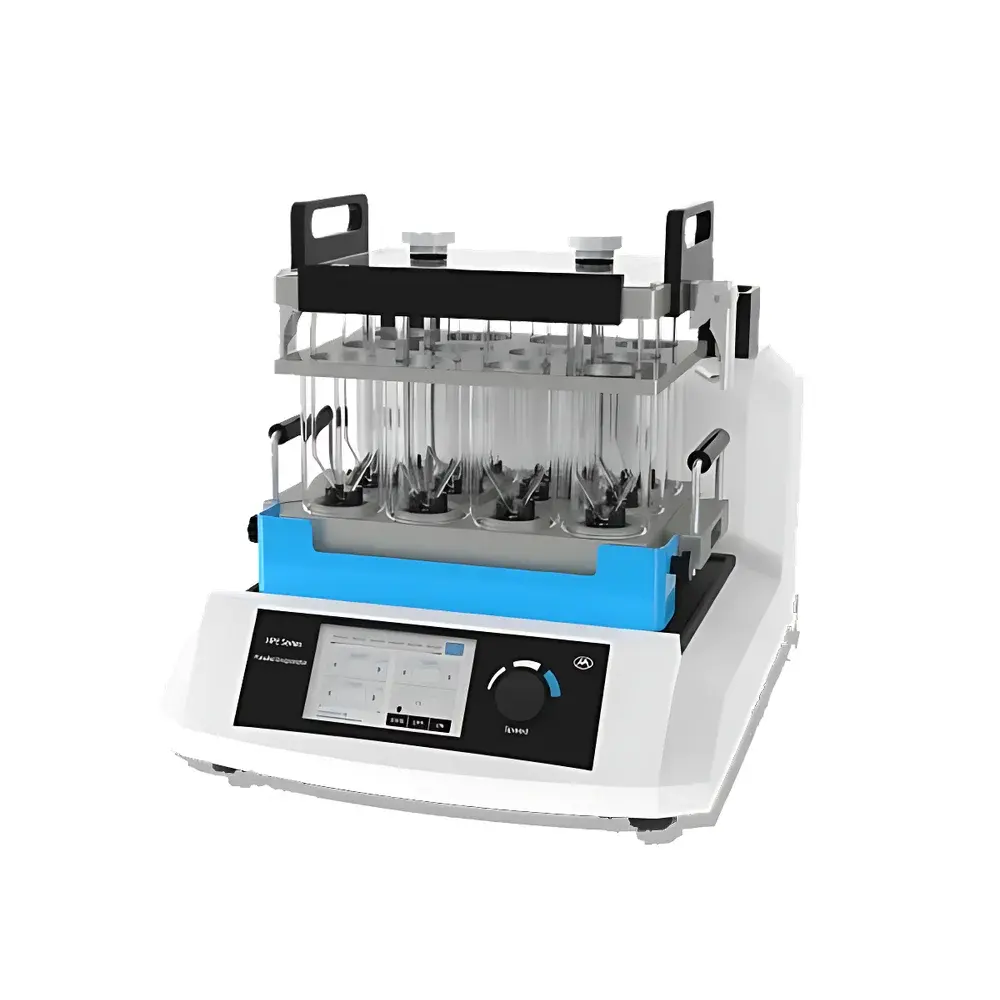
HengAo HPE-6 Parallel Vacuum Concentrator
| Brand | Tianjin HengAo |
|---|---|
| Origin | Tianjin, China |
| Manufacturer Type | Direct Manufacturer |
| Instrument Type | Automated Quantitative Concentrator |
| Temperature Range | Ambient +5°C to 100°C |
| Temperature Control Accuracy | ±0.5°C |
| Sample Capacity per Position | 200 mL |
| Maximum Throughput | 24 Samples Simultaneously |
| Evaporation Mode | Simultaneous Vacuum Reduction, Heated Water Bath, and Orbital Vortex Agitation |
| Solvent Recovery Efficiency | High |
| Footprint | Benchtop, Ventilation Hood-Compatible |
Overview
The HengAo HPE-6 Parallel Vacuum Concentrator is an engineered solution for high-throughput, gentle, and reproducible solvent removal in analytical, pharmaceutical, and environmental laboratories. It operates on the principle of simultaneous vacuum-assisted evaporation, conductive heating via a precisely controlled water bath, and orbital vortex agitation—collectively enabling rapid yet thermally benign concentration of heat-sensitive analytes. Unlike single-sample concentrators or rotary evaporators requiring manual intervention, the HPE-6 implements parallel processing across up to 24 independent sample positions, each sealed under vacuum with individual pressure and thermal regulation. This architecture eliminates inter-sample vapor migration and ensures strict isolation—critical for trace-level analysis, multi-analyte workflows, and regulated environments where carryover must be excluded by design. The system is optimized for applications demanding quantitative recovery, minimal analyte degradation, and full process traceability.
Key Features
- Parallel 24-position configuration with individually sealed sample vessels—prevents cross-contamination and enables heterogeneous batch processing
- Integrated gradient temperature and vacuum control: programmable ramping profiles allow precise adaptation to solvent volatility and analyte thermal stability
- Orbital vortex agitation synchronized with vacuum and heating—enhances mass transfer at the liquid–vapor interface without foaming or bumping
- Transparent circular water bath with 360° visibility—enables real-time monitoring of sample volume, boiling behavior, and endpoint detection
- Quick-swap sealing interface: proprietary plug-and-seal design permits removal and replacement of individual samples mid-run without disrupting ongoing concentration of others
- Benchtop form factor with full ventilation hood compatibility—ensures safe operation with volatile organic solvents while meeting laboratory space constraints
- High-efficiency condensate recovery system: captures >92% of common organic solvents (e.g., methanol, acetonitrile, ethyl acetate), reducing emissions and disposal costs
Sample Compatibility & Compliance
The HPE-6 accommodates standard 10–200 mL round-bottom or conical tubes (including glass, borosilicate, and compatible polymer formats) with interchangeable sealing adapters. Its sealed architecture meets ISO 17025 requirements for contamination control in accredited testing labs. While not intrinsically certified for GMP or GLP, the instrument’s deterministic operation—combined with user-defined method storage, audit-ready run logs, and parameter locking—supports alignment with FDA 21 CFR Part 11 when integrated into validated laboratory workflows. It complies with IEC 61010-1 for electrical safety and EN 61326-1 for electromagnetic compatibility in laboratory environments.
Software & Data Management
The HPE-6 operates via an embedded touchscreen interface supporting method creation, scheduling, and real-time parameter visualization (vacuum level in mbar, bath temperature in °C, elapsed time). Up to 99 preconfigured methods can be stored locally, each including temperature ramps, vacuum setpoints, agitation speed, and endpoint criteria (e.g., fixed time, minimum volume threshold via optional weight sensor integration). All runs generate timestamped CSV log files exportable via USB—containing setpoints, actual values, alarms, and operator ID—facilitating retrospective review and quality documentation. No cloud dependency; data remains on-device unless explicitly exported.
Applications
- Preparative cleanup prior to LC-MS/MS or GC-MS analysis in food safety, clinical toxicology, and environmental residue testing
- Concentration of enzymatic digests, peptide fractions, and nucleic acid eluates in proteomics and molecular biology workflows
- High-throughput sample preparation for EPA Method 525.3 (drinking water), 8270 (semivolatiles), and ISO 17892-6 (soil extract analysis)
- Stabilization of unstable metabolites during pharmacokinetic sample processing
- Reducing solvent volume in calibration standard preparation while preserving accuracy and homogeneity
FAQ
Can the HPE-6 be used with corrosive solvents such as hydrochloric acid or trifluoroacetic acid?
Yes—when equipped with optional PTFE-coated seals and a corrosion-resistant condenser (available as accessory kit), the system supports short-term exposure to low-concentration acidic vapors. Continuous use requires validation per solvent compatibility chart.
Is remote monitoring or network connectivity supported?
No native Ethernet or Wi-Fi interface is provided; however, the USB data export function enables integration with LIMS via post-run file ingestion.
What maintenance is required for long-term vacuum performance?
Annual inspection of the diaphragm vacuum pump oil (if oil-lubricated variant selected) and quarterly cleaning of the condenser coil with isopropanol are recommended. Dry scroll pump configurations require only filter replacement every 6 months.
Does the system support unattended overnight operation?
Yes—programmable endpoint logic (time-based or external sensor-triggered) combined with automatic pump shutdown and vacuum release ensures safe, compliant unattended runs.
How is calibration verified for temperature and vacuum sensors?
Traceable NIST-calibrated reference probes can be inserted into designated ports during routine verification; calibration certificates are maintained per lab SOPs, not automatically generated by the device.



