
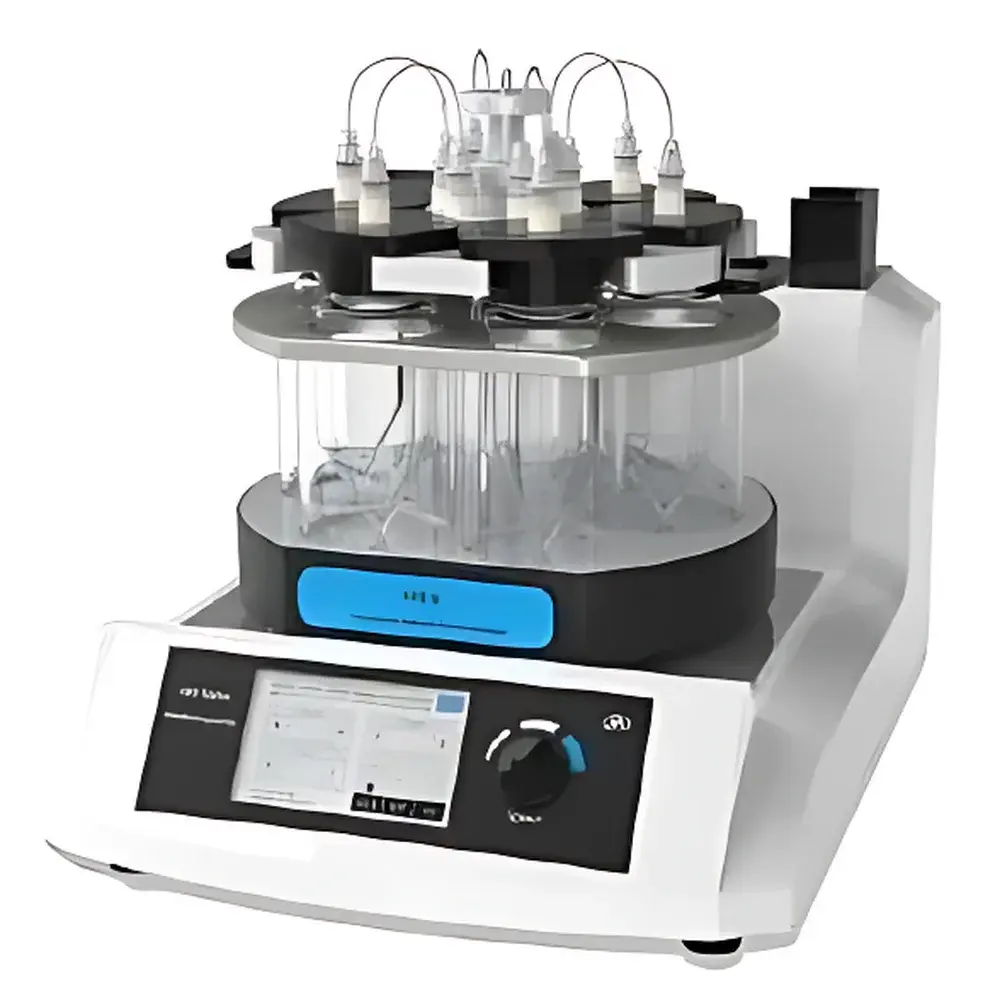
HengAo HPE-6B Parallel Vacuum Centrifugal Concentrator
| Brand | Tianjin HengAo |
|---|---|
| Origin | Tianjin, China |
| Manufacturer Type | Direct Manufacturer |
| Instrument Type | Vacuum Centrifugal Concentrator |
| Model | HPE-66B |
| Temperature Range | Ambient +5°C to 100°C |
| Temperature Control Accuracy | ±0.5°C |
| Sample Capacity per Position | 1 mL (compatible with 50–200 mL tubes) |
| Rotational Radius | 5 mm |
| Speed Range | 0–600 rpm |
| Heating Method | PTC Water Bath with Lid Heating |
| Vacuum Control Range | Adjustable down to ≤5 mbar (display resolution: 1 mbar |
| manual control precision | 10 mbar) |
| Gradient Programs | Up to 5 segments, 30 pre-stored methods |
| Max Total Program Duration | 42.5 hours |
| Display | 5-inch capacitive touchscreen with real-time pressure/temperature curve logging |
Overview
The HengAo HPE-6B Parallel Vacuum Centrifugal Concentrator is an engineered solution for high-throughput, gentle sample concentration in analytical, pharmaceutical, and life science laboratories. It integrates three orthogonal physical forces—centrifugal force, controlled vacuum, and precise water-bath heating—to accelerate solvent removal while preserving thermolabile analytes such as peptides, nucleic acids, metabolites, and small-molecule standards. Unlike conventional rotary evaporators or nitrogen blow-down systems, the HPE-6B operates under reduced pressure (down to 5 mbar) while maintaining rotational stability (0–600 rpm, 5 mm radius) and uniform thermal delivery via PTC-heated water bath with active lid heating. This tri-modal approach minimizes bumping, eliminates cold condensate reflux, and ensures reproducible endpoint drying across all six positions—critical for quantitative recovery in LC-MS, GC-MS, and preparative workflows.
Key Features
- Six independent, sealed sample positions—each with individual O-ring-sealed tube caps—eliminate cross-contamination during simultaneous processing of heterogeneous samples.
- Integrated gradient temperature and vacuum control: users define up to five sequential segments per run (e.g., low-temp pre-concentration → ramped evaporation → final dry-down), enabling method optimization for complex matrices containing solvents with disparate boiling points.
- 5-inch high-resolution capacitive touchscreen interface with real-time graphical logging of pressure and temperature profiles; supports export of CSV-formatted time-series data for audit-ready documentation.
- Chemically resistant vacuum system: diaphragm pump components—including pump head, membranes, and valves—are constructed from PTFE, ensuring compatibility with aggressive solvents (e.g., TFA, concentrated HCl, acetonitrile/water mixtures) without degradation.
- Compact footprint (W × D × H ≈ 380 × 320 × 310 mm) allows safe operation inside standard fume hoods; integrated solvent trap achieves >95% condensate recovery, minimizing VOC emissions and operator exposure.
- Lid heating function actively suppresses vapor recondensation on tube walls, improving mass transfer efficiency and reducing total cycle time by up to 35% compared to non-lid-heated configurations.
Sample Compatibility & Compliance
The HPE-6B accommodates standard laboratory glassware including 50 mL, 100 mL, and 200 mL round-bottom and conical centrifuge tubes (tube adapters sold separately). Its modular sealing design supports both screw-cap and crimp-cap formats. All wetted materials comply with USP Class VI biocompatibility requirements. The instrument meets CE marking directives (2014/30/EU EMC and 2014/35/EU LVD) and conforms to ISO 13485-aligned manufacturing controls. For regulated environments, audit trail functionality (via timestamped method logs and parameter change history) supports alignment with FDA 21 CFR Part 11 principles when paired with validated networked data management protocols.
Software & Data Management
No external PC is required—the embedded controller stores up to 30 user-defined methods with full parameter recall (temperature setpoints, vacuum ramps, rotation speed, dwell times). Each method includes programmable hold steps, alarm thresholds (e.g., overpressure, overheating), and automatic shutdown on completion. Pressure and temperature curves are displayed live and archived internally for ≥1,000 runs. Data export via USB-C enables integration into LIMS or ELN platforms. Optional firmware updates provide enhanced GLP/GMP reporting features—including electronic signatures and deviation flagging—upon validation.
Applications
- High-throughput preparation of biological extracts prior to LC-MS/MS analysis (e.g., plasma, urine, tissue homogenates).
- Concentration of unstable calibration standards and internal standards in regulated bioanalytical method development (aligned with ICH M10 and USP ).
- Dry-down of reaction mixtures following solid-phase extraction (SPE) or liquid-liquid extraction (LLE) in pharmaceutical QC labs.
- Parallel solvent exchange (e.g., acetonitrile → methanol → water) in oligonucleotide purification workflows.
- Pre-concentration of environmental water samples for trace-level pesticide residue analysis per EPA Method 525.3.
FAQ
Can the HPE-6B handle acidic or basic vapors without corrosion?
Yes—the entire vacuum path uses PTFE-coated or fully PTFE components, validated for continuous use with 6 M HCl, 14 M NaOH, and trifluoroacetic acid at temperatures ≤60°C.
Is method validation support available for GxP environments?
HengAo provides IQ/OQ documentation templates and can supply factory-verified calibration certificates traceable to NIST standards for temperature, pressure, and rotational speed.
What maintenance intervals are recommended for the vacuum pump?
PTFE diaphragms require replacement every 12 months under typical usage (≤4 hrs/day); no oil changes or filter servicing is needed due to the oil-free, membrane-based architecture.
Does the system support remote monitoring or integration with lab automation?
While native Ethernet or RS-232 is not included, the USB-C data port enables scripted control via Python or LabVIEW using vendor-provided command-line protocol documentation.
How is endpoint detection managed without optical sensors?
Endpoint is determined empirically via preset time/temperature/vacuum profiles; for critical applications, users may integrate external gravimetric feedback using a compatible analytical balance via optional analog output module.



