
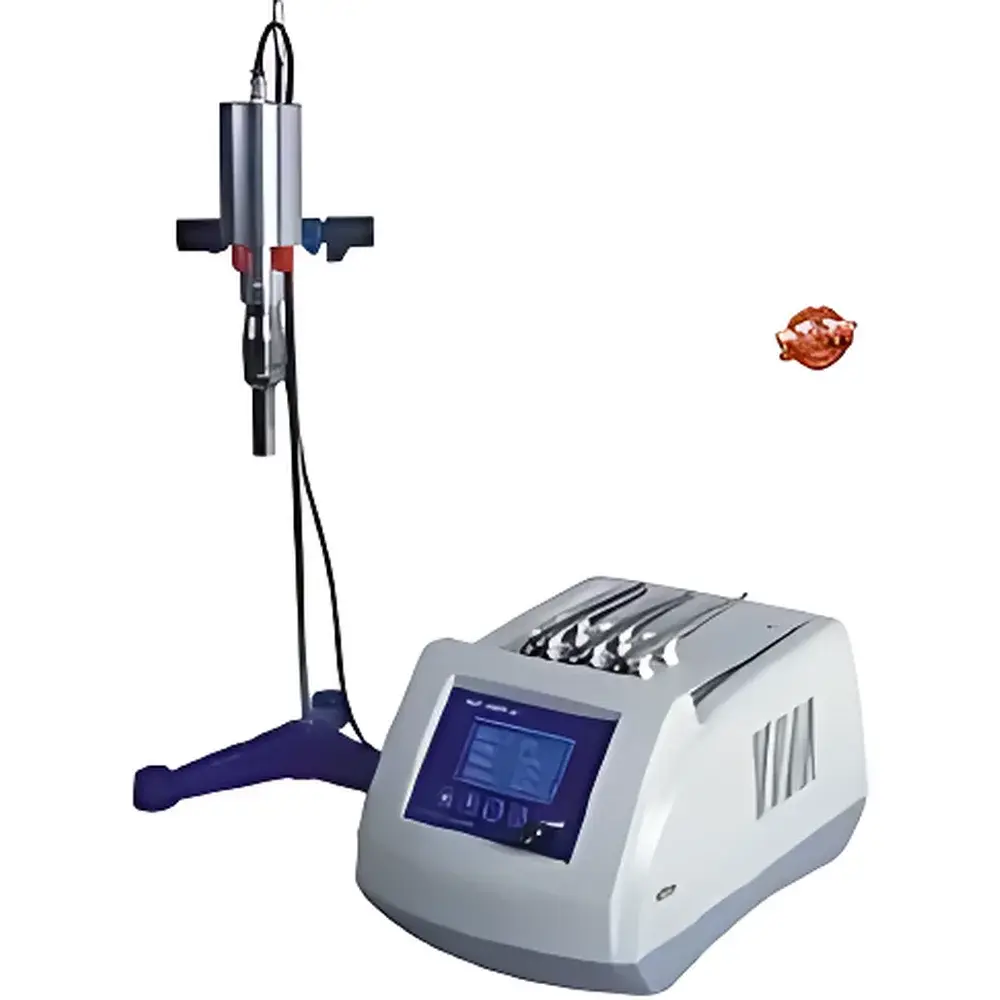
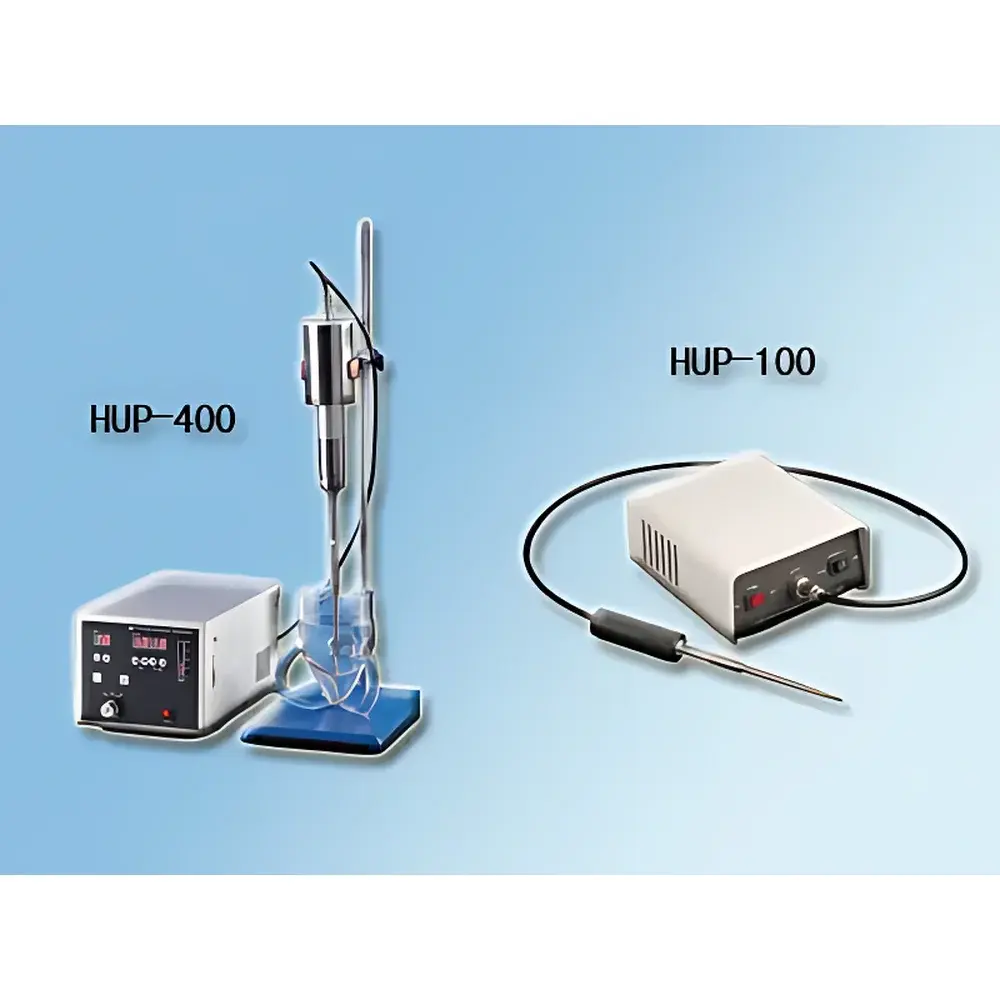
HengAo HPU-100/400A Ultrasonic Cell Disruptor
| Brand | Tianjin HengAo |
|---|---|
| Origin | Tianjin, China |
| Manufacturer Type | Direct Manufacturer |
| Instrument Type | Ultrasonic Cell Disruptor |
| Ultrasonic Power | 80 W (HPU-100) / 400 W (HPU-400A) |
| Operating Frequency | Adjustable |
| Temperature Range | 0–100 °C |
| Sample Volume | 150 µL (minimum) |
| Sample Capacity | Single sample per cycle |
| Pulse Duty Cycle | 1–99% (adjustable) |
| Timer Range | 1–99 min |
| Probe Options | 1/8″ (HPU-100), 1/2″ (HPU-400A) |
| Sample Volumes Supported | 1–100 mL (HPU-100) |
| Memory Presets | 5 user-defined protocols |
Overview
The HengAo HPU-100/400A Ultrasonic Cell Disruptor is an engineered benchtop sonication system designed for controlled mechanical lysis of biological cells and subcellular structures through acoustic cavitation. It operates on the principle of high-intensity ultrasonic energy transmission via piezoelectric transduction: electrical input is converted into longitudinal mechanical vibrations at resonant frequencies, amplified through titanium alloy probes (horns), and coupled into liquid media to generate transient microcavities. Upon collapse, these cavities produce localized shockwaves, extreme shear gradients (>10⁶ s⁻¹), and transient temperatures exceeding 5,000 K—sufficient to disrupt lipid bilayers, denature proteins, and fragment nucleic acids without bulk thermal degradation. Unlike homogenization or bead-beating methods, ultrasonic disruption offers precise spatial control, minimal cross-contamination risk, and compatibility with temperature-sensitive biomolecules when operated under chilled conditions (0–10 °C). The dual-model platform—HPU-100 (80 W, micro-volume focus) and HPU-400A (400 W, scalable processing)—enables method transfer across R&D, QC, and pilot-scale workflows in regulated and non-regulated environments.
Key Features
- Two-tier power architecture: 80 W output for low-volume, high-precision lysis (e.g., single-cell lysates, nuclear extracts); 400 W output for robust tissue homogenization and large-volume emulsification (up to 600 mL).
- Digitally programmable pulse modulation: adjustable duty cycle (1–99%), burst duration, and off-time—critical for managing heat accumulation and preserving labile analytes such as phosphoproteins or RNA.
- Five recallable protocol slots store amplitude (%), time, pulse mode, and probe configuration—supporting GLP-compliant repeatability and instrument qualification (IQ/OQ).
- Real-time visual feedback: LED bar graph displays instantaneous power delivery (0–100%), synchronized with digital timer (1–99 min resolution) and auto-standby transition upon completion.
- Modular probe system: standardized 1/8″ (3.2 mm) tip for volumes ≥150 µL; 1/2″ (12.7 mm) tip for macro-homogenization; all probes constructed from medical-grade Ti-6Al-4V alloy for corrosion resistance and acoustic efficiency.
- Integrated temperature monitoring interface (optional external PT100 sensor): enables closed-loop cooling integration with recirculating chillers to maintain sample integrity during extended sonication cycles.
Sample Compatibility & Compliance
The HPU-100/400A accommodates a broad range of biological matrices—including mammalian cell suspensions (HEK293, CHO), bacterial cultures (E. coli, B. subtilis), yeast, plant tissues (leaf, root), viral particles, and synthetic liposomes. It supports ISO 13485-aligned workflows for diagnostic reagent development and complies with general laboratory safety standards (IEC 61000-6-3 EMC, IEC 61010-1). While not pre-certified for FDA 21 CFR Part 11, its parameter logging capability (via optional RS-232/USB data export) facilitates audit-ready recordkeeping for GMP-aligned processes. All protocols are compatible with ASTM E2875-22 (Standard Guide for Ultrasonic Processing of Biological Samples) and support validation per USP <1058> Analytical Instrument Qualification.
Software & Data Management
The device operates via embedded firmware with no proprietary software dependency. Parameter settings—including amplitude, total runtime, pulse ratio, and memory slot selection—are retained after power cycling. For traceability, optional serial communication (RS-232 or USB-C) allows timestamped export of operational logs (start time, duration, power %, probe ID) to CSV-compatible systems. When integrated into LIMS or ELN platforms, these logs support electronic signature workflows compliant with ALCOA+ principles (Attributable, Legible, Contemporaneous, Original, Accurate). Firmware updates are delivered via secure USB flash drive with SHA-256 checksum verification.
Applications
- Intracellular extraction: Release of soluble proteins, enzymes, and organelles from Gram-negative bacteria without detergent-induced aggregation.
- Nucleic acid isolation: Shearing of genomic DNA to 200–1,000 bp fragments for NGS library prep—validated against QIAamp DNA Micro kits.
- Liposome and nanoemulsion formulation: Production of uniform vesicle populations (PDI <0.2) for drug delivery research.
- Herbal active compound recovery: Enhanced extraction yield of polyphenols and alkaloids from Ginseng and Salvia miltiorrhiza matrices, reducing solvent use by up to 40% versus Soxhlet.
- Vaccine antigen processing: Controlled disruption of virus-like particles (VLPs) while retaining epitope conformation for immunogenicity assays.
FAQ
What is the minimum recommended sample volume for the HPU-100 model?
150 µL—achieved using the 1/8″ probe with optimized immersion depth (3–5 mm below meniscus) and pulse modulation (e.g., 30% duty cycle, 0.5 s on/1.2 s off).
Can the HPU-400A be used for continuous operation without overheating?
Continuous mode is supported for ≤5 min at ≤70% amplitude with active cooling (chilled bath or recirculating chiller set to 4 °C); longer durations require pulsed operation.
Is probe sterilization possible between runs?
Yes—Ti-6Al-4V probes tolerate autoclaving (121 °C, 15 psi, 20 min), ethanol immersion (70%), or UV-C exposure (254 nm, 30 min); avoid sodium hypochlorite or strong acids.
Does the system support compliance with ISO/IEC 17025 calibration requirements?
While the unit itself is not calibrated, amplitude linearity and timer accuracy can be verified using NIST-traceable hydrophone measurements and stopwatch validation—documentation templates available upon request.
How does ultrasonic cavitation differ from high-pressure homogenization in terms of shear profile?
Ultrasonication delivers highly localized, transient shear (microsecond-scale pulses), whereas homogenizers apply sustained laminar shear over milliseconds—making ultrasound preferable for fragile complexes like ribonucleoprotein particles (RNPs).





