
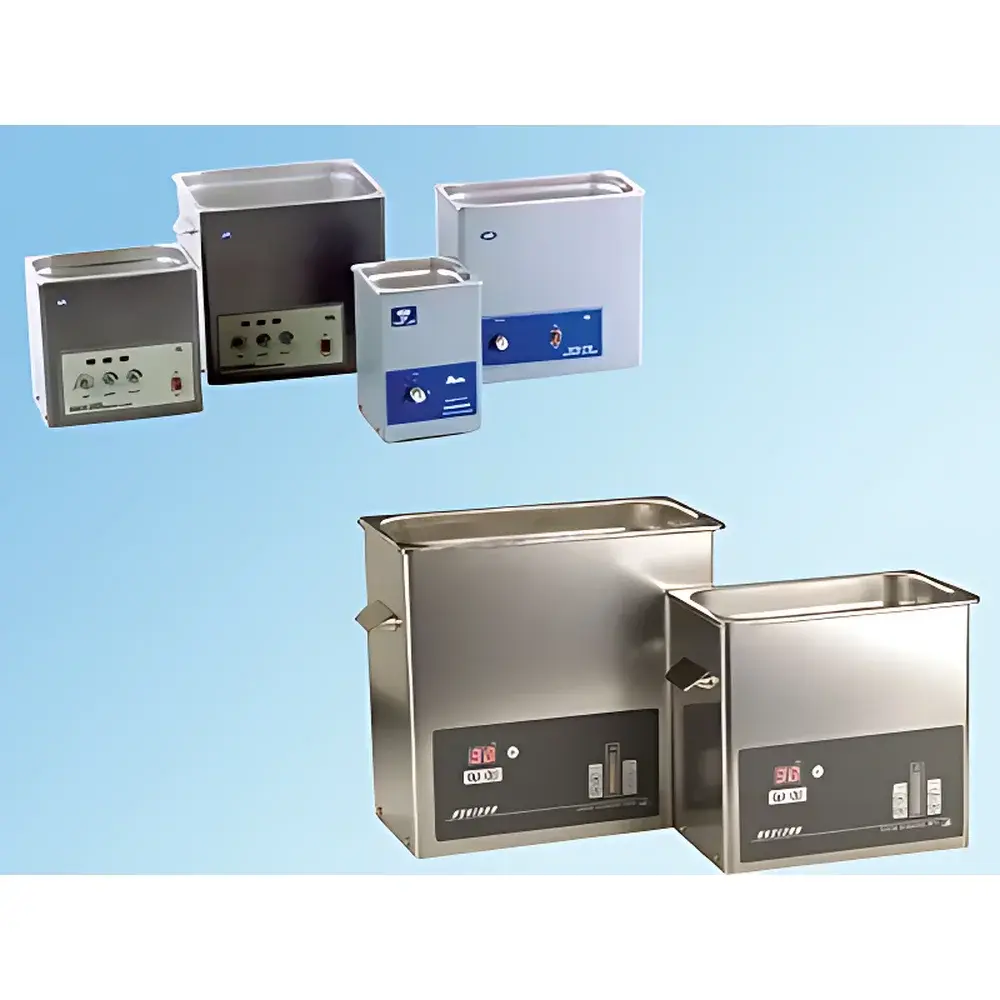
HengAo HS Series Ultrasonic Cleaner
| Brand | Tianjin HengAo |
|---|---|
| Origin | Tianjin, China |
| Manufacturer Type | Direct Manufacturer |
| Product Category | Domestic (China-Made) |
| Model Series | HS Series |
| Instrument Type | General-Purpose Ultrasonic Cleaner |
| Tank Capacity | 2–40 L |
| Ultrasonic Power Output | 60–1000 W |
| Power Adjustment Range | 0–100% (Continuously Variable) |
| Temperature Control Range | Ambient to 99 °C |
| Timer Setting Range | 0–99 minutes |
Overview
The HengAo HS Series Ultrasonic Cleaner is an engineered laboratory-grade cleaning system designed for precision removal of particulate, organic, and residual contaminants from delicate and geometrically complex surfaces. It operates on the principle of acoustic cavitation: high-frequency ultrasonic energy (typically 40 kHz, standard across the HS series) propagates through a liquid medium, generating transient microbubbles that undergo rapid compression and expansion cycles. Upon collapse, these bubbles release localized shockwaves and microjets—mechanical forces capable of dislodging sub-micron contaminants from surface topographies, blind holes, crevices, and porous substrates without mechanical abrasion or thermal degradation. This physical cleaning mechanism ensures high reproducibility, uniformity across sample batches, and compatibility with heat-sensitive materials—making it indispensable in analytical sample preparation, instrument component maintenance, and pre-sterilization workflows.
Key Features
- Continuously adjustable ultrasonic power (0–100%) enables optimization of cavitation intensity for diverse sample types—from robust metal tools to fragile optical lenses or microfluidic chips.
- Digital temperature control (ambient to 99 °C) supports thermally enhanced cleaning protocols, accelerating dissolution of waxy, greasy, or polymer-based residues when used with compatible aqueous or mild solvent-based cleaning solutions.
- Precision timer (0–99 minutes) with auto-shutdown ensures consistent exposure duration, critical for method validation and GLP-compliant documentation.
- Integrated pulse modulation circuitry (patented in HS-series design) maintains peak output above the cavitation threshold while allowing pulse width modulation—enabling either high-intensity cleaning for heavily soiled items or low-energy, gentle treatment for MEMS devices, semiconductor wafers, or biological tissue carriers.
- Stainless steel tank construction (304 grade) resists corrosion from common cleaning agents and facilitates long-term reliability under repeated thermal and chemical stress.
- Front-panel digital interface with real-time display of set parameters (power %, temperature, time remaining) simplifies operation and reduces operator error.
Sample Compatibility & Compliance
The HS Series accommodates a broad spectrum of laboratory substrates including glassware (vials, cuvettes, pipettes), metallic components (syringe needles, surgical instruments), ceramic filters, quartz crystals, silicon wafers, and polymer-based microplates. Its non-contact, solvent-efficient cleaning process aligns with ISO 13485 requirements for medical device reprocessing validation and supports ASTM D2603 (Standard Test Method for Sonic Shear Stability of Lubricating Oils) when configured for controlled degassing applications. While not certified for sterile processing per ISO 17664, the unit meets general safety standards for Class I electrical equipment (IEC 61010-1) and is routinely employed in environments adhering to GLP and GMP principles—particularly where audit-trail documentation of cleaning parameters (via optional RS-232/USB data logging) is required.
Software & Data Management
The HS Series operates via embedded firmware without proprietary software dependencies. Optional communication modules (RS-232 or USB-to-serial adapters) enable integration into lab information management systems (LIMS) or custom automation scripts for parameter logging, remote start/stop commands, and timestamped event recording. All operational settings—including power level, temperature setpoint, and elapsed time—are retained in non-volatile memory during power interruption, supporting continuity in validated workflows. For regulatory compliance, users may configure external electronic logbooks to capture parameter changes, ensuring traceability per FDA 21 CFR Part 11 requirements when paired with appropriate access controls and electronic signature protocols.
Applications
- Pre-analytical sample preparation: removal of adsorbed proteins, salts, or carryover contaminants from HPLC vials, GC autosampler trays, and ICP-MS nebulizer components.
- Solution degassing: elimination of dissolved air prior to spectroscopic analysis, cell culture media preparation, or vacuum infiltration procedures.
- Dispersion and emulsification support: aiding uniform suspension of nanoparticles, catalysts, or liposomal formulations in R&D laboratories.
- Maintenance of precision instrumentation: cleaning of optical mirrors, interferometer components, and electron microscopy grids without surface scratching.
- Academic research: enabling reproducible cleaning protocols in materials science, nanotechnology, and biomedical engineering labs where surface integrity directly impacts experimental outcomes.
FAQ
What frequency does the HS Series operate at?
The standard operating frequency is 40 kHz, optimized for balanced cavitation intensity and penetration depth across typical laboratory tank dimensions.
Can the HS Series be used with flammable solvents?
No—only aqueous or water-miscible, non-flammable cleaning solutions are recommended. The unit lacks explosion-proof certification and is not rated for volatile organic solvent use.
Is calibration required for routine operation?
While no factory calibration certificate is supplied, periodic verification of temperature accuracy (±1 °C) and timer consistency (±1 second) is advised for ISO/IEC 17025-aligned labs using the device in accredited testing procedures.
Does the HS Series include a heater safety cutoff?
Yes—a redundant overtemperature protection circuit automatically deactivates heating if internal sensor readings exceed 105 °C, preventing dry-run damage or thermal runaway.
How often should the tank solution be changed?
Solution replacement frequency depends on contamination load; however, best practice recommends full change after every 8–10 cleaning cycles or when visible turbidity, foam stability, or reduced cleaning efficacy is observed.



