
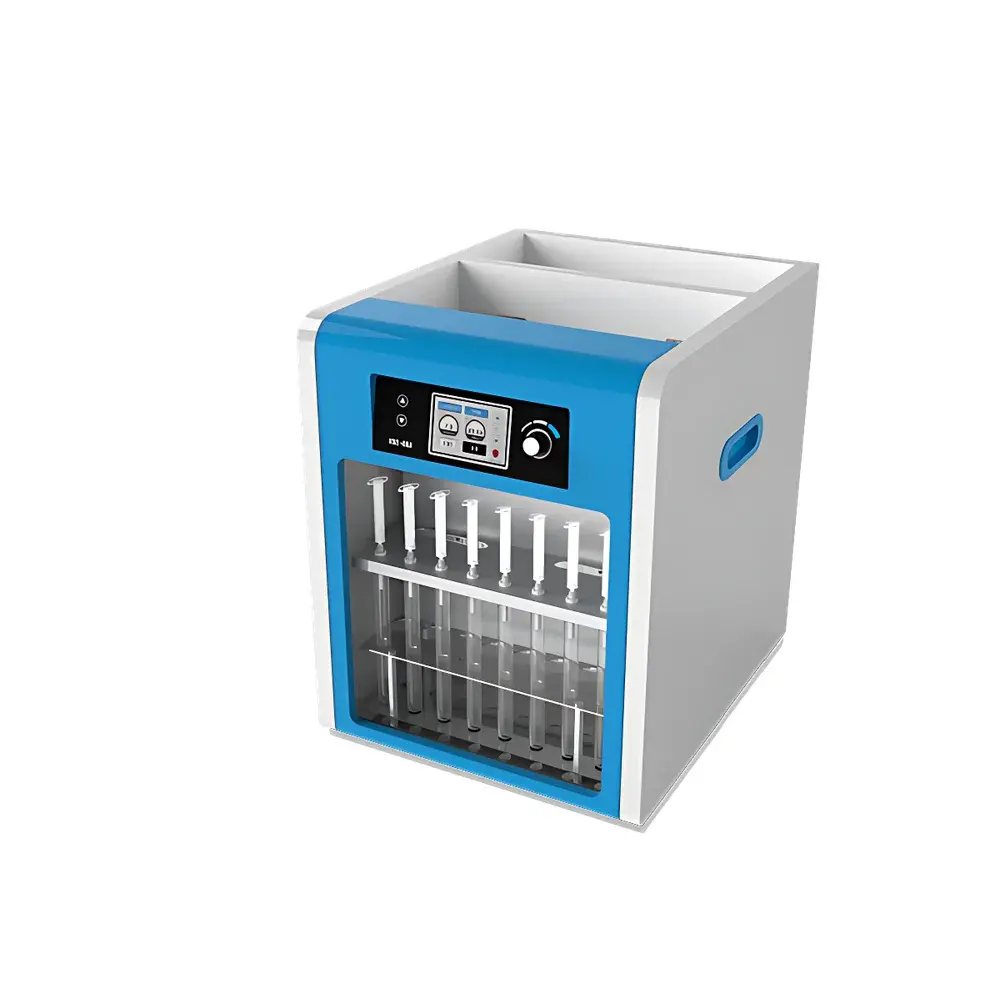
HengAo HSE-08A Multi-Channel Numerically Controlled Solid Phase Extraction System
| Brand | Tianjin HengAo |
|---|---|
| Origin | Tianjin, China |
| Manufacturer Type | Direct Manufacturer |
| Model | HSE-08A |
| Automation Level | Semi-Automatic |
| Number of Channels | 8 (configurable from 1–8) |
| Extraction Mode | Column-Based SPE |
| Flow Rate Control Range | 0.1–7 mL/min |
| Eluent Compatibility | Solvent-Universal (no restriction) |
| Sample Capacity | 1–8 samples per run |
| Loading Volume Support | Large-Volume Injection (up to 1000 mL, compatible with standard SPE cartridges) |
| Wetted Materials | PTFE (polytetrafluoroethylene) only |
Overview
The HengAo HSE-08A Multi-Channel Numerically Controlled Solid Phase Extraction System is an engineered solution for reproducible, scalable, and method-compliant solid-phase extraction in regulated and research laboratory environments. It operates on a dual-pressure principle: precise vacuum-assisted loading and conditioning steps—controlled via digitally calibrated peristaltic or syringe-driven flow regulation—followed by positive-pressure elution using inert gas (e.g., nitrogen) or programmable pump delivery. This architecture eliminates manual column manipulation variability while maintaining full compatibility with standard 1 mL, 3 mL, 6 mL, and 12 mL SPE cartridges from leading suppliers (e.g., Waters, Agilent, Thermo Fisher). Designed for method transfer integrity, the system supports all major SPE protocols—including reversed-phase, ion-exchange, and mixed-mode chemistries—and enables consistent retention, washing, and elution kinetics across all eight independently addressable channels.
Key Features
- Independent channel control with digital flow regulation (0.1–7 mL/min), ensuring inter-channel precision ≤ ±3% RSD for identical method parameters
- PTFE-only fluid path construction—fully inert to aggressive organic solvents (e.g., dichloromethane, acetonitrile, methanol) and strong acids/bases—minimizing analyte adsorption and leachables
- Semi-automated workflow integration: programmable timing for load/condition/elute steps, automated column switching between manifold and elution rack, and optional pause/resume functionality
- Large-volume sample introduction support (up to 1000 mL per channel) with integrated overflow detection and pressure relief to prevent cartridge channeling or breakthrough
- Modular design allowing configuration for 1–8 active channels; each channel features individual vacuum gauge monitoring and real-time flow feedback
- Ergonomic column positioning with standardized spacing (9 mm center-to-center) for seamless compatibility with robotic liquid handlers and autosamplers
Sample Compatibility & Compliance
The HSE-08A accommodates all commercially available SPE cartridges and disks without adapter modification. Its PTFE manifold and tubing meet USP Class VI biocompatibility requirements and are compliant with ISO 15195:2018 (laboratory calibration standards) for trace-level analysis workflows. The system supports method validation per FDA Guidance for Industry: Bioanalytical Method Validation (May 2018) and aligns with EPA Method 508.1, 525.3, and 8270D for environmental contaminant isolation. When operated under documented SOPs—including defined maintenance intervals, flow calibration logs, and operator training records—the instrument meets GLP audit requirements for contract laboratories conducting food safety (e.g., EU Regulation No. 396/2005), pesticide residue (AOAC 2012.01), and pharmaceutical impurity profiling studies.
Software & Data Management
The embedded controller provides local method storage (≥50 protocols), time-stamped event logging (including flow rate deviations, vacuum pressure thresholds, and step completion), and USB export of CSV-formatted run reports. While no proprietary PC software is required, exported data are structured to integrate with LIMS platforms (e.g., LabWare, STARLIMS) via standard ODBC drivers. Audit trail functionality includes user login tracking, parameter change history, and electronic signature support—enabling compliance with 21 CFR Part 11 when paired with validated third-party data management systems. All firmware updates are delivered via signed binary packages with SHA-256 verification.
Applications
- Food & agricultural testing: multi-residue analysis of pesticides (organophosphates, neonicotinoids), mycotoxins (aflatoxin B1, ochratoxin A), and veterinary drug residues (tetracyclines, sulfonamides) in milk, honey, cereals, and fruit extracts
- Environmental monitoring: isolation of PAHs, PCBs, phthalates, and PFAS from surface water, wastewater, and soil leachates prior to GC-MS or LC-MS/MS quantification
- Clinical & pharmaceutical research: clean-up of plasma, urine, and tissue homogenates for therapeutic drug monitoring (e.g., immunosuppressants, antiepileptics) and metabolite profiling
- Regulatory compliance labs: preparation of drinking water samples per ISO 22069 for microplastic particulate isolation and subsequent µFTIR identification
- Industrial QC: extraction of catalyst residues, stabilizers, and antioxidants from polymer matrices prior to ICP-OES or GPC analysis
FAQ
Does the HSE-08A support method development with gradient elution?
No—this system implements isocratic elution only. Gradient solvent programming requires external LC-grade pumps and mixing modules not integrated into the HSE-08A architecture.
Can it be used with 96-well plate SPE formats?
Not natively. The manifold is configured for individual cartridge handling. Plate-based workflows require a separate vacuum manifold or robotic SPE platform.
Is calibration traceable to NIST standards?
Yes—flow calibration certificates (with uncertainty budgets) are issued per ISO/IEC 17025-accredited third-party calibration services upon request; factory calibration uses gravimetric measurement against NIST-traceable mass standards.
What maintenance intervals are recommended for routine operation?
Vacuum pump oil replacement every 500 hours; PTFE tubing inspection every 200 runs; flow sensor recalibration annually or after 1000 operational hours—whichever occurs first.
How is cross-contamination prevented between sequential runs?
Through physical separation of loading and elution manifolds, dedicated PTFE pathways per channel, and automated post-run purge cycles using inert gas at ≥10 psi for ≥30 seconds per port.



