
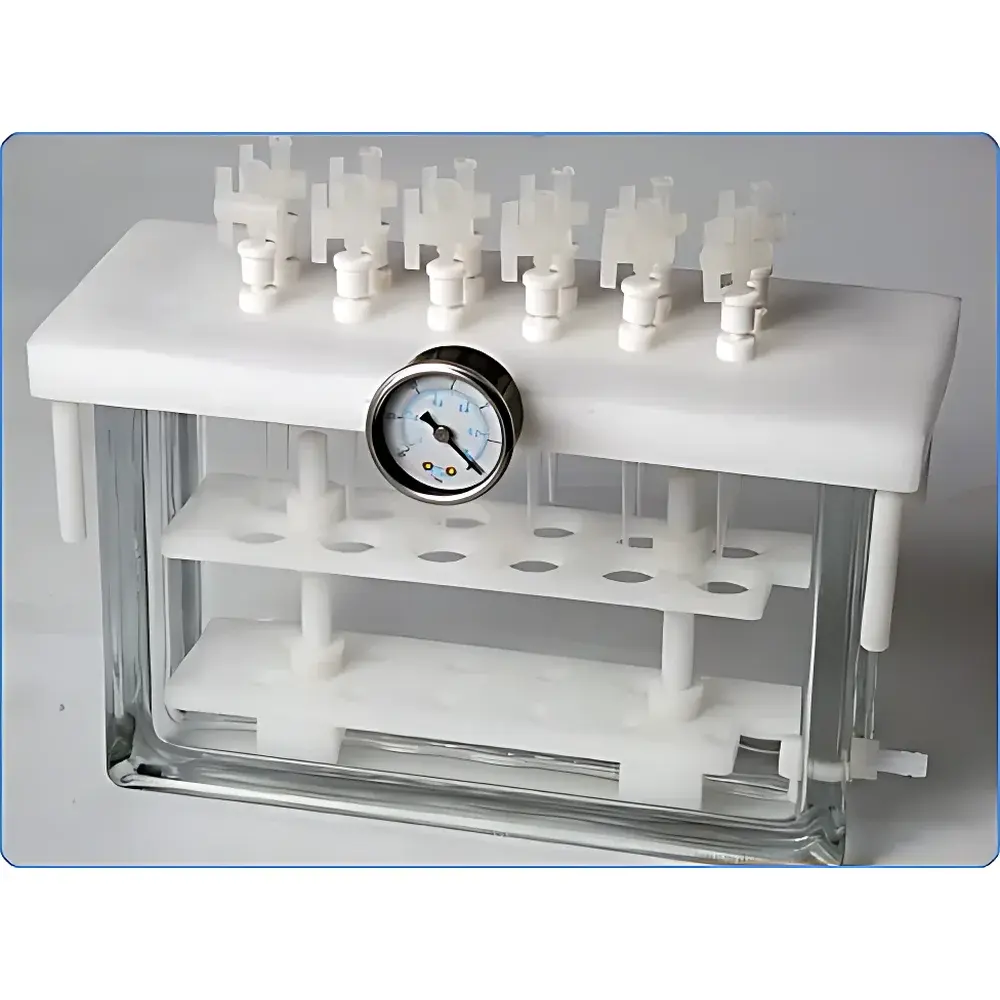
HengAo HSE-24B Manual Solid Phase Extraction System
| Brand | Tianjin HengAo |
|---|---|
| Origin | Tianjin, China |
| Manufacturer Type | Direct Manufacturer |
| Model | HSE-24B |
| Automation Level | Manual |
| Channel Count | 24-Channel |
| Extraction Format | Cartridge-Based (Column) |
| Flow Rate Control Range | 1–30 mL/min |
| Solvent Compatibility | Broad (All Common Organic and Aqueous Solvents) |
| Sample Capacity | 24 Samples per Run |
| Sample Loading Volume | High-Volume Capability (Up to 1 L with Compatible Cartridges) |
| Wetted Materials | PTFE (Polytetrafluoroethylene) Only |
| Regulatory Compliance | Designed for GLP/GMP-Compliant Labs |
| Standards Alignment | ASTM D7295, ISO 16775, USP <621> Method Suitability Guidance |
Overview
The HengAo HSE-24B Manual Solid Phase Extraction System is a robust, benchtop cartridge-based sample preparation platform engineered for precision and reproducibility in analytical laboratories. It operates on the principle of selective adsorption and elution—leveraging reversed-phase, ion-exchange, or mixed-mode sorbent chemistries housed in standard 1–6 mL SPE cartridges—to isolate target analytes from complex liquid matrices. Unlike liquid–liquid extraction (LLE), which relies on partition coefficients and introduces emulsion risks and large solvent volumes, the HSE-24B enables controlled, gravity- or vacuum-assisted flow through packed sorbent beds, delivering superior analyte recovery (typically >85% for validated methods), reduced matrix interference, and significantly shorter sample throughput times. Its modular architecture supports method development, routine QC, and high-throughput screening across regulated and non-regulated environments—including environmental monitoring, food safety testing, forensic toxicology, and pharmaceutical bioanalysis.
Key Features
- 24-position parallel processing configuration with independent flow control per channel via adjustable PTFE-tipped stopcocks—ensuring consistent residence time and minimizing cross-contamination risk.
- PTFE-only wetted path (manifold, tubing, and column adapters) provides exceptional chemical resistance to aggressive solvents (e.g., acetonitrile, methanol, dichloromethane, 1 M HCl, 1 M NaOH), eliminating metal leaching and ensuring trace-level integrity.
- Modular vacuum manifold design compatible with standard SPE cartridges (1–6 mL format) and 12– and 24-well collection plates—enabling seamless integration into existing workflows without proprietary consumables.
- Integrated pressure regulation interface allows connection to external vacuum pumps (recommended: ≤−80 kPa) or nitrogen gas manifolds for precise, low-pulsation flow delivery—critical for fragile analytes and unstable derivatives.
- Stainless steel support frame with anodized aluminum base ensures mechanical stability during sequential loading, washing, and elution steps—even under extended operation.
- Tool-free cartridge alignment system with tapered PTFE sealing gaskets guarantees leak-free operation across all 24 positions, verified at 0.5 bar differential pressure.
Sample Compatibility & Compliance
The HSE-24B accommodates aqueous samples (e.g., drinking water, wastewater, urine, plasma), organic extracts (e.g., hexane extracts of soil), and semi-aqueous suspensions (e.g., homogenized food matrices post-protein precipitation). It supports both off-line and on-line SPE coupling—for instance, direct transfer of eluates to autosampler vials for LC–MS/MS analysis or evaporation-ready tubes for GC–ECD quantification. The system meets foundational requirements for method validation under ISO/IEC 17025:2017 and supports audit-ready documentation when paired with laboratory information management systems (LIMS). While inherently manual, its design aligns with FDA 21 CFR Part 11 principles for electronic record integrity—particularly when used in conjunction with standardized SOPs, operator training logs, and instrument usage registers required in GLP and GMP environments.
Software & Data Management
As a manually operated platform, the HSE-24B does not include embedded firmware or proprietary software. This architecture eliminates licensing costs, cybersecurity vulnerabilities, and software obsolescence—making it ideal for labs prioritizing long-term operational continuity and method transparency. All procedural parameters (flow rate, wash volume, elution solvent sequence) are documented externally in validated SOPs or electronic lab notebooks (ELNs). Integration with third-party data systems occurs at the workflow level: e.g., barcode-scanned cartridge lot numbers logged in LIMS; eluate volumes recorded via digital balance interfaces; or time-stamped operator entries synchronized with chromatography data systems (CDS) for full traceability.
Applications
- Environmental Analysis: Extraction of organochlorine pesticides (e.g., DDT, endosulfan), PAHs, and heavy metal chelates from surface water, groundwater, and sediment porewater—per EPA Methods 508.1, 525.3, and 1694.
- Food Safety Testing: Multi-residue cleanup of fruits, vegetables, cereals, and animal tissues prior to LC–MS/MS detection of neonicotinoids, mycotoxins, and veterinary antibiotics—aligned with EU SANTE/11312/2021 guidelines.
- Clinical & Forensic Toxicology: Isolation of benzodiazepines, opioids, and stimulants from serum and urine—supporting confirmation testing per ISO 15197 and SWGTOX best practices.
- Pharmaceutical Development: Desalting and buffer exchange of peptide-rich bioprocess intermediates; removal of phospholipids from plasma prior to PK/PD assay development.
- Beverage Quality Control: Removal of polyphenolic interferences from wine and fruit juice matrices prior to HPLC–UV determination of preservatives (e.g., sorbic acid, benzoic acid).
FAQ
Is the HSE-24B compatible with 3 mL and 6 mL SPE cartridges?
Yes—the manifold accepts standard polypropylene and glass SPE cartridges ranging from 1 mL to 6 mL, including stacked-bed and mixed-mode formats.
Can it be used under positive pressure with nitrogen gas?
Yes—via optional PTFE-compatible gas inlet fittings; recommended pressure range: 10–30 psi for reproducible flow control.
What maintenance is required?
Routine cleaning with methanol/water (1:1) followed by air-drying; annual inspection of PTFE gaskets and stainless-steel vacuum ports for wear or residue accumulation.
Does it support method transfer from automated SPE platforms?
Yes—its manual, parameter-transparent operation facilitates straightforward translation of validated methods from robotic systems, especially where cost, simplicity, or regulatory flexibility are primary concerns.
Are replacement parts available globally?
All components—including PTFE stopcocks, column adapters, and vacuum manifolds—are stocked and shipped internationally with documented material certifications (RoHS, REACH, USP Class VI).
Related Products



