
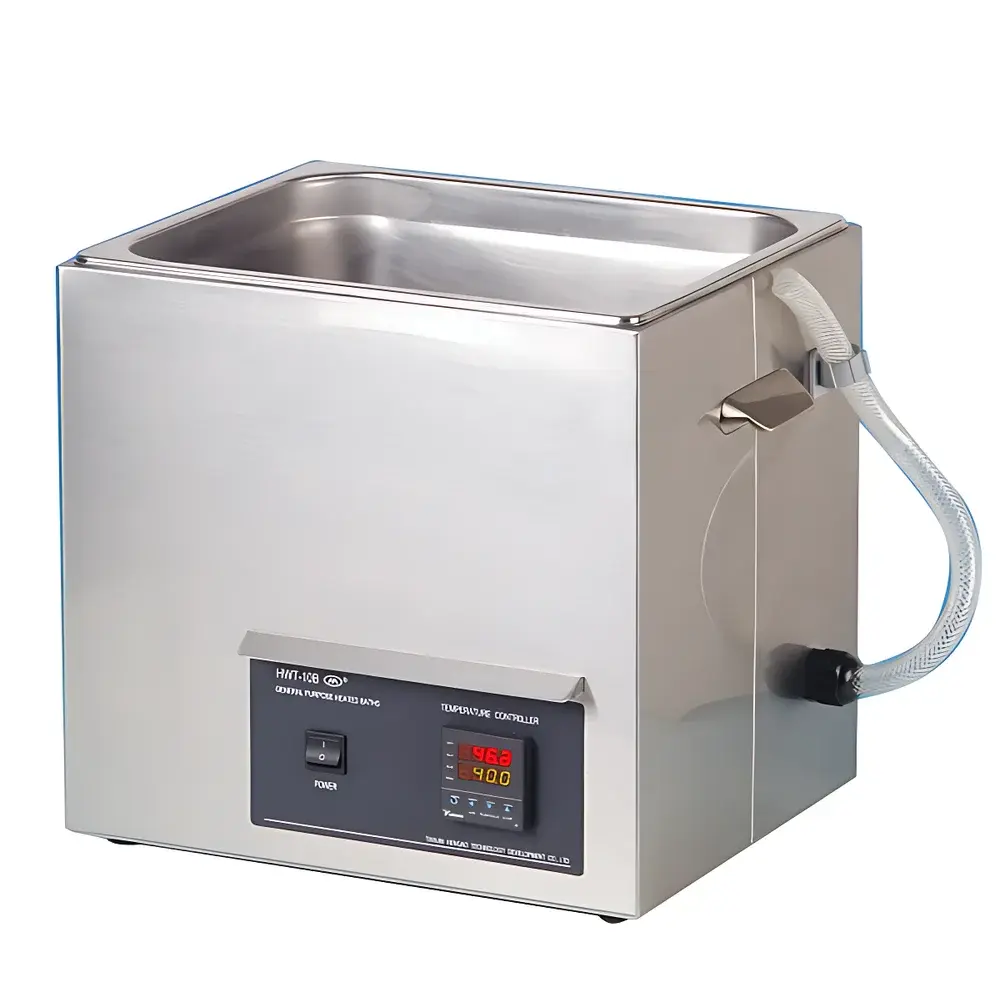
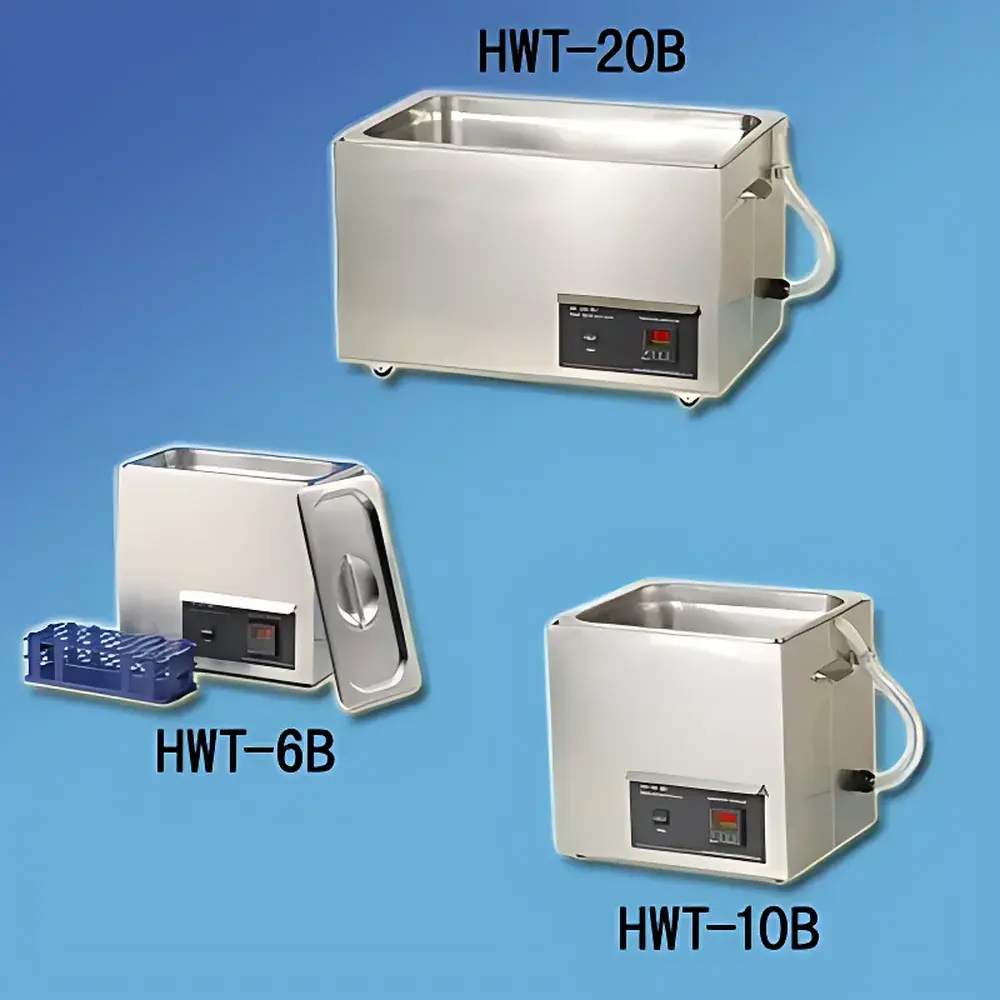
HengAo HWT-10B Benchtop Water Bath
| Brand | Tianjin HengAo |
|---|---|
| Origin | Tianjin, China |
| Manufacturer Type | Direct Manufacturer |
| Equipment Type | Immersion Constant-Temperature Bath |
| Circulation | Non-Circulating |
| Heating Only | Yes |
| Bath Capacity | 10 L |
| Temperature Range | Ambient to 100 °C |
| Temperature Stability | ±1 °C |
Overview
The HengAo HWT-10B is a benchtop non-circulating immersion water bath engineered for precise, stable thermal control in routine laboratory applications. It operates on the principle of direct conductive heat transfer from PTC (Positive Temperature Coefficient) ceramic heating elements to deionized or distilled water within a sealed stainless-steel chamber. Unlike recirculating baths, the HWT-10B maintains temperature uniformity through optimized thermal mass distribution, insulated chamber geometry, and PID-based closed-loop feedback control—making it suitable for applications where gentle, localized heating is required without forced convection or external fluid exchange. Its design prioritizes operational safety, corrosion resistance, and long-term reliability under continuous use in QC labs, clinical microbiology settings, and academic teaching laboratories.
Key Features
- PTC ceramic heating system: Delivers rapid, self-regulating heat output with inherent overtemperature protection; eliminates risk of dry-burn or element oxidation.
- PID microprocessor control: Enables stable setpoint maintenance within ±1 °C across the full 20–100 °C operating range; LED digital display provides real-time temperature readout with 0.1 °C resolution.
- 304 stainless-steel tank and housing: Fully welded construction resists corrosion from aqueous solutions, mild solvents, and repeated cleaning with ethanol or diluted disinfectants.
- Enhanced thermal insulation: High-density polyurethane foam layer applied to base and all four side walls minimizes ambient heat loss and improves energy efficiency.
- Intuitive touch-sensitive interface: Single-button navigation for setpoint adjustment, power toggle, and status indication; no mechanical potentiometers to wear or drift.
- Fixed-volume configuration: 10 L internal capacity accommodates standard Erlenmeyer flasks (up to 2 L), centrifuge tubes (50 mL), and multi-well plates—optimized for common bench-scale incubation and reaction protocols.
Sample Compatibility & Compliance
The HWT-10B is compatible with glassware (borosilicate, Pyrex), polypropylene, and polycarbonate containers rated for sustained exposure up to 100 °C. It is not intended for use with volatile organic solvents, low-boiling-point liquids, or open-vessel evaporation processes requiring active vapor management. While not certified to UL/CSA or CE standards as a standalone medical device, its electrical architecture complies with IEC 61010-1:2010 requirements for laboratory equipment safety. The unit meets general GLP documentation prerequisites when used in validated workflows—for example, as part of ASTM D1500 (petroleum color measurement) or USP environmental conditioning steps where auxiliary temperature control is specified.
Software & Data Management
The HWT-10B operates as a stand-alone analog-digital hybrid instrument with no embedded data logging or PC connectivity. All operational parameters are managed locally via front-panel controls. For traceable temperature validation, users may integrate external calibrated thermistors or PT100 probes connected to third-party data acquisition systems (e.g., LabVIEW-compatible DAQ modules or ISO/IEC 17025-accredited temperature recorders). The unit supports periodic verification per ISO/IEC 17025 Clause 6.4.6 and satisfies basic audit requirements for temperature-controlled storage under FDA 21 CFR Part 11 when paired with procedural controls (e.g., written SOPs, manual logbooks, and scheduled calibration checks).
Applications
- Microbial culture incubation: Maintaining consistent growth temperatures for bacterial enrichment (e.g., at 35–37 °C) during CLSI-compliant susceptibility testing.
- Enzyme activity assays: Stabilizing reaction mixtures during kinetic studies requiring precise thermal control between 25–65 °C.
- Solubility and dissolution testing: Supporting USP Apparatus I/II auxiliary heating components in pharmaceutical QA/QC environments.
- Sample thawing and rehydration: Controlled warming of frozen biological specimens, lyophilized reagents, or cryopreserved cell stocks.
- Chemical synthesis pre-heating: Conditioning reaction vessels prior to addition of exothermic reagents in undergraduate organic chemistry labs.
FAQ
Is the HWT-10B suitable for oil bath applications?
No—the unit is designed exclusively for aqueous media. Use of oils or silicone fluids may compromise seal integrity, accelerate heater degradation, and violate electrical safety ratings.
Can external temperature probes be connected for remote monitoring?
Yes—though the unit lacks native analog/digital outputs, its bath cavity allows insertion of externally powered RTD or thermistor probes compatible with standard data loggers.
What is the recommended calibration frequency?
Per ISO/IEC 17025 guidance, annual calibration against NIST-traceable references is advised; more frequent verification (e.g., daily before use) is recommended in regulated environments.
Does the bath include overtemperature or dry-run protection?
Yes—integrated PTC self-limiting behavior combined with dual-stage thermal cutoff switches prevents operation above 105 °C or without minimum water level.
How does ambient temperature affect stability performance?
At room temperatures below 18 °C or above 30 °C, ±1 °C stability is maintained only when the bath is covered with a thermal lid; uncovered operation may introduce ±1.5 °C deviation at extremes.



