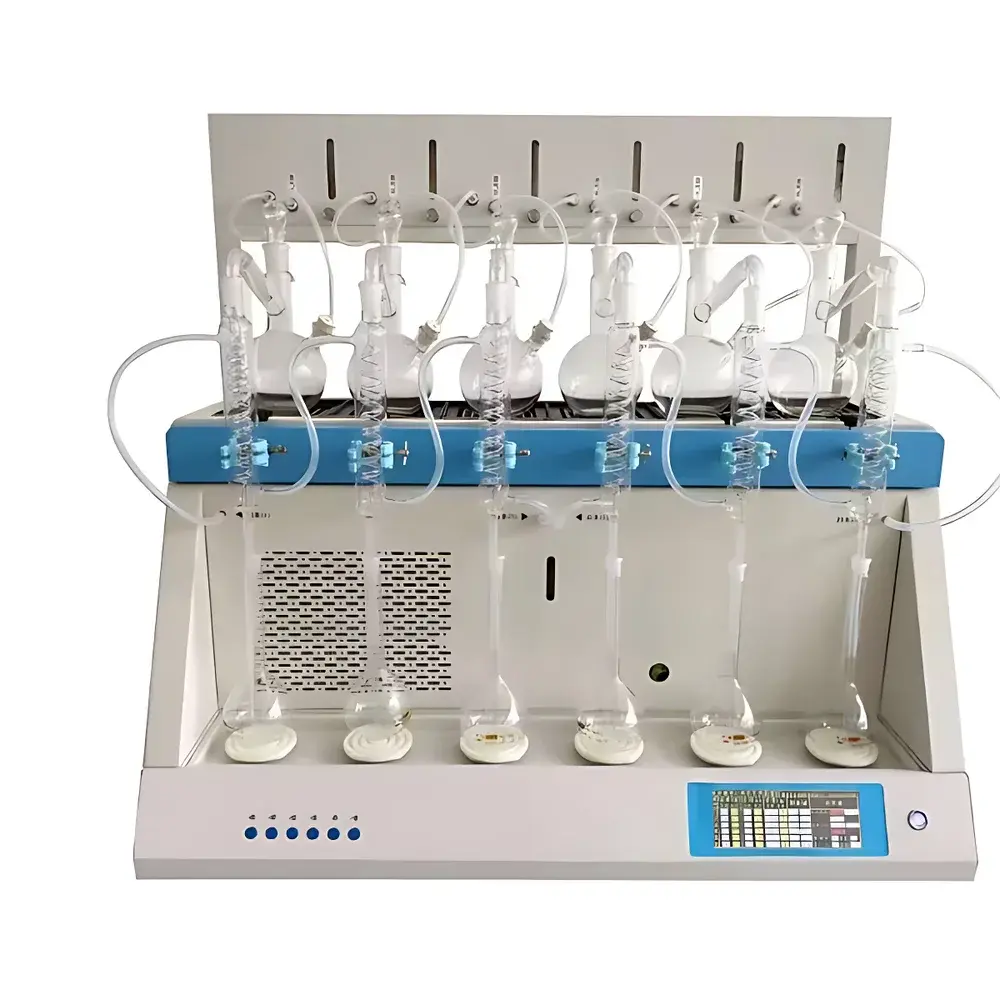
HengaoDe HAD-69 Multi-Channel Intelligent Steam Distillation System for SO₂ Residue Analysis in Food Samples
| Brand | HengaoDe |
|---|---|
| Origin | Beijing, China |
| Manufacturer Type | Authorized Distributor |
| Country of Origin | China |
| Model | HAD-69 |
| Price | USD 42.50 (based on ¥298 at 7.0 CNY/USD) |
| Heating Method | Far-Infrared Ceramic Heater (Flame-Free, Waterproof) |
| Number of Heating Units | 6 (Independent Single-Channel Control) |
| Heating Power Range | 0–800 W per channel |
| Total Power | 0–4800 W |
| Temperature Control Precision | ±1°C |
| Distillation Rate | 2–12 mL/min (Adjustable) |
| Nitrogen Flow Control | 60–600 mL/min per channel (Individual Valves) |
| Endpoint Detection | Dual-Mode — Weight-Based (±2 mL accuracy via Load Cell) & Time-Based (0–200 min) |
| Cooling System | Closed-Loop Internal Recirculation with Compressor + Air-Cooling Hybrid |
| Anti-Bumping & Anti-Suck-Back | Integrated Solenoid Valve & Micro-Boil Regulation |
| Compliance | Verified Recovery Rate ≥95% per CNAS-Accredited Lab Validation (Volatile Phenol, Cyanide, Ammonia-N, SO₂) |
Overview
The HengaoDe HAD-69 Multi-Channel Intelligent Steam Distillation System is an engineered solution for standardized, high-reproducibility distillation pretreatment in analytical laboratories—specifically designed to quantify residual sulfur dioxide (SO₂) in food matrices per national and international food safety protocols (e.g., GB 5009.34, AOAC 990.15, ISO 5775-1). Unlike conventional open-heating setups, the HAD-69 employs far-infrared ceramic heating elements to deliver uniform thermal energy without flame or moisture ingress risk, minimizing decomposition artifacts and ensuring stoichiometric SO₂ liberation from sulfite-bound forms (e.g., Na₂S₂O₅, K₂S₂O₅). Its dual endpoint control—weight-based termination using precision load cells (±2 mL resolution) and programmable time cutoff—eliminates operator dependency and aligns with GLP-compliant documentation requirements. The system supports parallel processing of up to six samples under identical thermal profiles, enabling statistically robust batch analysis for QC/QA labs in food manufacturing, third-party testing, and regulatory surveillance.
Key Features
- 6 independent heating channels with individual power regulation (0–800 W), allowing method-specific optimization per sample type (e.g., dried fruit vs. wine must)
- Micro-boil modulation algorithm dynamically adjusts power output to suppress violent boiling and foam carryover—critical for viscous or protein-rich food extracts
- Integrated nitrogen purge manifold with per-channel mass flow control (60–600 mL/min) to inert distillate headspace and prevent SO₂ oxidation during condensation
- Closed-loop refrigeration system combining compressor cooling and forced-air heat dissipation—maintains consistent condenser temperature (<10°C) across 8+ hour continuous operation
- Automated water-fill system with level-sensing and audible alert—reduces manual intervention and ensures uninterrupted cooling performance
- Compliance-ready design: All critical parameters (heating time, weight loss, nitrogen flow) are logged internally; data export via USB supports audit trail reconstruction
Sample Compatibility & Compliance
The HAD-69 accommodates standard 500 mL pear-shaped distillation flasks and accepts wide-bore receiving vessels (volumetric flasks, conical flasks, graduated cylinders), facilitating direct titration or spectrophotometric quantification of distillate. It has been validated for SO₂ recovery from diverse food matrices including dried apricots, wine, shrimp paste, and processed meats—demonstrating ≥95% mean recovery (n=12) against certified reference materials (CRMs) per CNAS-accredited interlaboratory studies. The system conforms to ISO/IEC 17025:2017 clause 7.2.2 (method validation) and supports traceability per FDA 21 CFR Part 11 when paired with compliant LIMS software. Its flame-free heating architecture meets IEC 61010-1 safety requirements for laboratory equipment in non-explosive environments.
Software & Data Management
While the HAD-69 operates as a standalone hardware platform, its embedded controller stores all run metadata—including start/stop timestamps, total distillate mass per channel, cumulative heating energy, and nitrogen flow logs—for up to 500 cycles. Data export is performed via USB flash drive in CSV format, compatible with Excel, JMP, or laboratory informatics systems. Optional firmware upgrade enables RS-485 Modbus RTU communication for integration into centralized lab automation networks. No proprietary software installation is required; raw logs contain column headers aligned with ISO/IEC 17025 documentation standards (e.g., “Channel_ID”, “Distillate_Mass_g”, “Endpoint_Condition”, “Operator_ID”).
Applications
Beyond SO₂ residue analysis in food, the HAD-69 serves as a general-purpose distillation workstation for EPA Method 450.1 (cyanide), ASTM D129-18 (sulfur in petroleum), APHA 4500-NH₃ F (ammonia-nitrogen), and ISO 660 (acid value in oils). Its modular design allows adaptation to volatile phenol (ISO 6439), formaldehyde (GB/T 17629), and ethanol determination workflows. Universities use it for teaching quantitative separation principles; contract testing labs deploy it for multi-analyte screening under ISO/IEC 17025 scope extensions.
FAQ
Does the HAD-69 require external cooling water?
No—its integrated closed-loop refrigeration system eliminates dependence on municipal water supply or chillers, reducing infrastructure constraints and operational cost.
Can I validate distillation efficiency for my specific food matrix?
Yes—the system supports spike-recovery experiments using isotopically labeled SO₂ standards (e.g., ³⁴SO₂); recovery data can be entered into built-in calibration curves for matrix-matched quantification.
Is the nitrogen flow calibrated per channel?
Each channel features a dedicated needle valve and calibrated flow meter (±5% full scale), enabling precise stoichiometric control during oxidative stabilization.
What maintenance is required for long-term reliability?
Annual verification of load cell linearity and infrared heater emissivity is recommended; no consumables beyond standard glassware are needed—no catalysts, reagents, or membranes required.
How does the anti-suck-back mechanism function during vacuum-assisted distillation?
An electronically actuated solenoid valve isolates the condenser path upon pressure differential detection (>−0.05 bar), preventing backflow of cooled distillate into hot flasks—a failure mode known to compromise SO₂ recovery in acidic media.