
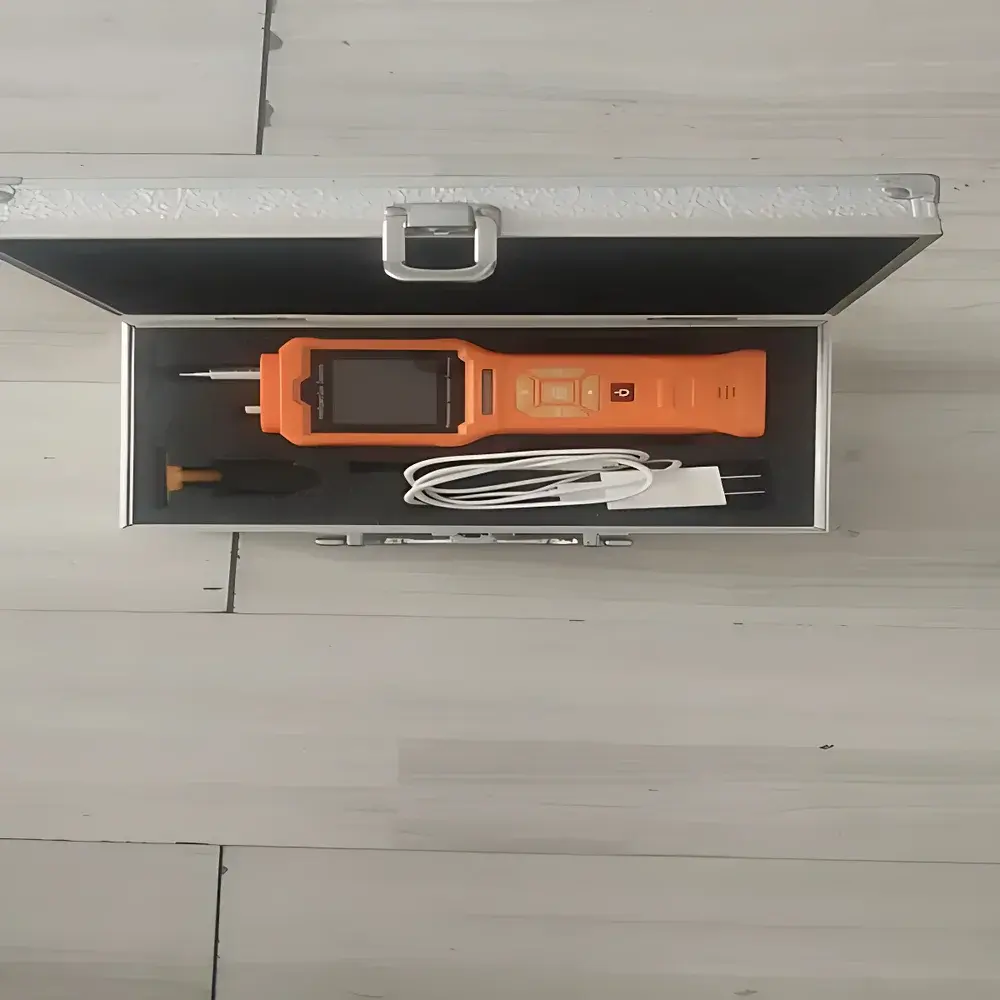
HengaoDe HAD-QQC Portable Hydrogen Purity Analyzer
| Brand | HengaoDe |
|---|---|
| Origin | Beijing, China |
| Manufacturer Type | Authorized Distributor |
| Country of Origin | China |
| Model | HAD-QQC |
| Price | USD 198 |
| Sensor Range | 0–100 ppm / 500 ppm / 1000 ppm / 10,000 ppm / 40,000 ppm / 0–50% VOL / 0–99.99% VOL |
| Resolution | 0.1 ppm (≤1000 ppm), 1 ppm (≤40,000 ppm), 0.01% VOL |
| Response Time (T90) | ≤20 s |
| Accuracy | ≤±3% FS (sensor-dependent) |
| Linearity Error | ≤±1% FS |
| Zero Drift | ≤±1% FS/year |
| Repeatability | ≤±1% FS |
| Explosion Protection Certification | CNEx16.0538 |
| Ingress Protection | IP65 |
| Detection Method | Pump-aspiration |
| Data Storage Capacity | 120,000 records |
| Operating Temperature | −30 °C to +60 °C |
Overview
The HengaoDe HAD-QQC Portable Hydrogen Purity Analyzer is a field-deployable gas detection instrument engineered for quantitative measurement of hydrogen (H₂) concentration in industrial process environments, confined spaces, and safety-critical infrastructure. It operates on the principle of electrochemical or catalytic bead sensing—depending on configured sensor module—delivering real-time, selective detection across multiple calibrated ranges (ppm to %VOL). Designed for operational robustness, the analyzer integrates a built-in micro-pump for active sampling, stainless-steel dust filtration, and temperature/humidity compensation (optional add-on), enabling reliable performance under variable ambient conditions. Its architecture complies with fundamental functional safety expectations for portable gas monitors used in petrochemical, power generation, semiconductor fabrication, and hydrogen fuel handling applications.
Key Features
- Multi-range configurable sensor modules: Supports selectable full-scale ranges from 0–100 ppm up to 0–99.99% VOL, optimized for leak detection, purity verification, and inerting validation.
- Pump-aspiration sampling system: Ensures consistent volumetric draw rate and representative sample delivery—even in low-flow or stagnant zones.
- High-resolution digital display with intuitive menu navigation: Real-time concentration, battery status, alarm indicators, and timestamped data logging visible on integrated LCD.
- Configurable measurement modes: Continuous real-time monitoring, timed interval acquisition, and user-defined trigger-based storage.
- Comprehensive data management: Stores up to 120,000 timestamped readings internally; historical datasets accessible via on-device scroll interface.
- Ruggedized enclosure certified to IP65 ingress protection and CNEx16.0538 explosion-proof standard for use in Zone 1/2 hazardous locations.
- Field-serviceable modular design: Sensor cartridges, filters, and battery packs are replaceable without specialized tools or calibration recalibration.
Sample Compatibility & Compliance
The HAD-QQC is validated for direct measurement of hydrogen in air, nitrogen, argon, and other non-corrosive carrier gases. It is not intended for use in strongly oxidizing, acidic, or solvent-saturated atmospheres without prior compatibility assessment. While not certified to IEC 61508 or SIL2 as a standalone safety instrument, its performance characteristics align with the technical requirements referenced in ISO 26122 (hydrogen fuel quality), ASTM D7615 (standard guide for hydrogen purity analysis), and OSHA 1910.103 (hydrogen handling safety). Device firmware and calibration traceability support GLP-compliant recordkeeping when paired with external audit-ready software.
Software & Data Management
Data export is supported via USB interface (device-mounted port) to standard PC platforms running Windows OS. Exported CSV files contain timestamp (YYYY-MM-DD HH:MM:SS), measured concentration, unit, sensor ID, and environmental metadata (if optional T/RH probe installed). The embedded real-time clock maintains synchronization within ±2 seconds/month, satisfying basic traceability requirements per FDA 21 CFR Part 11 Annex A for electronic records in non-GMP laboratory settings. No proprietary drivers or cloud dependencies are required—raw data files are human-readable and compatible with common statistical analysis packages (e.g., MATLAB, JMP, Python pandas).
Applications
- Verification of hydrogen purity in PEM electrolyzer outlet streams prior to compression and storage.
- Leak surveillance around gasketed flanges, valve stems, and compressor seals in hydrogen refueling stations.
- Monitoring headspace gas composition during catalyst regeneration in hydroprocessing units.
- Quality control of high-purity hydrogen supplied to analytical instruments (e.g., GC carrier gas).
- Pre-startup purge validation in ammonia synthesis loops and methanol reformers.
- Educational use in university chemical engineering labs for gas law experiments and sensor response characterization.
FAQ
What calibration gases are recommended for routine bump testing?
Certified 50% LEL (2.5% H₂ in air) and zero air (N₂-balanced) are recommended for daily functional checks. Full two-point calibration requires traceable standards from ISO/IEC 17025-accredited providers.
Can the instrument operate continuously on battery power?
Yes—typical runtime exceeds 10 hours at 1-sample-per-second acquisition rate with backlight disabled. Battery health is monitored and reported via low-voltage warning and automatic shutdown at <10.5 V.
Is firmware upgrade supported in the field?
Yes—firmware updates are delivered as signed .bin files via USB; update procedure is guided by on-screen prompts and includes checksum validation and rollback capability.
Does the device meet ATEX or IECEx certification requirements?
No—only CNEx16.0538 (China National Explosion Protection Certification) is held. For ATEX/IECEx-regulated installations, consult local authority approval pathways or consider alternative models with dual-certified enclosures.
How often should sensor zero and span calibration be performed?
Manufacturer recommends zero calibration before each shift and span calibration every 30 days—or after exposure to concentrations exceeding 150% of selected range—to maintain stated accuracy specifications.





