
HengaoDe HAD-ZY89 Smart Digital Oil-in-Water Sensor
| Brand | HengaoDe |
|---|---|
| Origin | Beijing, China |
| Manufacturer Type | Authorized Distributor |
| Country of Origin | China |
| Model | HAD-ZY89 |
| Price | USD 170 (FOB) |
| Measurement Principle | UV Fluorescence |
| Range | 0–50 ppm |
| Resolution | 0.001 ppm (customizable) |
| Temp. Range | 0.0–60.0 °C |
| Min. Flow Rate | >0.02 m/s |
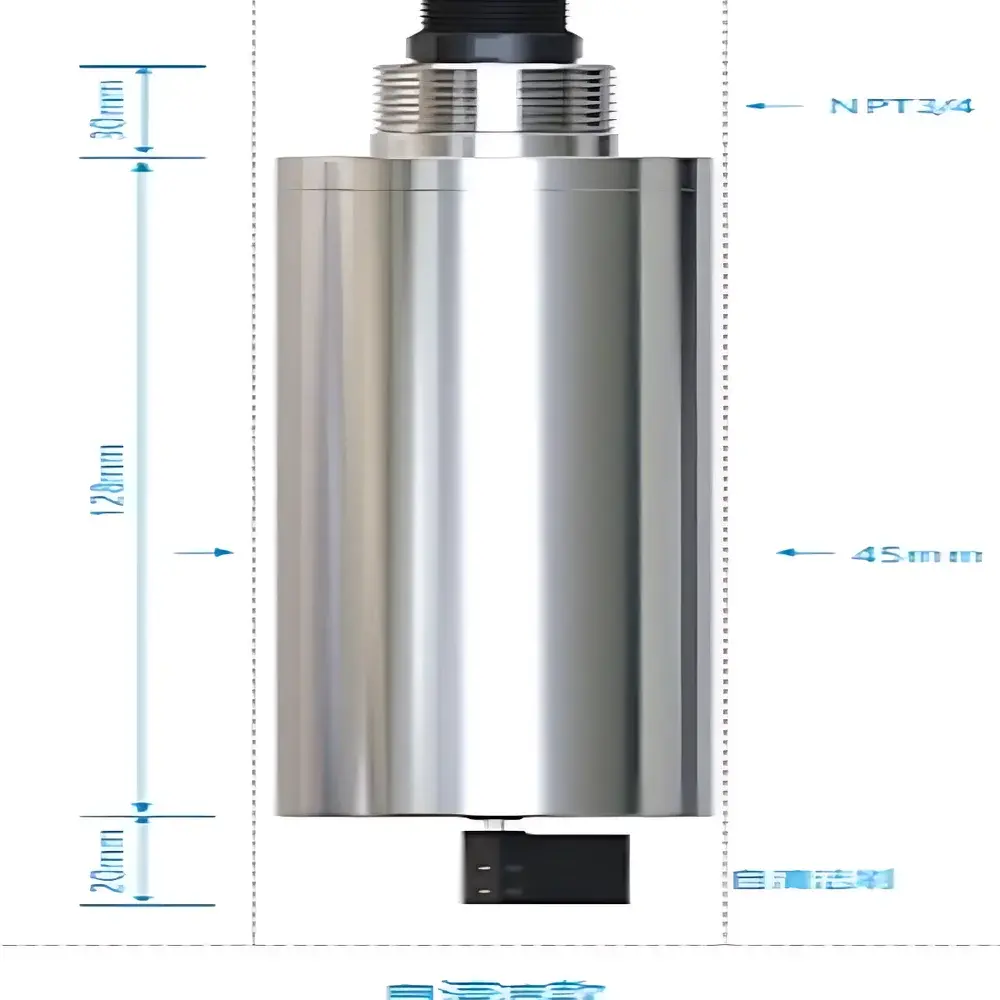
| Housing Material | Stainless Steel (316L) |
| Thread Connection | NPT 3/4" or M39×1.5 |
| Cable Length | 5 m (customizable) |
| Accuracy | ±3% FS |
| Calibration | Zero & Span Calibration |
| IP Rating | IP68 |
| Pressure Rating | 0–3 bar |
| Output Signal | RS485 (MODBUS-RTU) |
Overview
The HengaoDe HAD-ZY89 Smart Digital Oil-in-Water Sensor is an industrial-grade submersible probe engineered for continuous, real-time quantification of hydrocarbon contamination in aqueous environments using ultraviolet (UV) fluorescence spectroscopy. This principle relies on the selective excitation of aromatic hydrocarbons (e.g., benzene, toluene, xylene, and polycyclic aromatic compounds) at characteristic UV wavelengths (typically 254–280 nm), followed by detection of emitted fluorescence in the visible range (300–450 nm). The sensor’s optical path is optimized to minimize interference from turbidity, colored dissolved organic matter (CDOM), and chlorophyll-a—common confounders in natural waters. Designed for deployment in open-channel flow, submerged pipelines, intake reservoirs, and aquaculture systems, the HAD-ZY89 delivers stable, drift-compensated output under variable hydraulic conditions, supporting compliance with environmental monitoring protocols such as EPA Method 1664A and ISO 9377-2 for petroleum hydrocarbons in water.
Key Features
- Stainless steel (316L) housing rated IP68 and pressure-resistant up to 3 bar—suitable for permanent submersion in rivers, lakes, marine intakes, and wastewater effluent channels.
- UV fluorescence detection with factory-calibrated spectral response; optional user-accessible calibration via MODBUS-RTU commands for zero and span verification.
- Integrated temperature sensor (PT1000-class) enabling automatic temperature compensation across 0.0–60.0 °C, critical for maintaining measurement stability in diurnal or seasonal field deployments.
- Minimum fluid velocity requirement of >0.02 m/s ensures representative sampling without sediment accumulation on the optical window—validated per ASTM D3921 for in-situ oil-in-water probes.
- Digital RS485 interface compliant with MODBUS-RTU protocol (slave ID, baud rate, parity configurable), enabling seamless integration into SCADA, PLC, or data logger networks without analog signal degradation.
- Optically sealed quartz window with anti-fouling geometry and optional ultrasonic cleaning interface (add-on module) to extend maintenance intervals in high-biofouling environments.
Sample Compatibility & Compliance
The HAD-ZY89 is validated for use in freshwater, brackish water, seawater (up to 35 ppt salinity), and treated municipal/industrial effluents. It exhibits minimal cross-sensitivity to diesel, gasoline, lubricating oils, and crude oil emulsions within the 0–50 ppm range. While not certified to UL/ATEX for hazardous areas, its design conforms to IEC 61000-6-2 (immunity) and IEC 61000-6-4 (emission) standards for industrial environments. Data integrity meets GLP-aligned practices: all calibration events (timestamped, operator-ID tagged) are logged internally and retrievable via MODBUS register reads. Though not FDA 21 CFR Part 11–compliant out-of-the-box, audit-trail functionality can be enabled through compatible host software supporting electronic signatures and change control.
Software & Data Management
The sensor operates autonomously but interfaces with third-party platforms including Ignition SCADA, LabVIEW, and Python-based telemetry systems via standard MODBUS function codes (0x03 Read Holding Registers, 0x10 Write Multiple Registers). Key registers include real-time oil concentration (ppm), temperature (°C), sensor status flags (e.g., fouling alert, low signal), and calibration metadata. Optional firmware updates support enhanced spectral correction algorithms for site-specific interferent profiles. Raw data export (CSV/JSON) includes UTC timestamps synchronized via host system NTP—enabling traceable time-series analysis aligned with ISO 5725 repeatability and reproducibility requirements.
Applications
- Environmental monitoring: Early detection of pipeline leaks, refinery outfalls, and stormwater runoff contamination in watershed management programs.
- Aquaculture operations: Real-time surveillance of hydrocarbon exposure thresholds for sensitive species (e.g., salmonids, shellfish larvae) per WHO and EU Directive 2008/105/EC environmental quality standards.
- Drinking water source protection: Integration at raw water intakes to trigger alarm protocols when oil concentrations exceed 0.01 ppm—the WHO provisional guideline value for chronic exposure.
- Algal bloom research: Correlative analysis of oil fluorescence signals against chlorophyll-a and CDOM fluorescence to distinguish anthropogenic hydrocarbon inputs from natural organic matter dynamics.
- Industrial pretreatment compliance: Continuous verification of oil/water separator efficiency in food processing, metal finishing, and petrochemical facilities subject to local discharge permits.
FAQ
Does the HAD-ZY89 require periodic lamp replacement?
No. The sensor uses solid-state UV-LED excitation sources with a rated lifetime exceeding 10,000 hours under continuous operation—eliminating consumable lamps and associated recalibration cycles.
Can it measure emulsified oil in high-turbidity wastewater?
Yes. Its dual-wavelength fluorescence ratioing algorithm mitigates scattering effects; however, suspended solids >200 NTU may require inline filtration (50 µm) upstream to maintain optical path clarity.
Is factory calibration traceable to NIST standards?
Calibration is performed using certified mineral oil-in-water reference standards (NIST-traceable SRM 2781 & 2782), with full uncertainty budgets documented in the Certificate of Conformance supplied with each unit.
What is the recommended maintenance interval?
Visual inspection and window cleaning every 3 months in low-fouling applications; quarterly in eutrophic or tidal zones. No internal user-serviceable parts—return-to-factory service available for sensor recalibration or electronics diagnostics.
How does it handle biofilm formation on the optical surface?
The quartz window features a hydrophobic nano-coating that reduces adhesion; for persistent biofouling, the optional ultrasonic transducer module (HAD-ZY89-US) provides non-invasive 40 kHz cleaning pulses every 2 hours—programmable via MODBUS.



