
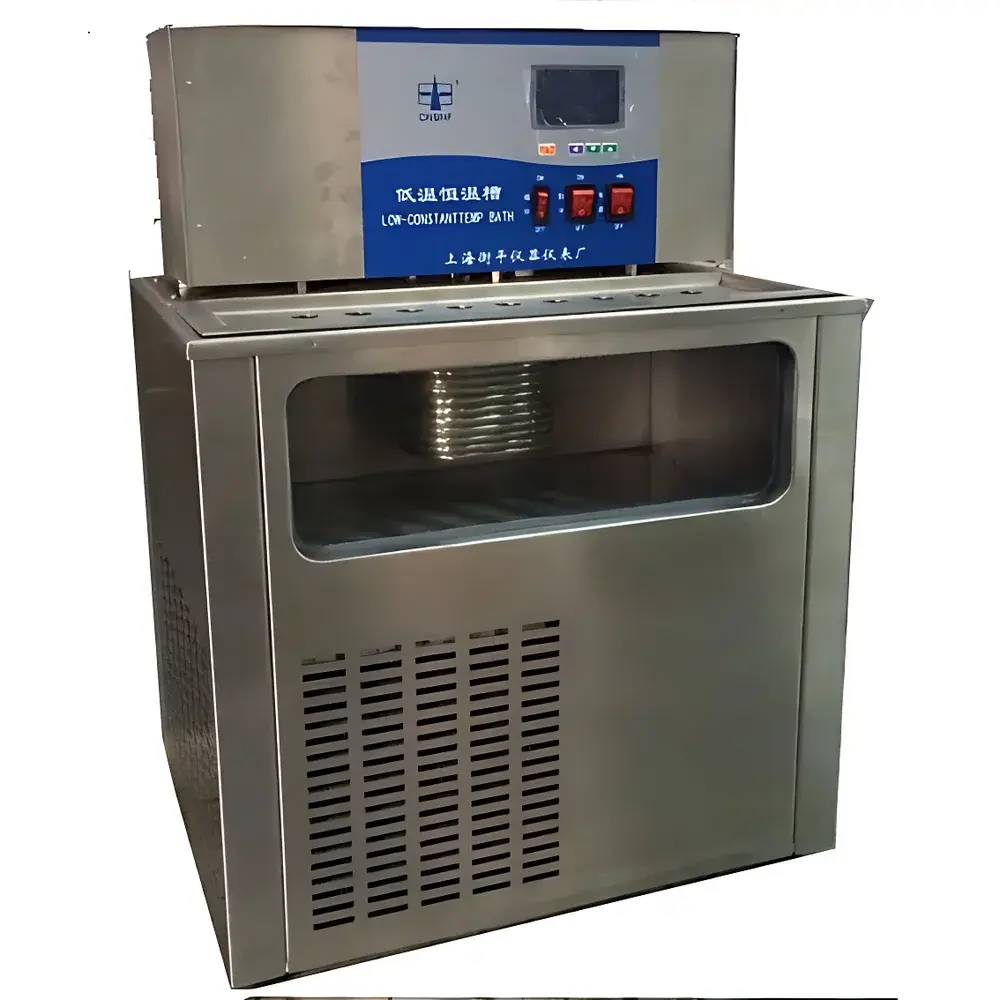
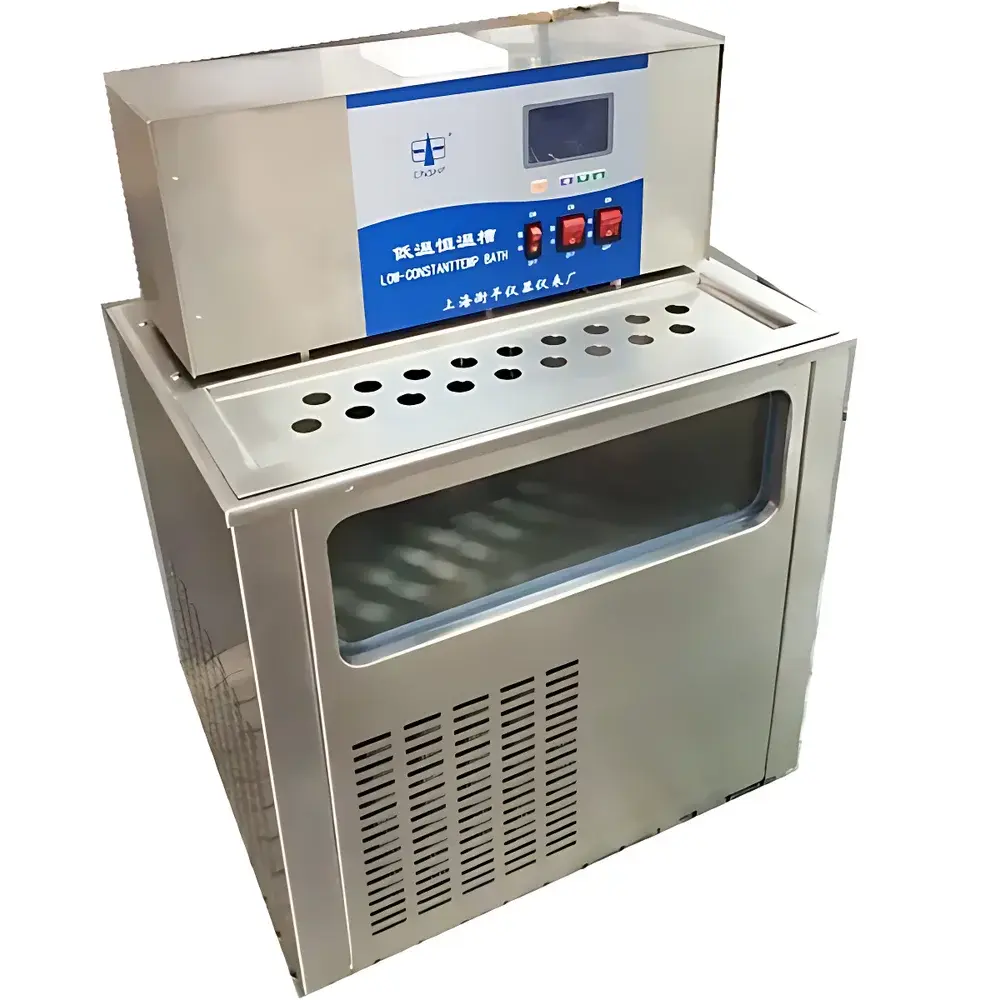
Hengping DC-0520 LCD-Display Cryogenic Thermostat Bath
| Brand | Hengping |
|---|---|
| Origin | Shanghai, China |
| Model | DC-0520 |
| Temperature Range | −80 °C to +100 °C (customizable) |
| Bath Volume | 22 L |
| Temperature Stability | ±0.1 °C |
| Set/Display Resolution | 0.01 °C |
| Heating System | Independent Ni-Cr Alloy Heater |
| Refrigeration | Air-Cooled Single-Stage R134a Compressor |
| Circulation Pump | Stainless Steel Impeller, 40 W |
| Control System | PID Algorithm with LED Digital Display |
| Sensor | Pt100 Platinum Resistance Thermometer |
| Power Supply | 220 V, 50 Hz |
| Dimensions (L×W×H) | 500 × 350 × 660 mm |
| Weight | ~30 kg |
| Construction | SUS304 Stainless Steel Interior, Multi-Layer Insulated Tempered Glass Viewing Panel, Powder-Coated Cold-Rolled Steel Exterior |
| Optional Interfaces | RS232 Serial Port, PC Control Software, Magnetic Stirring Module |
Overview
The Hengping DC-0520 LCD-Display Cryogenic Thermostat Bath is a precision temperature-controlled liquid bath engineered for laboratory and industrial applications requiring stable thermal environments across a wide operational range (−80 °C to +100 °C). It operates on the principle of active dual-mode thermal regulation—combining independent resistive heating and air-cooled compression refrigeration—to maintain setpoint accuracy under dynamic load conditions. The bath employs a microprocessor-based PID controller with real-time feedback from a calibrated Pt100 sensor, ensuring high reproducibility in temperature-sensitive procedures such as reaction kinetics studies, calibration of thermometric standards, viscosity measurements, and stability testing of pharmaceutical formulations. Its transparent multi-layer tempered glass construction enables unobstructed optical access to submerged samples and reaction vessels, supporting visual monitoring of phase transitions, precipitation, colorimetric changes, or fluid dynamics without compromising thermal integrity.
Key Features
- Single-pane optically clear, multi-layer insulated tempered glass viewport with integrated LED illumination for high-contrast internal observation.
- PID-controlled thermal management delivering ±0.1 °C temperature stability over the full operating range; setpoint and actual temperature displayed simultaneously with 0.01 °C resolution.
- SUS304 stainless steel bath interior resistant to corrosion from aqueous, organic, and mildly acidic media—compatible with common solvents including ethanol, glycerol-water mixtures, and silicone oils.
- Integrated recirculating pump (40 W, all-stainless wetted parts) ensures uniform temperature distribution (<0.05 °C axial/radial gradient) and eliminates leakage-prone external tubing configurations.
- Energy-efficient design featuring polyurethane foam insulation on base and rear walls, combined with low-emissivity glass, reducing thermal loss by >40% compared to conventional single-wall baths.
- Dual safety architecture: hardware-based overtemperature cutoff (mechanical thermostat), plus software-monitored sensor fault detection (open/short circuit diagnostics).
- Modular expansion support: optional RS232 interface enables integration into LIMS or automated test systems; optional magnetic stirrer module permits in-bath agitation without external motor mounts.
Sample Compatibility & Compliance
The DC-0520 accommodates standard laboratory glassware up to 500 mL capacity (e.g., beakers, reaction flasks, cuvettes) and supports immersion of probes, sensors, and analytical cells. Its non-reactive SUS304 chamber and inert R134a refrigerant comply with ISO 17025 requirements for equipment used in accredited calibration laboratories. The system meets IEC 61010-1 safety standards for electrical equipment for measurement, control, and laboratory use. While not certified to FDA 21 CFR Part 11 out-of-the-box, audit-ready data logging (via optional PC software) supports GLP/GMP traceability when paired with time-stamped temperature records and user-access logs.
Software & Data Management
The optional RS232 communication interface allows bidirectional control via ASCII command protocol. Compatible Windows-based software provides remote setpoint adjustment, real-time temperature graphing, automatic data export (CSV/TXT), and configurable alarm thresholds. All logged data include timestamps, operator ID fields, and checksum-verified integrity flags—facilitating compliance with ISO/IEC 17025 clause 7.7 (result reporting) and ASTM E2500-13 (verification of automated systems). Firmware updates are delivered via secure USB flash drive; no internet connectivity required during operation.
Applications
- Calibration of thermometers, RTDs, and thermocouples per ASTM E74 and ISO/IEC 17025 Annex A.3.
- Temperature-dependent viscosity testing using rotational viscometers (e.g., Brookfield, Anton Paar) mounted directly above the bath.
- Controlled-rate crystallization studies in pharmaceutical development and polymer science.
- Stability testing of reference materials under ICH Q5C guidelines.
- Thermal conditioning of electronic components prior to environmental stress screening (ESS).
- Supporting electrochemical cell operation at defined temperatures in battery research labs.
FAQ
What is the minimum achievable temperature with the standard DC-0520 configuration?
The base model achieves −5 °C (with water/glycol mixture) or −20 °C (with specialized coolant); extended-range variants down to −80 °C are available upon request with dual-stage compressor upgrade.
Can the bath maintain temperature uniformity with external heat loads, such as immersed electrodes or optical fibers?
Yes—the integrated circulation system and PID tuning compensate for localized thermal perturbations; uniformity remains within ±0.05 °C at steady state even with continuous 5 W power dissipation inside the bath.
Is the RS232 interface compatible with LabVIEW and MATLAB?
Yes—standard SCPI-like ASCII commands enable native integration; driver examples and protocol documentation are provided with the optional software package.
Does the unit meet CE marking requirements for export to the European Union?
The DC-0520 conforms to EN 61010-1:2010+A1:2019 and EN 61326-1:2013 for EMC; CE declaration is supplied with EU-distributed units.
How often does the Pt100 sensor require recalibration?
Per ISO/IEC 17025, annual verification against a NIST-traceable reference thermometer is recommended; drift typically remains <0.02 °C/year under normal laboratory conditions.
Related Products



