
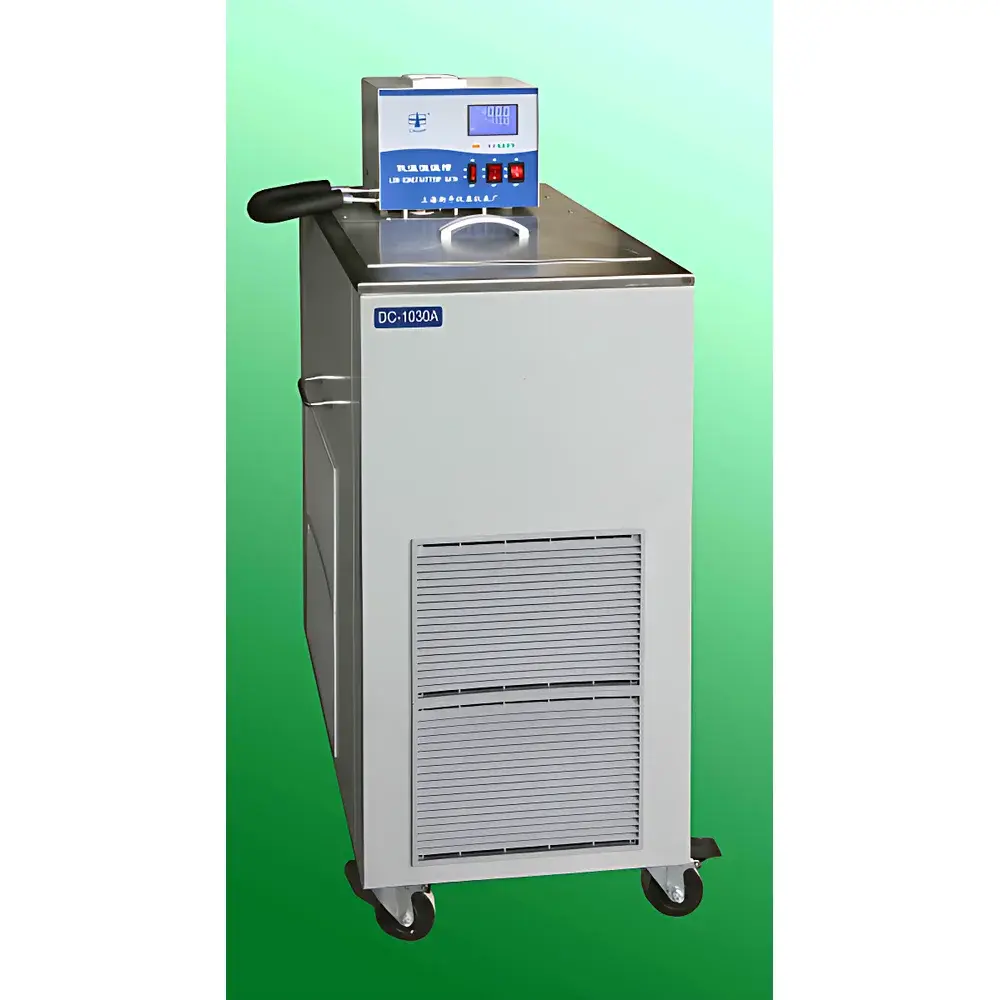
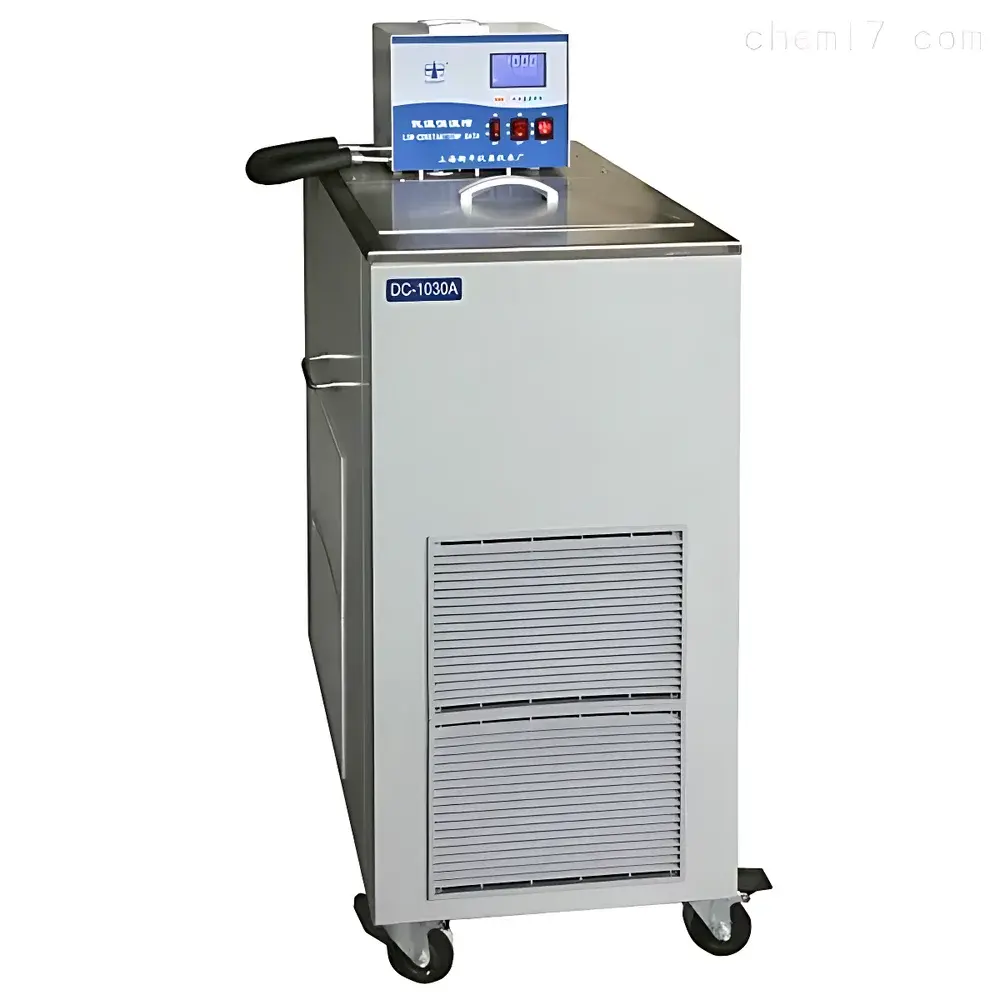
Hengping DC-1030A LCD Display Low-Temperature Constant Temperature Bath
| Brand | Hengping |
|---|---|
| Model | DC-1030A |
| Type | Vertical Cryogenic Thermostat |
| Temperature Stability | ±0.02 °C (at 25 °C, water or ethanol) |
| Display Resolution | 0.01 °C (setpoint), 0.1 °C (actual) |
| Internal Volume | 30 L |
| External Dimensions | 375 × 455 × 740 mm |
| Refrigeration System | Single-stage compressor (R404A/R23 cascade optional for sub–40 °C operation) |
| Circulation | Dual-mode (internal + external), flow rate 10 L/min |
| Temperature Range | –30 °C to 100 °C (medium-dependent) |
| Control | Microprocessor-based PID with auto-tuning |
| Sensor | Pt100 platinum resistance thermometer |
| Construction | SUS304 stainless steel tank and top plate, electrostatically sprayed anti-aging enclosure |
| Power Supply | 220 VAC ±10%, 50 Hz |
| Total Power | 3.0 kW |
| Compliance | Designed for GLP/GMP-aligned lab environments |
Overview
The Hengping DC-1030A is a vertically configured, microprocessor-controlled low-temperature constant temperature bath engineered for high-stability thermal management in demanding laboratory applications. It operates on the principle of active refrigeration combined with precision feedback control—utilizing a Pt100 platinum resistance sensor for real-time temperature monitoring and a self-tuning PID algorithm to maintain setpoint accuracy within ±0.02 °C at 25 °C (with water or ethanol as medium). The unit employs a single-stage hermetic compressor system optimized for rapid cooldown and sustained thermal uniformity across its 30-liter working volume. For extended low-temperature operation below –40 °C, optional cascade refrigeration configurations (R404A/R23) are available—though the DC-1030A standard configuration is rated for –30 °C to 100 °C, accommodating common heat-transfer fluids including deionized water, ethylene glycol/water mixtures, and ethanol. Its thermally insulated, fully foamed housing minimizes parasitic heat exchange, while the dual-mode circulation system (internal recirculation + externally plumbed output) enables both direct sample immersion and remote temperature control of auxiliary equipment such as rotary evaporators, spectrophotometers, or reaction calorimeters.
Key Features
- Precision temperature control with ±0.02 °C stability (25 °C, aqueous/ethanolic medium) and 0.01 °C setpoint resolution
- Large backlit LCD display showing simultaneous setpoint and actual temperature, operational status, and alarm conditions
- Dual-function circulation pump delivering 10 L/min flow for uniform thermal distribution—designed as a low-heat-generation centrifugal type to prevent self-heating artifacts
- Robust mechanical construction: 304 stainless steel tank and top plate, reinforced electrostatically coated steel chassis with R-corner safety geometry
- Integrated safety architecture including over-temperature/under-temperature limits, dry-run protection for heater, compressor overheat and overcurrent cutoffs, sensor open-circuit detection, and automatic power recovery after brownout
- Ergonomic design elements: fold-down side handles, heavy-duty locking casters (standard on ≥20 L units), and removable air-intake grilles for routine condenser maintenance
- Flexible mounting and integration: front-accessible fluid ports, standardized 1/4″ NPT external circulation fittings, and rear-panel I/O for optional communication modules
Sample Compatibility & Compliance
The DC-1030A accommodates a wide range of sample formats—from open-beaker immersion of reference standards and calibration probes to closed-loop thermal conditioning of external apparatus via its dual-port circulation manifold. Its 30 L capacity and 270 × 220 × 270 mm (L × W × D) bath opening support large-volume vessels, multi-probe arrays, and modular instrumentation platforms. All wetted surfaces are fabricated from electropolished 304 stainless steel, ensuring compatibility with pH-neutral to mildly acidic/basic aqueous solutions and common organic solvents (e.g., ethanol, methanol, ethylene glycol blends). The system complies with IEC 61010-1:2010 for laboratory electrical safety and meets CE marking requirements for EMC and low-voltage directives. When equipped with RS485 interface and validated firmware, it supports audit-trail-enabled operation per FDA 21 CFR Part 11 guidelines—enabling secure user authentication, electronic signatures, and immutable parameter-change logging for regulated QC/QA workflows.
Software & Data Management
While the DC-1030A operates autonomously via its embedded microcontroller, optional digital interfaces expand its integration capability. An RS485 port (Modbus RTU protocol) allows bidirectional communication with SCADA systems, LIMS, or custom LabVIEW/Python-based control suites—enabling remote setpoint adjustment, real-time temperature streaming, and alarm event triggering. Optional firmware upgrades support up to 30-segment programmable ramp-soak profiles, with time-stamped execution logging stored internally (non-volatile memory). For regulatory environments, traceable calibration records—including sensor offset verification, stability validation reports, and periodic performance checks—can be exported in CSV format. The unit’s deterministic control loop ensures repeatability across instrument lifecycles, supporting ISO/IEC 17025-compliant uncertainty budgets when used in metrology-grade thermal validation protocols.
Applications
This bath serves as a primary temperature source in analytical, materials, and life science laboratories where thermal consistency directly impacts measurement fidelity. It is routinely deployed for calibrating platinum resistance thermometers (PRTs), thermistors, and liquid-in-glass standards per ASTM E74-22; stabilizing optical components in laser interferometry and CCD cooling systems; maintaining isothermal conditions during viscometry, DSC reference runs, and enzymatic kinetics assays; and providing controlled thermal sinks for semiconductor wafer probing, vacuum chamber shrouds, and MRI cryo-cooling loops. In industrial QA settings, it supports accelerated aging studies (ASTM D3045), rheological testing of polymer melts, and cold-chain validation of medical devices. Its external circulation mode enables precise jacketed-reactor control—widely adopted in API synthesis, catalytic screening, and continuous-flow chemistry platforms.
FAQ
What temperature range is supported by the DC-1030A without optional modifications?
The standard DC-1030A achieves –30 °C to 100 °C using environmentally compliant refrigerants (R404A) and standard heat-transfer media.
Can the unit maintain ±0.02 °C stability across its full temperature range?
Stability specification of ±0.02 °C is validated at 25 °C with water or ethanol; deviation increases marginally at extremes (±0.05 °C typical at –30 °C or 100 °C) due to fluid property changes and ambient load effects.
Is external temperature feedback supported for closed-loop control of peripheral equipment?
Yes—optional extended PT100 probe input enables real-time monitoring and dynamic correction of external system temperature, improving overall thermal regulation fidelity.
Does the DC-1030A meet requirements for GxP-regulated environments?
With RS485 connectivity, validated firmware, and appropriate SOP documentation, it supports 21 CFR Part 11 compliance for electronic records and signatures in pharmaceutical and clinical diagnostics labs.
What maintenance intervals are recommended for optimal long-term performance?
Condenser cleaning every 3–6 months (depending on ambient dust levels), annual verification of Pt100 calibration traceability, and biannual inspection of circulation pump seals and refrigerant charge integrity are advised per manufacturer service guidelines.
Related Products



