
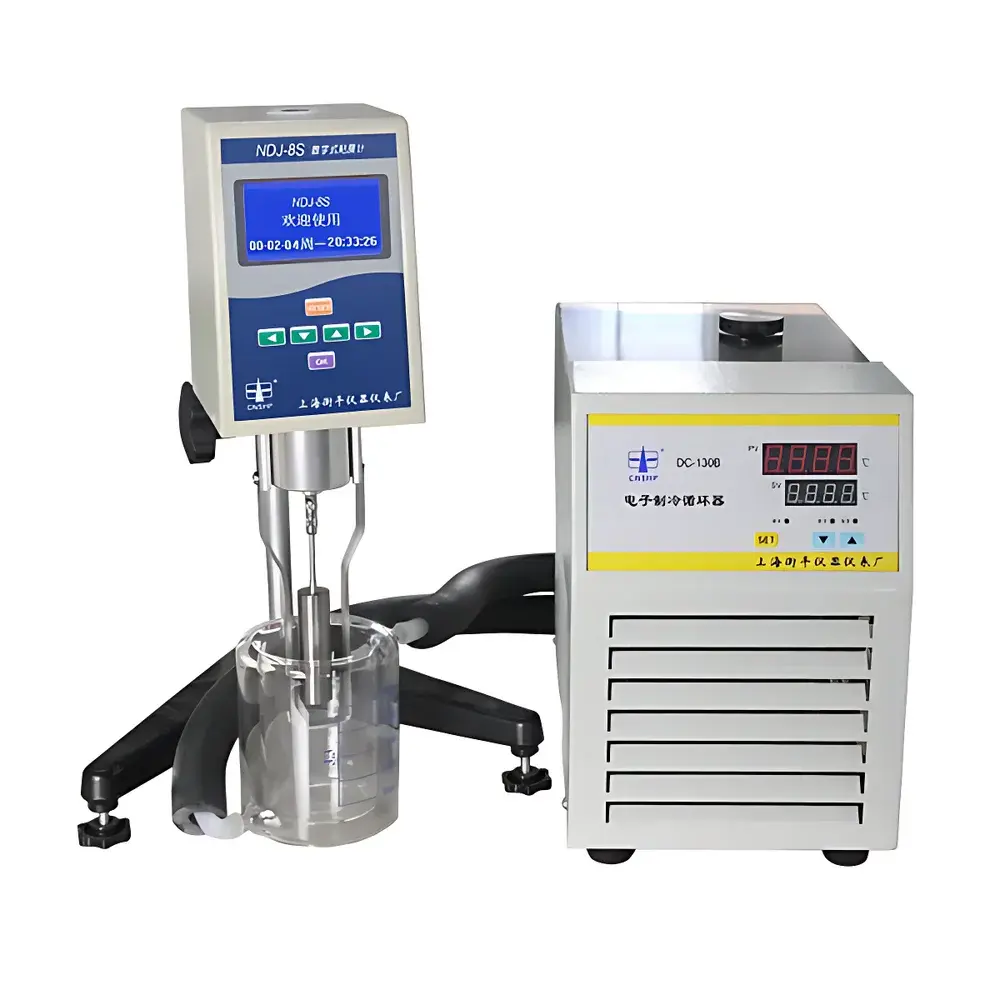
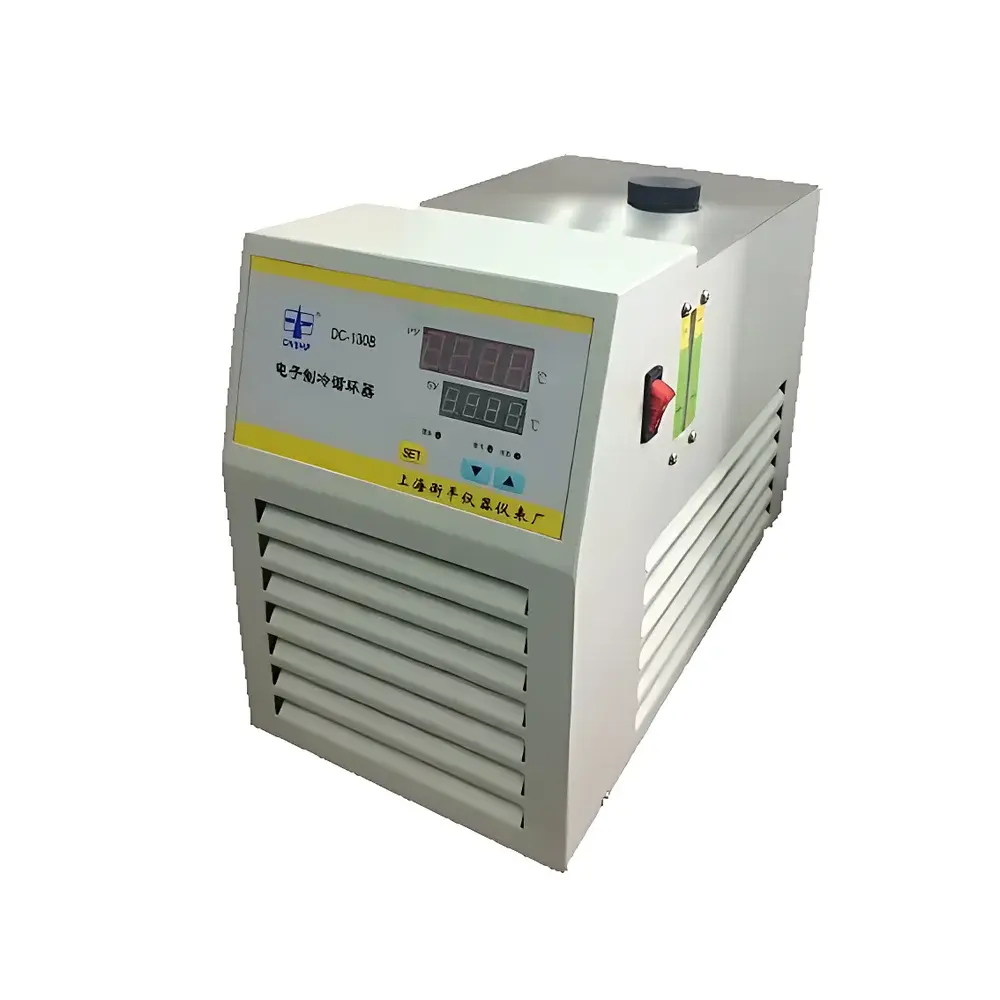
Hengping DC-130B Miniature Semiconductor Circulating Chiller
| Brand | Hengping |
|---|---|
| Origin | Shanghai, China |
| Model | DC-130B |
| Instrument Type | Split-type |
| Cooling Method | Air-cooled |
| Temperature Range | 10–50 °C |
| Refrigeration Capacity | 300 W |
| Temperature Stability | ±0.1 °C |
| Circulation Pressure | 2.0 bar |
| Flow Rate | 4 L/min |
| Reservoir Volume | 0.5 L |
| Operating Mode | Continuous |
Overview
The Hengping DC-130B Miniature Semiconductor Circulating Chiller is a compact, air-cooled temperature control system engineered for precise thermal management of small-scale laboratory instruments requiring stable, low-noise cooling. Unlike conventional compressor-based chillers, the DC-130B employs solid-state thermoelectric (Peltier) modules for refrigeration—enabling rapid thermal response, silent operation, and maintenance-free performance over extended duty cycles. Its microprocessor-controlled dual-channel PID algorithm—auto-tuned for optimal dynamic compensation—ensures high reproducibility across the full 10–50 °C operating range. Designed specifically for integration with benchtop analytical devices such as Abbe refractometers, tensiometers, rotational viscometers, and CCD detectors, the unit delivers consistent heat exchange via forced liquid circulation, establishing a secondary, externally referenced temperature field with minimal thermal lag.
Key Features
- Compact footprint (200 × 200 × 300 mm) optimized for space-constrained lab benches and instrument enclosures
- Thermoelectric refrigeration architecture—zero refrigerant emissions, no mechanical compressor vibration or audible noise
- Dual-channel PID temperature controller with auto-tuning capability; independent display of setpoint and actual temperature (0.1 °C resolution)
- High-stability Pt100 platinum resistance thermometer (PRT) sensor for accurate, drift-resistant feedback
- Integrated circulation pump delivering 4 L/min flow at 2.0 bar pressure—sufficient for closed-loop cooling of low-thermal-mass accessories
- 0.5 L stainless-steel reservoir with corrosion-resistant internal coating and level monitoring
- Comprehensive safety protection: sensor fault detection, upper/lower temperature limit enforcement, and overheat cutoff
- Continuous-duty operation under 220 V ±10%, 50 Hz supply; total power consumption ≤300 W
Sample Compatibility & Compliance
The DC-130B is routinely deployed as an auxiliary thermal management module for instruments sensitive to ambient thermal drift—including optical analyzers (e.g., Abbe refractometers), interfacial property testers (tensiometers), rheological systems (rotational viscometers), and detector assemblies (CCD cameras, photomultiplier housings). Its stable output supports GLP-compliant calibration workflows where temperature-induced measurement bias must be minimized. While not certified to ISO/IEC 17025 or ASTM E2877 for metrological traceability, its ±0.1 °C stability meets typical requirements for method validation in QC laboratories per USP and ISO 17025 Annex A.3. The unit complies with IEC 61010-1:2010 for electrical safety in laboratory equipment and incorporates reinforced insulation and grounding continuity per Class I protection standards.
Software & Data Management
The DC-130B operates as a standalone analog-controlled chiller without embedded digital communication interfaces (e.g., RS-232, USB, or Ethernet). Temperature setpoints and real-time readings are managed exclusively via front-panel membrane buttons and dual LED displays. No proprietary software, drivers, or cloud connectivity are provided. This design prioritizes operational simplicity, electromagnetic compatibility (EMC), and long-term reliability in electromagnetically noisy environments—such as near NMR spectrometers, laser systems, or RF-powered deposition tools. For audit-trail requirements under FDA 21 CFR Part 11 or GMP Annex 11, external data loggers (e.g., calibrated thermocouple-based recorders) may be interfaced via analog voltage output (0–5 V or 4–20 mA optional add-on, not standard).
Applications
- Chemical & Biological Analysis: Temperature stabilization for atomic absorption spectroscopy (AAS), ICP-OES/MS sample introduction systems, NMR probe pre-cooling, rotary evaporator condensers, and CCD-based fluorescence detectors
- Materials Characterization: Thermal conditioning of XRD goniometers, TEM/SEM cold stages, magnetron sputtering targets, and molecular beam epitaxy (MBE) substrate holders
- Physical Sciences: Laser diode temperature control (e.g., Ti:sapphire pump lasers), cryogen-free superconducting magnet support circuits, and vacuum chamber thermal shunts
- Industrial QA/QC: Calibration baths for viscosity standards (ASTM D445), refractive index reference cells (ASTM D1218), and surface tension verification (ASTM D971)
FAQ
Is the DC-130B suitable for use with high-heat-load instruments such as plasma sources or high-power lasers?
No. With a maximum refrigeration capacity of 300 W and a 0.5 L reservoir, the unit is rated for low-to-moderate thermal loads typical of benchtop analytical accessories—not primary cooling for high-wattage instrumentation.
Can the chiller operate below 10 °C or above 50 °C?
No. The thermoelectric module’s efficiency and thermal margin are engineered strictly for the 10–50 °C range. Operation outside this window risks premature Peltier degradation and loss of temperature stability.
Does the unit support external temperature feedback from a user-provided sensor?
No. The DC-130B uses only its internal Pt100 sensor for closed-loop control. External sensor input is not supported in the base configuration.
What maintenance is required during routine operation?
None beyond periodic visual inspection of reservoir fluid level and cleanliness. The sealed thermoelectric stack and brushless DC circulation pump require no scheduled servicing under continuous operation within specified environmental conditions (ambient ≤32 °C, relative humidity <80% non-condensing).



