
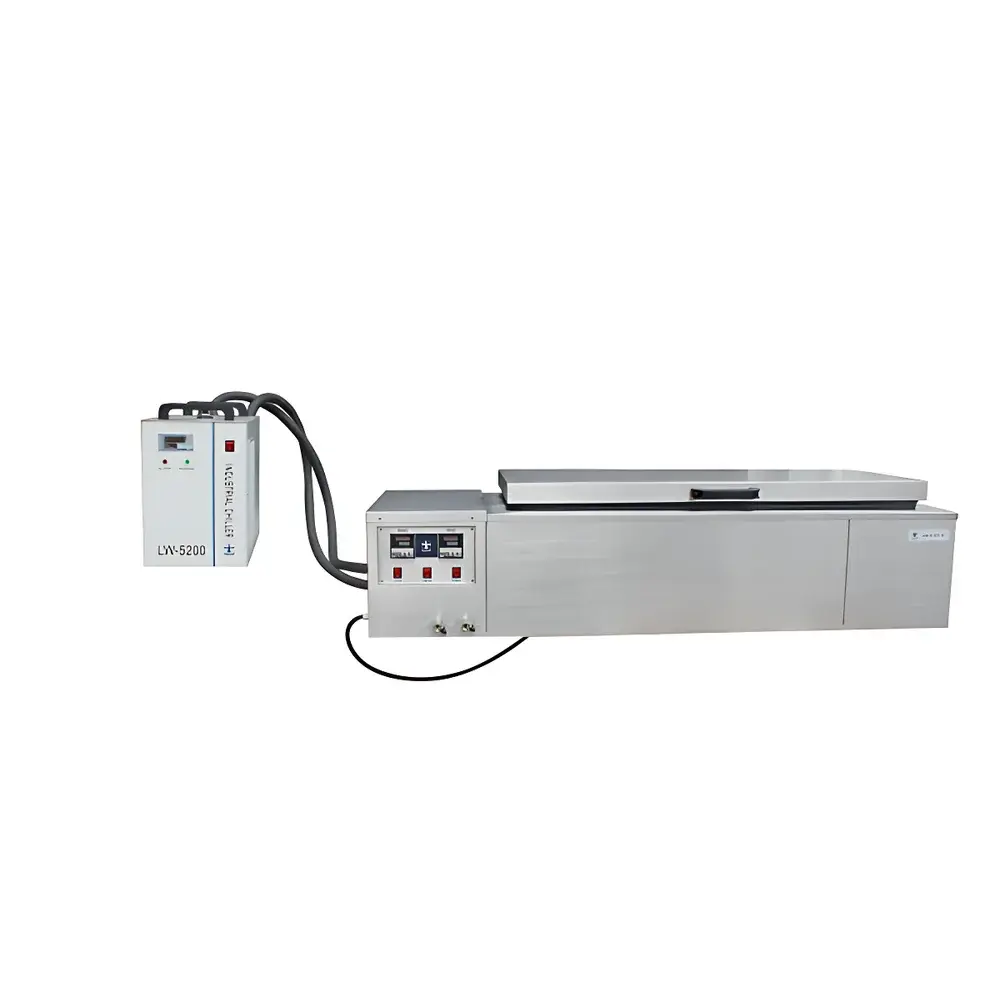
Hengping High-Low Temperature Circulating Bath
| Brand | Hengping |
|---|---|
| Origin | Shanghai, China |
| Model | High-Low Temperature Constant-Temperature Bath |
| Temperature Range | Typically –40 °C to +100 °C (configurable) |
| Temperature Stability | ±0.05 °C |
| Circulation Flow Rate | Up to 20 L/min |
| Bath Volume | 15–50 L (customizable) |
| Control Method | PID Auto-Tuning Digital Controller |
| Display | High-Brightness LED Numeric Display |
| Construction | Full 304 Stainless Steel |
| Cooling Method | Air-Cooled Compressor System |
| Heating Method | Immersed Electric Heater |
| External Circulation Interface | Dual Quick-Connect Fittings (Inlet/Outlet) |
Overview
The Hengping High-Low Temperature Circulating Bath is an engineered thermal control system designed for precise, stable, and repeatable temperature conditioning of external test setups, analytical instruments, or material samples. Operating on the principle of forced liquid circulation—where a thermally conductive silicone oil or water-based coolant is actively pumped through an insulated reservoir and external load—the bath maintains highly uniform thermal fields across demanding laboratory and industrial validation workflows. Unlike static water baths, this circulating design enables direct integration with calorimeters, viscometers, spectrophotometers, reaction blocks, and environmental simulation chambers. Its dual-range capability supports both cryogenic stabilization (down to –40 °C) and high-temperature operation (up to +100 °C), making it suitable for accelerated aging studies, thermal shock pre-conditioning, coefficient of thermal expansion (CTE) measurements, and ASTM D341 viscosity reference calibration.
Key Features
- Full 304 stainless steel construction ensures corrosion resistance, long-term dimensional stability, and compliance with ISO 17025 laboratory infrastructure requirements.
- PID auto-tuning digital temperature controller delivers ±0.05 °C stability under dynamic load conditions, with programmable ramp rates and soak hold functions.
- Air-cooled refrigeration system eliminates dependency on external chilled water utilities—ideal for labs without centralized cooling infrastructure.
- High-flow circulation pump (up to 20 L/min) with pressure-regulated output maintains consistent thermal transfer even when driving extended external loops or high-backpressure accessories.
- Dual quick-connect fluid ports support seamless integration with third-party equipment; optional pressure and flow sensors available for closed-loop feedback control.
- LED numeric display provides real-time setpoint, actual bath temperature, and system status indicators—designed for readability under low-light analytical environments.
Sample Compatibility & Compliance
This circulating bath accommodates a broad spectrum of sample configurations—including immersion probes, jacketed reactors, sensor calibration fixtures, and material test coupons—without requiring sample-specific modifications. It meets mechanical and electrical safety standards per GB/T 22989–2008 (Chinese national standard for constant temperature equipment) and aligns with functional expectations of IEC 61000-6-3 (EMC emission limits) and IEC 61000-6-2 (immunity). While not certified to UL or CE as a standalone medical device, its architecture supports GLP-compliant usage when integrated into validated systems—audit trails, calibration logs, and deviation reporting are enabled via optional RS485/Modbus RTU interface for traceability under FDA 21 CFR Part 11 Annex 11 frameworks.
Software & Data Management
The bath operates autonomously via front-panel controls but includes analog (0–5 V / 4–20 mA) and digital (RS485) interfaces for integration into centralized lab automation platforms. When connected to SCADA or LIMS systems, temperature setpoints, actual readings, alarm states, and runtime diagnostics can be logged at user-defined intervals (1 s to 60 min resolution). Optional PC software provides graphical trend analysis, CSV export, and configurable pass/fail thresholds for automated QC release decisions—supporting routine verification per ISO/IEC 17025 clause 6.4.3 (equipment monitoring).
Applications
- Thermal validation of polymer melt flow indexers and rheometers requiring stable bath temperatures during ASTM D1238/D3835 testing.
- Pre-conditioning of electronic components prior to HALT/HASS screening per JEDEC JESD22-A104.
- Calibration of platinum resistance thermometers (PRTs) and thermocouples across multi-point ITS-90 traceable ranges.
- Stabilization of optical benches and interferometer stages where thermal drift compromises nanometer-level positional accuracy.
- Supporting controlled-rate crystallization experiments in pharmaceutical solid-state development (ICH Q5C).
- Environmental stress screening of automotive connectors and cable assemblies per SAE J2244 and GMW3172.
FAQ
What fluids are compatible with this circulating bath?
Deionized water (for 0–100 °C), 20% ethylene glycol/water mix (for –20 °C to 80 °C), or low-volatility silicone oils (e.g., Dow Corning 200 Fluid, for –40 °C to 100 °C). Avoid halogenated solvents or low-flashpoint hydrocarbons.
Can the bath maintain temperature while pumping against high external backpressure?
Yes—the integrated centrifugal pump sustains rated flow up to 2.5 bar (36 psi) static backpressure, verified per DIN EN 12830 Annex C for environmental test chamber coupling.
Is NIST-traceable calibration documentation available?
Factory calibration certificates (with uncertainty budgets per ISO/IEC 17025) are provided; on-site verification using accredited PRTs is recommended annually or per internal SOP.
Does the unit support remote start/stop and setpoint adjustment?
Yes—via Modbus RTU commands over RS485; discrete I/O terminals also allow dry-contact initiation from PLC or safety interlock circuits.
What maintenance intervals are recommended for the refrigeration system?
Compressor oil and filter-drier replacement every 24 months under continuous operation; condenser coil cleaning quarterly in dust-prone environments.



