
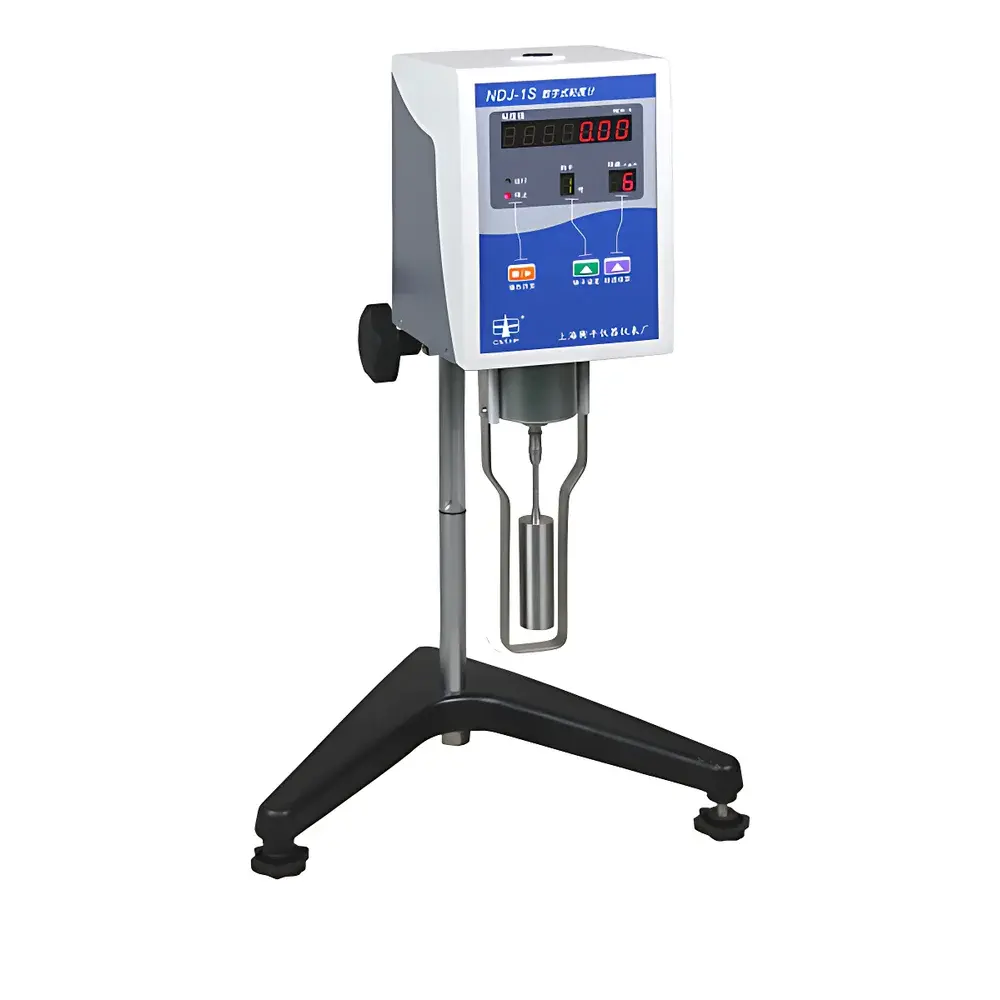
Hengping NDJ-1S Digital Display Rotational Viscometer
| Brand | Hengping |
|---|---|
| Origin | Shanghai, China |
| Model | NDJ-1S |
| Viscosity Range | 1–100,000 mPa·s |
| Standard Spindles | #1–#4 |
| Rotational Speeds | 6, 12, 30, 60 rpm |
| Accuracy | ±2% (for Newtonian fluids) |
| Power Supply | AC 220 V ±10%, 50 Hz ±10% |
| Operating Temperature | 5–35 °C |
| Relative Humidity | ≤80% |
| Dimensions | 380 × 320 × 390 mm |
| Net Weight | 4.5 kg |
| Optional Spindle | #0 (0.1–10 mPa·s) |
Overview
The Hengping NDJ-1S Digital Display Rotational Viscometer is a microprocessor-controlled, coaxial cylinder-type viscometer engineered for precision measurement of dynamic viscosity in both Newtonian and non-Newtonian fluids. Based on the principle of rotational viscometry—where torque required to rotate a spindle at a defined angular velocity within a fluid sample is directly proportional to its shear viscosity—the NDJ-1S delivers stable, repeatable readings under controlled shear conditions. Designed as a direct replacement for analog pointer-type instruments, it eliminates parallax error and mechanical hysteresis through solid-state sensing and digital signal processing. Its compact benchtop architecture integrates a brushless DC motor drive, real-time torque feedback loop, and LED-based display interface optimized for laboratory environments where ease-of-use, operational consistency, and compliance with basic quality control protocols are essential.
Key Features
- Three-button intuitive interface: dedicated keys for spindle selection, speed adjustment, and viscosity readout—enabling rapid method setup without menu navigation.
- High-brightness 4-digit LED display with automatic unit indication (mPa·s or cP), supporting immediate visual verification of measurement status.
- Four standard spindles (#1–#4) covering a broad dynamic range (1–100,000 mPa·s); optional #0 spindle extends low-viscosity capability down to 0.1 mPa·s.
- Fixed-speed operation at four discrete rotational rates (6, 12, 30, 60 rpm), each calibrated per ASTM D2196 and ISO 2555 standards for rotational viscometry.
- Aluminum alloy housing providing mechanical stability, thermal mass buffering, and EMI shielding for improved signal integrity during extended testing cycles.
- Auto-hold function triggers upon torque stabilization, followed by automatic spindle stop—reducing operator intervention and minimizing sample disturbance.
Sample Compatibility & Compliance
The NDJ-1S is suitable for homogeneous liquid samples with moderate volatility and no significant particle loading (>5 µm). It supports routine QC testing of industrial fluids including solvent-based coatings, edible oils, polymer melts (pre-diluted), pharmaceutical suspensions, and surfactant solutions. While not certified for GLP or GMP environments out-of-the-box, its fixed-speed architecture, traceable calibration points, and documented accuracy (±2% for Newtonian reference oils) align with foundational requirements of ISO/IEC 17025-compliant laboratories performing first-tier viscosity verification. Users may implement internal SOPs referencing ASTM D1200 (for automotive paints), ISO 2555 (for polymer solutions), or USP (for topical semisolids) when validating test methods.
Software & Data Management
The NDJ-1S operates as a standalone instrument without proprietary PC software. All measurements are displayed and retained locally on the LED screen until overwritten by subsequent readings. For documentation traceability, users are advised to record values manually or integrate the device into external LIMS or ELN systems via manual entry. Though lacking USB/RS-232 output, its deterministic response time (<2 s to stabilization at 60 rpm) and consistent repeatability support manual audit trails compliant with FDA 21 CFR Part 11 Annex A guidelines for paper-based records. Calibration certificates for individual spindles and speed settings can be generated in-house using NIST-traceable silicone oil standards.
Applications
- Quality assurance of batch consistency in paint, ink, and adhesive manufacturing.
- Routine monitoring of edible oil oxidation state through viscosity drift over shelf life.
- Formulation screening of hydrocolloid blends (e.g., xanthan/carboxymethylcellulose) in food R&D labs.
- Stability assessment of suspension-based pharmaceutical products prior to centrifugation studies.
- Educational use in undergraduate physical chemistry and materials science laboratories for introducing rheological concepts.
FAQ
What spindle should I use for a sample with viscosity ~500 mPa·s?
For optimal accuracy, select spindle #2 at 30 rpm or spindle #3 at 12 rpm—both configurations fall within the mid-range of the instrument’s calibrated torque envelope.
Can the NDJ-1S measure thixotropic behavior?
No—it provides single-point steady-state viscosity values only; time-dependent structural recovery or breakdown requires a programmable rheometer with controlled shear rate ramps and oscillatory modes.
Is temperature control integrated?
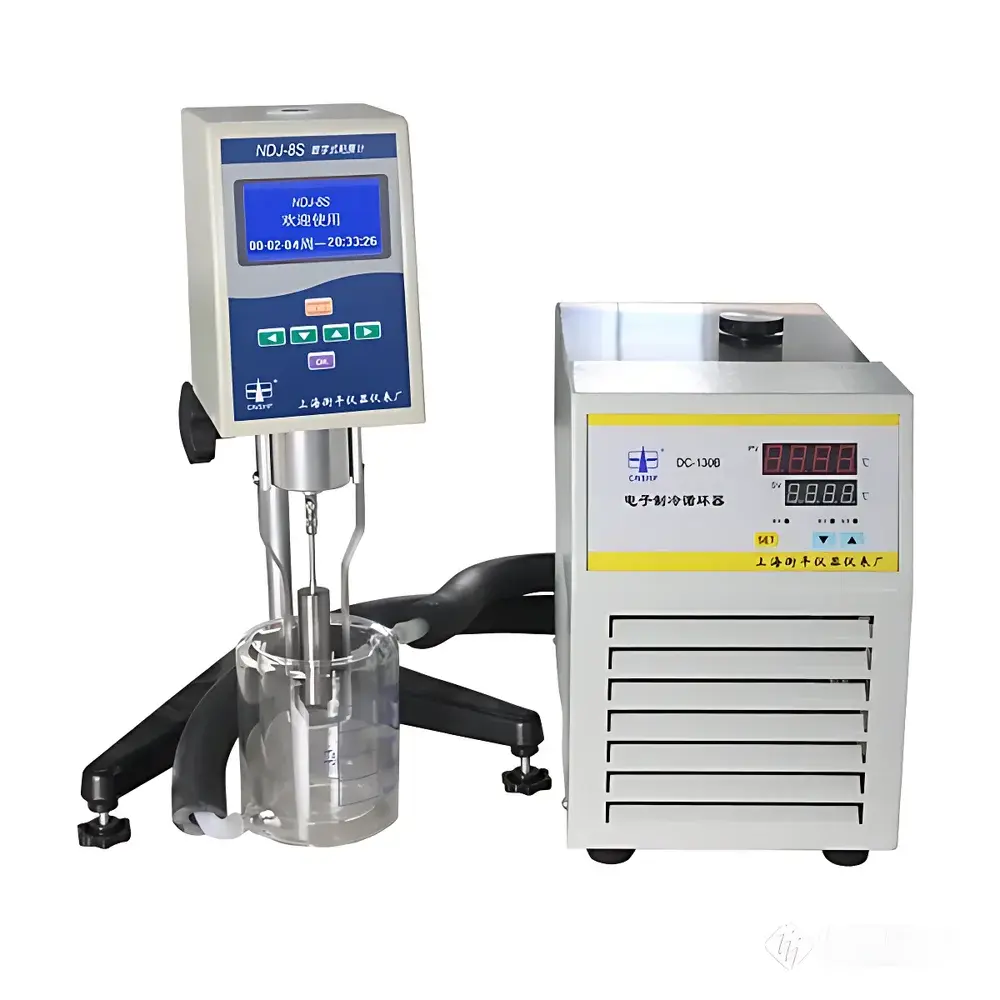
No—external temperature regulation (e.g., water bath or Peltier stage) must be applied to maintain sample thermal stability during measurement, as viscosity is highly temperature-sensitive.
How often should calibration be performed?
Annual verification against certified reference oils is recommended; more frequent checks are advised after mechanical shock, spindle replacement, or when results deviate from historical baselines by >3%.
Does the instrument meet ISO 17025 requirements?
It supports ISO/IEC 17025 implementation when used with documented calibration procedures, environmental controls, and trained personnel—but does not include automated uncertainty calculation or electronic audit trail functionality.



