
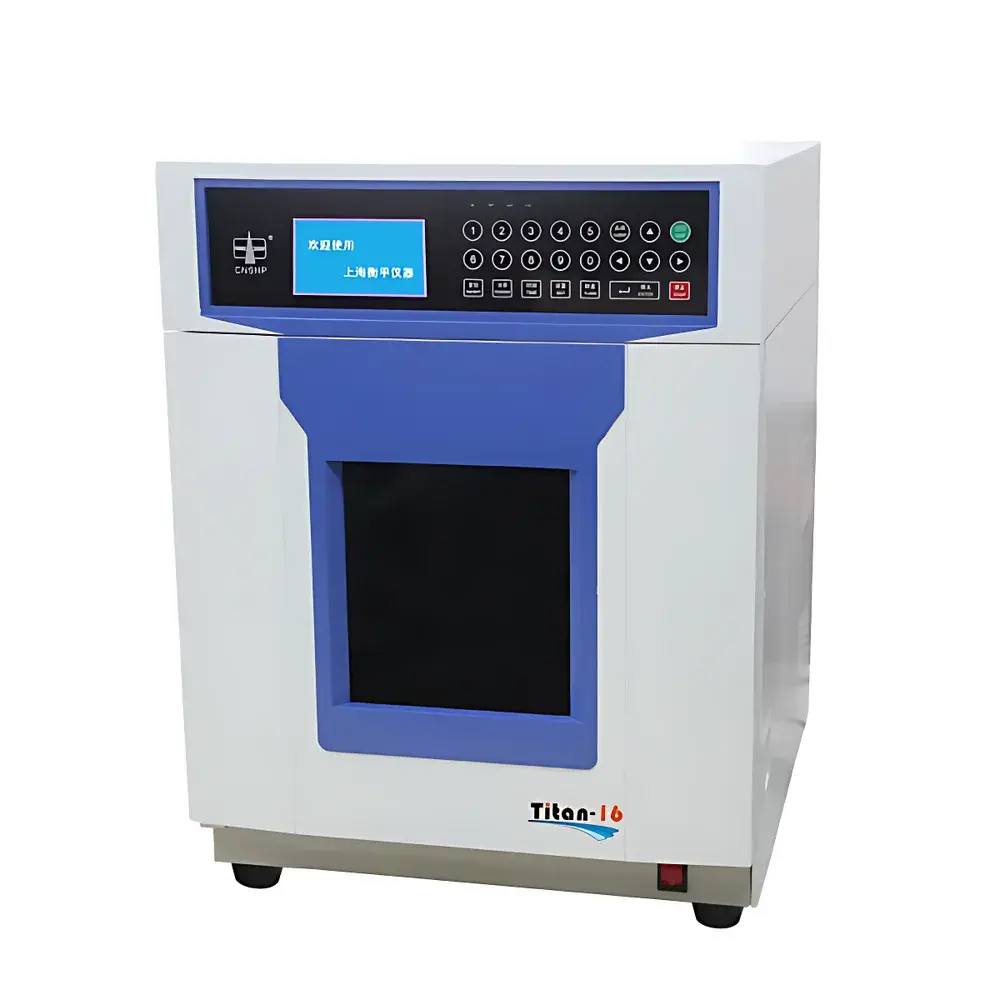
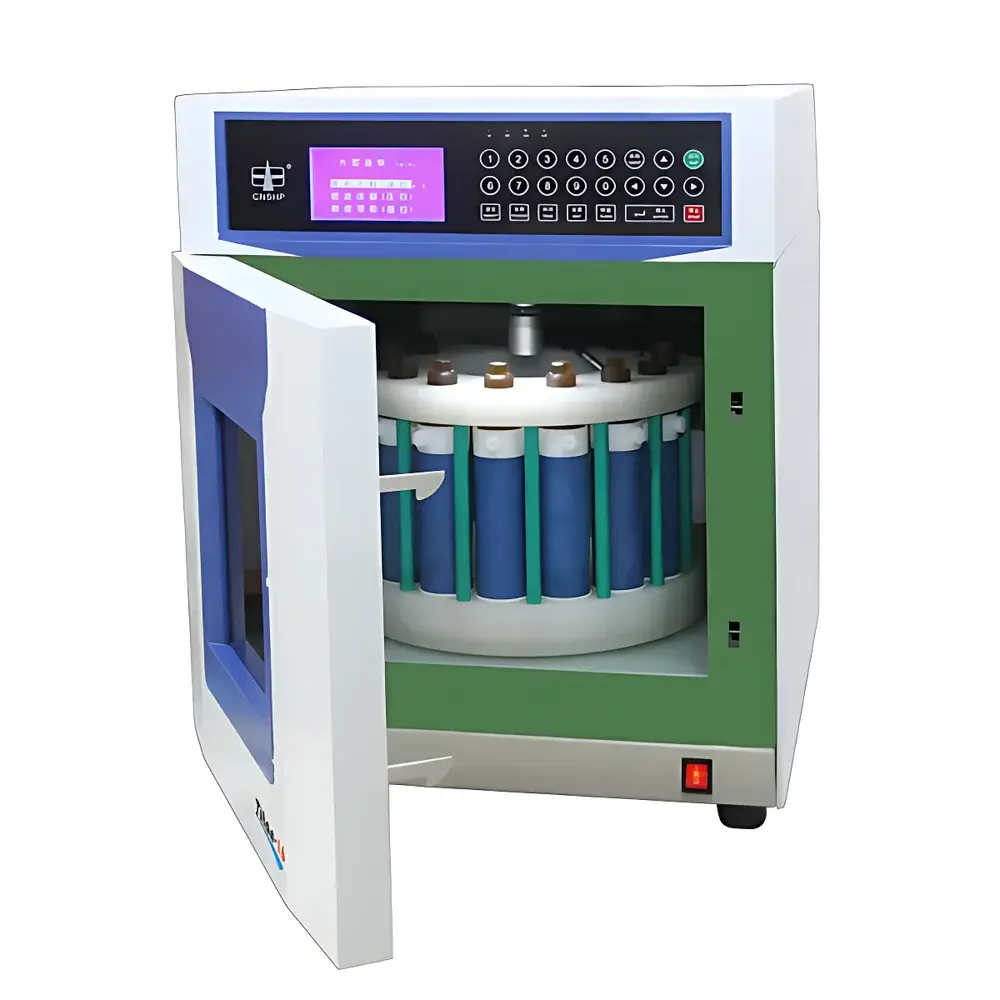
Hengping Titan-16 Sealed Microwave Digestion and Extraction Platform
| Brand | Hengping |
|---|---|
| Model | Titan-16 |
| Origin | Shanghai, China |
| Instrument Type | High-throughput sealed microwave digestion/extraction system |
| Sample Capacity | 16 positions |
| Microwave Source | Dual magnetron (2 × 1000 W) |
| Max Temperature | 300 °C |
| Max Pressure | 15 MPa |
| Cavity Material | 316L stainless steel with 8-layer PFA coating |
| Safety Certification | Integrated active/passive pressure relief, auto-locking door with real-time status monitoring, aerospace-grade composite outer vessels rated to 80 MPa (11,600 psi) |
| Temperature Sensing | Platinum resistance sensor (−40 °C to 500 °C |
| Pressure Sensing | Piezoelectric crystal sensor (0–20 MPa |
| Rotation | Unidirectional continuous rotation |
| Power Supply | 220 VAC ±10%, 50 Hz |
| Dimensions (L×W×H) | 480 × 550 × 630 mm |
| Net Weight | 57 kg |
| Operating Environment | 15–80% RH, ambient temperature up to 50 °C |
Overview
The Hengping Titan-16 Sealed Microwave Digestion and Extraction Platform is an industrial-grade, high-throughput system engineered for trace-element analysis, environmental testing, food safety, pharmaceutical QA/QC, and geological sample preparation. It operates on the principle of controlled microwave energy absorption by polar solvents and ionic matrices—enabling rapid, uniform, and reproducible thermal decomposition under inert, pressurized conditions. Unlike open-vessel or single-magnetron systems, the Titan-16 employs dual 1000 W magnetrons with frequency-modulated non-pulsed output, ensuring stable power delivery across variable load conditions and minimizing thermal gradients within the cavity. Its sealed rotor architecture maintains precise pressure–temperature coupling, critical for complete mineralization of refractory matrices (e.g., silicates, polymers, biological tissues) while suppressing volatile element loss. The platform complies with core method requirements outlined in EPA Method 3052, ISO 15587-1, ASTM D5511, and USP <231>, supporting GLP/GMP-aligned workflows through audit-trail-capable software and hardware-integrated safety interlocks.
Key Features
- Dual-Magnetron Microwave Generation: Two independently regulated 1000 W magnetrons deliver up to 2000 W total output with automatic power modulation—ensuring consistent energy coupling regardless of sample volume, matrix heterogeneity, or vessel loading configuration.
- Aerospace-Grade Composite Outer Vessels: Multi-layer carbon-fiber-reinforced polymer (CFRP) outer vessels fabricated via filament winding and resin infusion—rated to 80 MPa burst pressure and resistant to HF, HNO₃, and aqua regia vapors. Eliminates fiber delamination and acid permeation common in lower-specification fiberglass composites.
- Active–Passive Pressure Management: Dual-stage overpressure protection: (1) Bow-spring elastic pressure module providing quantitative, repeatable pressure release at user-defined thresholds; (2) Self-sealing PTFE–aluminum laminated rupture disc for instantaneous emergency venting. Both mechanisms operate without mechanical wear or calibration drift.
- Unidirectional Continuous Rotor Drive: Precision-engineered alloy turntable rotates continuously in one direction—avoiding torque reversal shock, reducing motor stress, and improving heating uniformity compared to oscillatory or stepwise rotation systems.
- Real-Time Multi-Point Status Monitoring: Dedicated LED indicators on front panel provide immediate visual feedback for door lock integrity, microwave emission status, rotor motion, and keypress registration—each linked to independent hardware-level fault detection circuits that halt operation upon anomaly detection.
- PFA-Coated 316L Stainless Steel Cavity: Eight-layer electrostatically applied perfluoroalkoxy (PFA) coating ensures long-term corrosion resistance against aggressive acid fumes. Top-mounted forced-air exhaust rapidly evacuates condensate and residual vapors, reducing dwell time of corrosive species and extending cavity service life.
Sample Compatibility & Compliance
The Titan-16 accommodates standardized TFM-lined reaction vessels in four rotor configurations (Titan-6, Titan-10, Titan-12, Titan-16), all sharing identical vessel geometry, sealing mechanics, and pressure–temperature rating. Each 100 mL inner vessel is compatible with HNO₃, HCl, HF, H₂O₂, and mixed-acid protocols—including closed-vessel fusion for silicate-rich samples. All vessel assemblies meet ISO/IEC 17025 traceability requirements when used with certified reference materials (CRMs) such as NIST SRM 1643e (trace elements in water) and BCR-667 (marine sediment). The system’s pressure and temperature control architecture satisfies FDA 21 CFR Part 11 data integrity criteria when paired with optional compliant software modules, enabling electronic signatures, change history logging, and role-based access control.
Software & Data Management
Hengping’s proprietary TitanControl™ software provides full instrument orchestration via USB or Ethernet interface. It supports method-driven operation with up to 99 programmable steps per protocol—including ramp-hold-cool sequences, dynamic power adjustment based on real-time sensor feedback, and multi-curve comparative analysis. All temperature and pressure data are timestamped and stored in CSV- and XML-compliant formats suitable for LIMS integration. Audit trails record operator ID, method version, parameter changes, alarm events, and calibration logs—retained for ≥10 years with optional encrypted backup to network drives. Software validation documentation (IQ/OQ/PQ templates) and GxP implementation guides are provided upon request.
Applications
- Environmental analysis: Total metal recovery from soils, sediments, sludges, and airborne particulates (PM₂.₅/PM₁₀ filters) per EPA SW-846 Methods 3050B, 3051A, and 3052.
- Food and agriculture: Determination of heavy metals (Pb, Cd, As, Hg) in cereals, dairy, seafood, and infant formula in accordance with EU Commission Regulation (EC) No 1881/2006 and AOAC 999.11.
- Clinical and forensic toxicology: Digestion of hair, nails, and tissue biopsies for ICP-MS quantification of essential/toxic elements.
- Geochemical exploration: Rapid dissolution of igneous and metamorphic rocks prior to XRF or ICP-OES analysis.
- Materials science: Leaching studies of catalysts, battery cathodes, and nanomaterials under controlled oxidative/reductive conditions.
FAQ
What safety certifications does the Titan-16 hold?
The Titan-16 conforms to IEC 61000-6-3 (EMC emissions), IEC 61000-6-2 (immunity), and IEC 61010-1 (safety requirements for laboratory equipment). Its pressure containment design exceeds ISO 15587-1 mechanical integrity benchmarks and has undergone third-party verification for 15 MPa sustained operation.
Can the Titan-16 be integrated into an automated sample prep line?
Yes—via RS-232 or Modbus TCP interfaces, the Titan-16 supports handshake protocols with robotic autosamplers and LIMS middleware. Optional dry-run simulation mode enables method validation without consumables.
Is HF-compatible digestion supported?
Fully supported. All wetted components—including inner vessels (TFM), sealing gaskets (FFKM), and outer composite sleeves—are chemically resistant to hydrofluoric acid concentrations up to 10% v/v at temperatures ≤220 °C.
How is temperature calibrated and verified?
Each unit ships with NIST-traceable calibration certificates for both platinum resistance thermometer (PRT) and piezoelectric pressure transducer. In-field verification uses external reference probes compliant with ASTM E74 and ISO/IEC 17025 procedures.
What maintenance intervals are recommended?
Routine inspection of door seals, waveguide cover, and exhaust filter every 200 operating hours; full cavity cleaning and PFA coating integrity check every 12 months; magnetron performance validation annually or after 5000 h cumulative runtime.



