
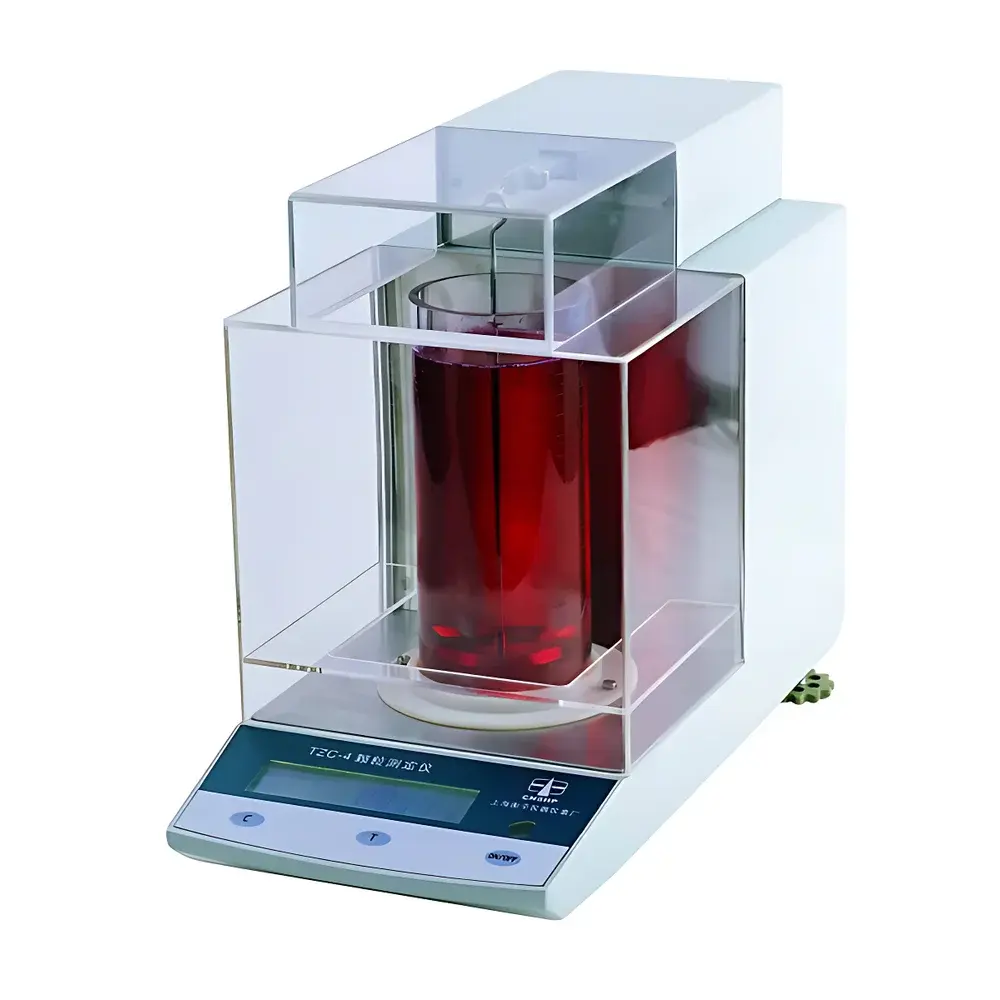
Hengping TZC-4 Sedimentation Balance Particle Size Analyzer
| Brand | Hengping |
|---|---|
| Origin | Shanghai, China |
| Model | TZC-4 Particle Size Analyzer |
| Dispersion Method | Wet Dispersion |
| Measurement Range | 1–260 µm |
| Repeatability | <1% |
| Measurement Time | 10 minutes |
| Maximum Capacity | 100 g |
| Readability | 1 mg |
| Particle Analysis Outputs | Sedimentation curve, D50 (median diameter), mean particle size, specific surface area, distribution histogram, error estimation |
Overview
The Hengping TZC-4 Sedimentation Balance Particle Size Analyzer is a precision instrument engineered for granulometric analysis of solid particulates based on the physical principle of gravitational sedimentation in liquid media. Unlike laser diffraction or dynamic light scattering systems, the TZC-4 implements a classical Stokes-based sedimentation method—measuring the time-dependent mass accumulation of settling particles on a high-resolution analytical balance. This approach provides direct, calibration-free determination of particle size distribution (PSD) for materials where optical opacity, irregular morphology, or high density preclude reliable optical characterization. The system integrates a microprocessor-controlled electronic balance (100 g capacity, 1 mg readability) with real-time data acquisition software to record cumulative sediment mass versus settling time, then computes equivalent spherical diameters using validated sedimentation kinetics models derived from Stokes’ law and empirical correction factors for hindered settling and particle shape effects.
Key Features
- Gravimetric sedimentation measurement principle—ideal for opaque, dense, or non-spherical powders unsuitable for laser-based techniques
- Automated real-time sedimentation curve acquisition with timestamped mass logging at configurable intervals
- Dual-range particle sizing capability: standard 1–160 µm mode; extended range up to 260 µm (optional calibration protocol)
- Integrated balance functions: auto-zeroing, internal calibration, tare compensation, and overload alerting
- Comprehensive post-processing algorithms for D10/D50/D90 calculation, specific surface area estimation (via volume-surface equivalence), and statistical dispersion metrics
- Thermally stabilized measurement chamber to minimize convection-induced artifacts during long-duration sedimentation runs
Sample Compatibility & Compliance
The TZC-4 accommodates a broad spectrum of industrial particulate materials including metal powders (e.g., sintered iron, tungsten carbide), ceramic precursors, cement clinker, coal fly ash, pigment dispersions, pharmaceutical excipients, refractory aggregates, and abrasive grits. Its wet-dispersion design requires compatibility with aqueous or low-viscosity organic suspending media (e.g., ethanol, isopropanol), with optional surfactant integration for deagglomeration. While not certified to ISO 13321 (sedimentation methods) or ASTM D1894 (sedimentation rate testing) out-of-the-box, the instrument’s operational methodology aligns with the foundational principles outlined in these standards. Data traceability supports GLP-compliant workflows when paired with user-defined audit trails and electronic signature protocols within the host laboratory information management system (LIMS).
Software & Data Management
The proprietary Windows-based acquisition and analysis suite enables synchronized control of balance communication, environmental parameter logging (temperature, viscosity input), and multi-sample batch processing. All raw sedimentation curves are stored in ASCII-compatible format for third-party statistical analysis. Reporting modules generate ASTM-compliant PSD tables, cumulative distribution plots, and histogram overlays with customizable binning. Export options include CSV, PDF, and EMF vector graphics. Audit trail functionality records operator ID, timestamp, instrument configuration, and manual intervention events—facilitating 21 CFR Part 11 readiness when deployed in regulated QA/QC environments with supplementary procedural controls.
Applications
- Quality assurance of metallurgical powders in additive manufacturing feedstock qualification
- Batch-to-batch consistency monitoring of cement fineness per ASTM C204
- Particle size profiling of fluorescent phosphors for display device R&D
- Evaluation of grinding efficiency in mineral processing circuits
- Teaching laboratory implementation for undergraduate courses in colloid science and powder technology
- Regulatory documentation support for pharmaceutical excipient particle characterization under USP <429>
FAQ
What physical principle does the TZC-4 employ for particle sizing?
It uses gravitational sedimentation kinetics governed by Stokes’ law, correlating settling velocity to equivalent spherical diameter in a Newtonian fluid medium.
Can the TZC-4 measure nanoparticles below 1 µm?
No—Brownian motion dominates below ~1 µm, invalidating Stokes-based assumptions; alternative techniques such as DLS or TEM are recommended for submicron analysis.
Is temperature control integrated into the system?
The instrument operates at ambient laboratory temperature; users must manually input suspension fluid viscosity and temperature for accurate Stokes corrections.
Does the system support GMP-compliant reporting?
Yes—when configured with user authentication, electronic signatures, and change-controlled software versions, it meets foundational requirements for regulated environments.
How is sample dispersion achieved?
Wet dispersion via ultrasonic bath pretreatment or mechanical stirring prior to introduction into the sedimentation column; no in-line disperser is included.



