
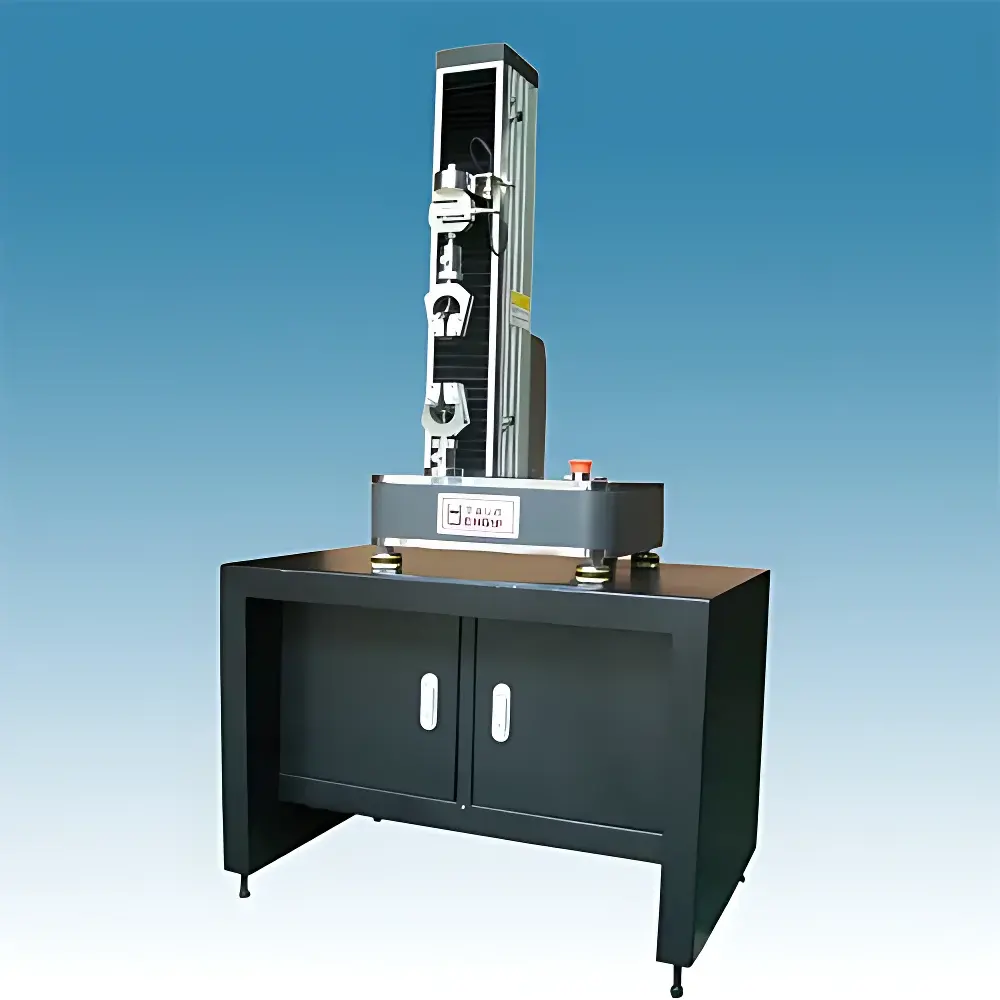
Hengyi HY-0350YU Lithium-Ion Battery Separator Puncture Resistance Tester
| Brand | Hengyi / Hengyitest |
|---|---|
| Origin | Shanghai, China |
| Manufacturer Type | Direct Manufacturer |
| Regional Category | Domestic (China) |
| Model | HY-0350YU |
| Instrument Type | Electromechanical Tensile Testing Machine |
| Maximum Test Load | 3 kN |
| Force Measurement Range | 0.001–100% FS |
| Force Accuracy | ±0.5% |
| Travel Distance | 500 mm |
| Displacement Resolution | 0.001 mm |
Overview
The Hengyi HY-0350YU Lithium-Ion Battery Separator Puncture Resistance Tester is a precision electromechanical testing system engineered for quantitative mechanical evaluation of microporous polyolefin separators used in commercial and high-energy-density lithium-ion batteries. It operates on the principle of controlled quasi-static penetration: a standardized hemispherical probe (Ø1.0 mm, R = 0.5 mm) is driven at a defined crosshead speed through a clamped separator specimen, and the peak force required to fully penetrate the membrane is recorded as the puncture resistance value (in N). This measurement directly correlates with the separator’s ability to resist mechanical failure induced by electrode surface asperities or lithium dendrite propagation—critical failure modes linked to internal short circuits, thermal runaway, and safety incidents. Unlike tensile strength alone, puncture resistance reflects real-world multiaxial stress states encountered during cell assembly, cycling, and abuse conditions. The system complies with the mechanical test requirements specified in GB/T 36363–2018 (“Polyolefin Separators for Lithium-Ion Batteries”) and supports full traceability under GLP-aligned workflows.
Key Features
- High-fidelity force measurement architecture with ±0.5% accuracy across the full 0.001–3 kN range, certified per ISO 7500-1 Class 0.5
- Digital servo control system with imported brushless motor and planetary gear reducer, enabling precise velocity regulation from 0.001 to 500 mm/min (±0.5% speed accuracy)
- Optical encoder-based displacement sensing with 0.001 mm resolution and ±0.5% linearity over 500 mm travel
- Dedicated puncture fixture set: ASTM/GB-compliant hemispherical probe (Ø1.0 mm, R = 0.5 mm) mounted on rigid load-cell-integrated holder; parallel pneumatic clamping ensures uniform sample pre-tension without slippage
- Modular auxiliary fixture interface supporting peel (GB/T 2792–2014), tensile (ASTM D882), tear (ISO 6383), and low-cycle fatigue configurations
- Integrated electronic limit protection, overload cutoff (>110% FS), and real-time diagnostic monitoring of drive current, voltage, and thermal load
Sample Compatibility & Compliance
The HY-0350YU accommodates standard separator specimens (typically 100 × 100 mm) and extends to thin films, nonwovens, metallized foils, medical adhesives, and laminated packaging materials (e.g., PET/Al/PE composites). All test protocols adhere to internationally recognized standards including GB/T 36363–2018 (separator puncture), GB/T 2792–2014 (peel strength), ASTM D882 (tensile properties of thin plastics), ISO 527-3 (plastics—tensile testing—films and sheets), and ISO 11339 (puncture resistance of packaging films). Data audit trails—including operator ID, timestamp, calibration certificate reference, and raw force-displacement curves—are retained in accordance with FDA 21 CFR Part 11 requirements when paired with validated software configuration.
Software & Data Management
The system employs a proprietary 32-bit ARM9-based controller with 24-bit analog-to-digital conversion and optically isolated USB 2.0 communication—eliminating ground-loop interference and supporting hot-plug reliability. The Windows-native testing software provides automated parameter calculation per ISO 527 and ASTM D882: puncture force (N), puncture energy (mJ), tensile strength (MPa), elongation at break (%), Young’s modulus (MPa), yield point, and secant modulus. Raw data exports to CSV, Excel, and XML formats; graphical overlays support comparative analysis across batches or material grades. Audit logs record all user actions, method changes, and calibration events with digital signature capability. Optional IQ/OQ documentation packages are available for GMP-regulated battery manufacturing environments.
Applications
- Quality control of dry-process and wet-process polypropylene/polyethylene separators during incoming inspection and release testing
- Development validation of ceramic-coated, PVDF-modified, or aramid-reinforced separators for enhanced dendrite resistance
- Comparative assessment of aging effects (thermal, humidity, electrolyte immersion) on mechanical integrity
- Failure mode analysis following overcharge, crush, or nail penetration abuse tests in cell-level safety studies
- Regulatory submission support for UN 38.3, IEC 62619, and UL 1642 certification dossiers
- Cross-functional R&D collaboration between battery materials scientists, cell engineers, and safety compliance teams
FAQ
What probe geometry is used for separator puncture testing per GB/T 36363–2018?
A hemispherical probe with 1.0 mm diameter and 0.5 mm radius is standard. The HY-0350YU includes this probe pre-mounted and calibrated.
Can the system perform both puncture and peel tests without hardware reconfiguration?
Yes—the modular fixture interface allows rapid swapping between puncture, 180° peel, and tensile grips; no recalibration is required between test modes.
Is force calibration traceable to national metrology institutes?
All systems ship with a factory calibration certificate traceable to CNAS-accredited standards; optional UKAS/NIST-traceable calibration kits are available.
Does the software support multi-user role-based access control?
Yes—administrator, operator, and reviewer roles can be assigned with configurable permissions for method editing, test execution, and report approval.
What environmental conditions are recommended for optimal test repeatability?
Testing should be conducted at 23 ± 2 °C and 50 ± 5% RH per GB/T 2918; the system includes ambient condition logging capability when integrated with external sensors.



