
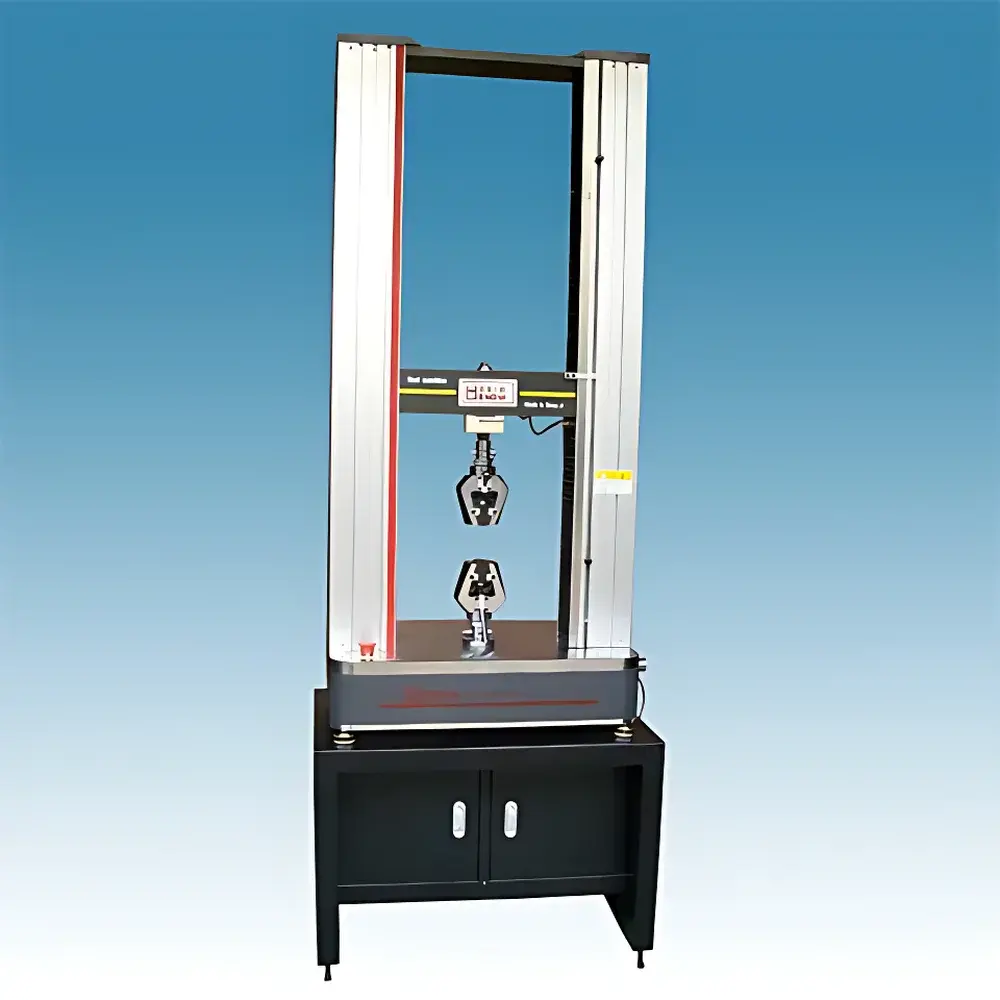
Hengyi HY-0580 Dual-Arm Computer-Controlled Electromechanical Fatigue Testing Machine
| Brand | Hengyi / Hengyitest |
|---|---|
| Origin | Shanghai, China |
| Manufacturer Type | Direct Manufacturer |
| Country of Origin | China |
| Model | HY-0580 (Dual-Arm) |
| Load Capacity | 5000 N |
| Accuracy Class | 0.5 |
| Effective Test Width | 380 mm |
| Effective Test Height | 800 mm |
| Speed Range | 1–500 mm/min |
| Speed Accuracy | ±0.5% of reading |
| Displacement Accuracy | ±0.5% of reading |
| Strain Measurement Accuracy | ±0.5% of reading |
| Dynamic Frequency Range | 0.01–200 Hz |
| Maximum Sampling Rate | 10,000 Hz |
| Waveform Options | Sine, Triangle, Square, Ramp, Trapezoidal, User-Defined |
| Power Supply | 220 V AC, 50 Hz, 1500 W |
| Host Weight | 180 kg |
| Dimensions (W×D×H) | 680 × 400 × 1420 mm |
| Operating Temperature | 10–35 °C (≤2 °C/h fluctuation) |
| Relative Humidity | <80% RH |
| Electromagnetic Interference | Minimal environment required |
Overview
The Hengyi HY-0580 Dual-Arm Computer-Controlled Electromechanical Fatigue Testing Machine is a precision-engineered dynamic mechanical testing system designed for high-reproducibility cyclic loading and fatigue life evaluation of small- to medium-scale specimens. Unlike hydraulic or servo-hydraulic systems, this machine employs a direct-drive linear motor actuator mounted in an upper-positioned configuration—eliminating the need for hydraulic fluid, lubricants, or pneumatic components. This electromechanical architecture ensures clean, quiet, low-maintenance operation while delivering precise force control across a broad frequency spectrum (0.01–200 Hz). The dual-column rigid frame provides structural stability during high-frequency dynamic tests, minimizing parasitic vibrations and ensuring accurate load transmission. Compliant with GB/T 2611–2007 (General Technical Requirements for Testing Machines) and JB 9397–2002 (Technical Specifications for Tension-Compression Fatigue Testing Machines), the HY-0580 supports static tensile, compressive, flexural, shear, peel (90°/180°), tear, adhesion, and elongation measurements—making it suitable for R&D validation, quality assurance, and regulatory compliance testing in materials science laboratories.
Key Features
- Dual-arm, dual-column structural design with T-slot test table for versatile fixture mounting and enhanced lateral rigidity
- Linear motor actuation system offering zero-backlash motion, no oil contamination risk, and inherent energy efficiency
- Full-scale force resolution of ±30,000 counts without range switching—ensuring consistent resolution from 0.1% to 100% of 5000 N capacity
- Real-time data acquisition at up to 10,000 Hz, enabling accurate capture of transient deformation responses and hysteresis loops
- Multi-waveform generation capability—including sine, triangle, square, ramp, trapezoidal, and user-defined waveforms—for simulating real-world service conditions
- Integrated electronic limit protection, overload cutoff (>110% full scale), auto-diagnostic routines for drive/control subsystems, and emergency stop circuitry
- Motorized crosshead with dual-speed (fast/slow) positioning and programmable return-to-start functionality
- Self-calibrating load cell, automatic zeroing, and displacement compensation algorithms to maintain metrological integrity over extended test campaigns
Sample Compatibility & Compliance
The HY-0580 accommodates specimens ranging from biomedical elastomers and hydrogels to polymer films, textile fibers, composite laminates, metallic foils, and thin-sectioned orthopedic implants. Its 380 mm effective test width and 800 mm vertical travel enable standardized testing of ASTM D412 (rubber tension), ASTM D638 (plastics tensile), ISO 527 (tensile properties of plastics), ISO 179 (impact resistance), ISO 1421 (rubber tear), and EN 1392 (textile seam strength). The system supports GLP-compliant workflows through audit-trail-enabled software logging, timestamped raw data export (CSV, ASCII), and user-access-level controls aligned with FDA 21 CFR Part 11 principles. All mechanical and electrical safety designs conform to IEC 61000-6-2 (immunity) and IEC 61000-6-4 (emission) standards for laboratory-grade instrumentation.
Software & Data Management
The proprietary Windows-based control software provides closed-loop PID regulation of force, displacement, or strain, with real-time graphical display of load vs. time, stress vs. strain, hysteresis loops, and cycle-count progression. Users can define multi-step test protocols—including hold periods, ramp rates, amplitude modulation, and conditional termination triggers (e.g., cycle count, specimen failure, displacement threshold). Raw datasets are stored with metadata (operator ID, calibration date, environmental logs) and support post-test analysis: modulus calculation, fatigue life curve (S–N) fitting, crack growth rate estimation (da/dN), and statistical summary reporting. Export formats include PDF test reports, Excel-compatible tabular outputs, and image snapshots of live plots—all traceable to instrument serial number and firmware revision.
Applications
- High-cycle fatigue characterization of polymeric biomaterials under physiological loading frequencies (0.5–5 Hz)
- Cyclic peel adhesion testing of medical device packaging per ISO 8553
- Dynamic mechanical analysis (DMA) of thermoplastic elastomers across temperature-controlled stages (when integrated with environmental chamber)
- Creep-recovery and stress-relaxation profiling of viscoelastic soft tissues and hydrogels
- Interfacial bond durability assessment in fiber-reinforced composites and adhesive joints
- Quality conformance testing for automotive interior trim, wearable electronics substrates, and flexible printed circuits
- Academic research in polymer physics, biomechanics, and nanocomposite reinforcement mechanisms
FAQ
What is the maximum dynamic test frequency supported by the HY-0580?
The system achieves up to 200 Hz in controlled displacement mode and 3 Hz in closed-loop force-controlled fatigue testing, depending on specimen stiffness and mass.
Does the machine support ASTM E466-compliant constant-amplitude axial fatigue testing?
Yes—the software includes preconfigured test templates compliant with ASTM E466 (Standard Practice for Conducting Force Controlled Constant Amplitude Axial Fatigue Tests), including R-ratio control and runout criteria.
Can third-party sensors (e.g., extensometers, acoustic emission transducers) be integrated?
The system features analog input channels (±10 V, 16-bit resolution) and digital I/O ports for synchronized external sensor triggering and data fusion.
Is calibration traceable to national metrology institutes?
Load cell calibration certificates are provided with NIST-traceable documentation; annual recalibration services are available through Hengyi’s ISO/IEC 17025-accredited service centers.
What maintenance intervals are recommended for long-term reliability?
No routine lubrication is required. Recommended preventive maintenance includes quarterly verification of encoder linearity, biannual verification of load cell output drift, and annual inspection of mechanical fasteners and cable harness integrity.



