
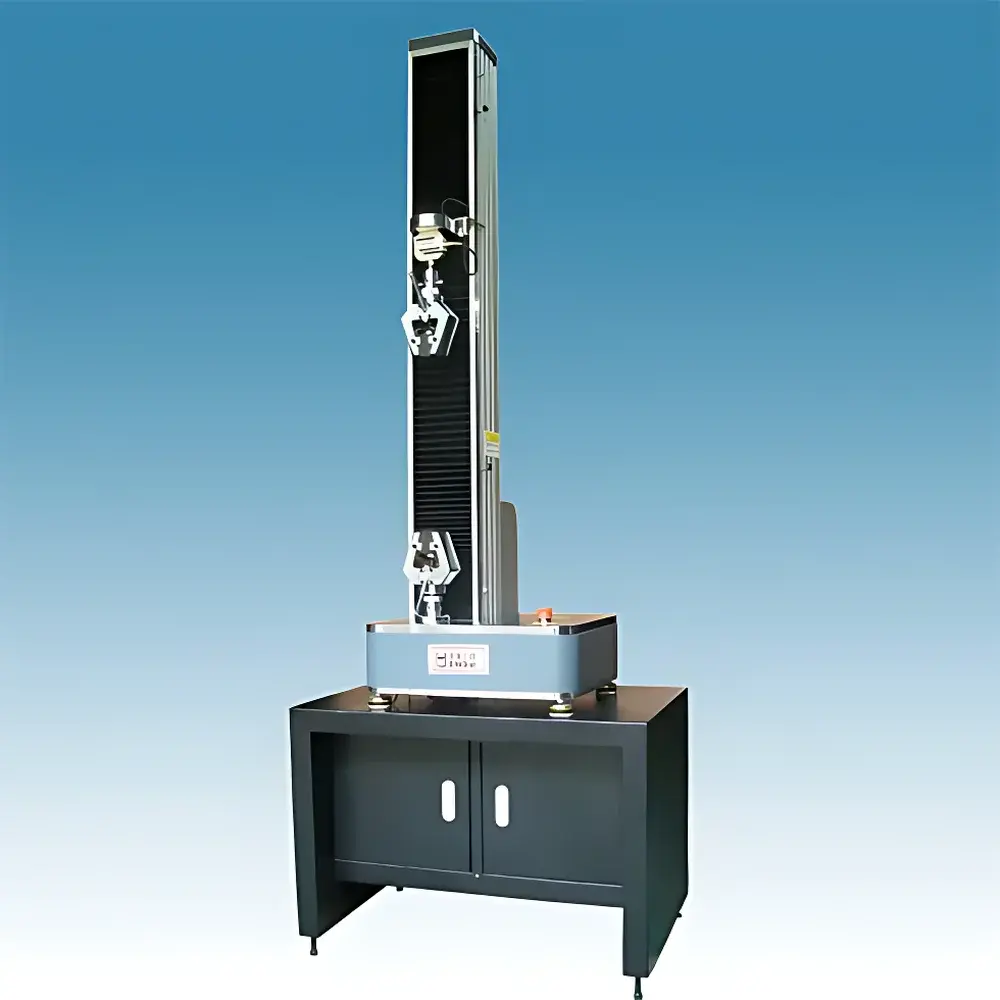
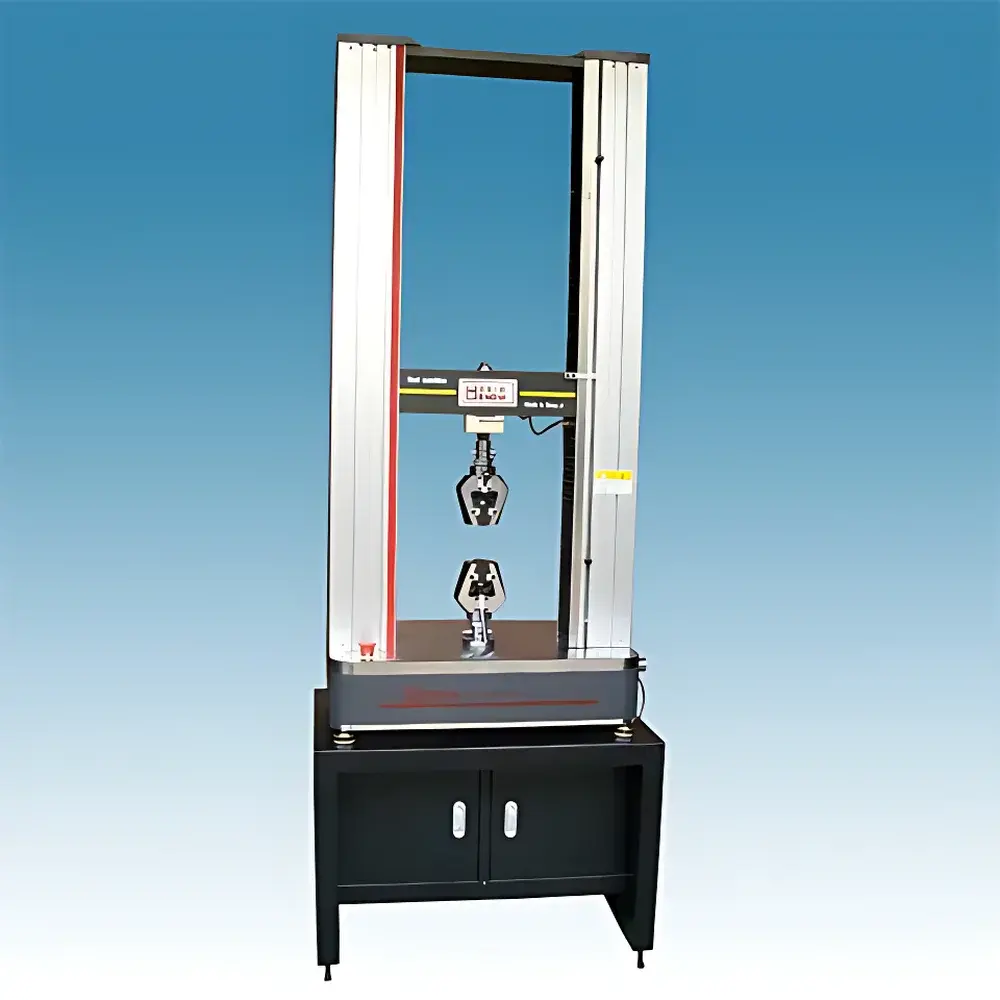
Hengyi HY-0580 (Single-Column) Microcomputer-Controlled Seal Strip Pull-Out Force Tester
| Brand | Hengyi / Hengyitest |
|---|---|
| Origin | Shanghai, China |
| Manufacturer Type | Direct Manufacturer |
| Country of Origin | China |
| Model | HY-0580 (Single-Column) |
| Instrument Type | Electromechanical Universal Testing Machine |
| Load Capacity Options | 1 N to 5000 N (interchangeable load cells) |
| Force Accuracy | ≤ ±0.5% of reading |
| Effective Test Width | 120 mm |
| Effective Vertical Travel | 800 mm |
| Speed Range | 0.001–500 mm/min (adjustable in real time) |
| Speed Accuracy | ±0.5% of set value |
| Displacement Measurement Accuracy | ±0.5% of reading |
| Force Resolution | ±500,000 counts (full-scale,不分档, constant resolution) |
| Control Modes | Force, displacement, strain, and closed-loop rate control |
| Compliance Standards | GB/T 2611–2007, GB/T 16491–2008, GB/T 16852.1–2008, GB/T 3923, GB/T 1040, ISO 527, ASTM D638, ASTM D3039, JIS K7113, DIN 53455 |
Overview
The Hengyi HY-0580 (Single-Column) Microcomputer-Controlled Seal Strip Pull-Out Force Tester is a precision electromechanical universal testing system engineered for quantitative mechanical evaluation of elastomeric and polymer-based sealing components—particularly automotive and architectural glass-mounted rubber or thermoplastic elastomer (TPE) seal strips. It operates on the principle of uniaxial tensile force measurement under controlled displacement rate, capturing the peak pull-out force required to disengage a standardized 100-mm seal strip specimen from its substrate at a defined speed of 100 mm/min. The system employs high-stiffness single-column architecture with integrated servo-motor actuation, digital load cell feedback, and real-time closed-loop control—ensuring traceable, repeatable, and standards-compliant mechanical characterization across R&D, quality assurance, and regulatory validation workflows.
Key Features
- Single-column rigid frame design optimized for compact laboratory integration while maintaining structural stability during dynamic loading (max. 5000 N capacity with interchangeable load cells)
- High-resolution force measurement system with ±500,000-count A/D conversion, no internal range switching, and constant resolution across full scale
- Precise speed control from 0.001 to 500 mm/min, with accuracy maintained within ±0.5% of set value per ISO 2041 and ASTM E4 requirements
- Multi-mode closed-loop control: force-controlled, displacement-controlled, and strain-controlled ramping; supports stress/strain rate programming per ISO 527-1 and ASTM D638 Annex A2
- Integrated safety architecture including electronic travel limits, overload protection (110% FS), automatic emergency stop, and self-diagnostic routines for drive, sensor, and power subsystems
- Motorized crosshead with dual-speed (fast/slow) positioning and jog functionality for rapid sample setup and post-test return
- Compliance-ready firmware supporting audit trails, user-level access control, and parameter locking—aligned with GLP and GMP documentation expectations
Sample Compatibility & Compliance
The HY-0580 accommodates standardized 100-mm seal strip specimens mounted on flat substrates (e.g., float glass, aluminum extrusions), as specified in OEM technical specifications for automotive glazing systems. Its modular fixture interface supports custom-designed clamping jaws, pneumatic grips, and substrate-holding fixtures for non-standard geometries. The instrument meets essential metrological and functional requirements of GB/T 2611–2007 (General Technical Requirements for Testing Machines), GB/T 16491–2008 (Electronic Universal Testing Machines), and GB/T 16852.1–2008 (Verification of Static Uniaxial Testing Machines). It further enables conformance assessment against international material test standards including ISO 527 (plastics), ISO 37 (vulcanized rubber), ASTM D412 (rubber tensile properties), ASTM D638 (plastic tensile behavior), and JIS K6251—when paired with appropriate test software modules and calibrated transducers.
Software & Data Management
The embedded Windows-based control software provides intuitive graphical interface for test method definition, real-time curve monitoring (force vs. displacement, stress vs. strain), and automated report generation in PDF or Excel formats. All raw data—including time-stamped force, displacement, and extensometer signals—are stored in encrypted binary format with metadata (operator ID, calibration certificate ID, environmental conditions). The software supports 21 CFR Part 11–compliant configurations upon request, including electronic signatures, audit trail logging, and role-based permission settings. Exported datasets include full traceability: calibration coefficients, uncertainty budgets per ISO/IEC 17025, and compliance flags against selected standard clauses (e.g., “Pass/Fail per GB/T 3923.1 Section 6.4”).
Applications
- Quantification of interfacial adhesion strength between EPDM, TPE, or silicone sealants and glass/aluminum substrates
- Batch-to-batch consistency verification for extruded automotive weatherstrips prior to vehicle assembly
- Accelerated aging studies evaluating seal integrity after thermal cycling (−40°C to +90°C) or UV exposure
- Mechanical qualification of bonding primers and surface treatments used in glazing attachment systems
- Research-grade tensile property mapping of low-force elastomeric materials (1 N–500 N range) where conventional UTM sensitivity is insufficient
- Supporting failure mode analysis (e.g., cohesive vs. adhesive failure) via synchronized video capture and load-displacement inflection point detection
FAQ
What is the minimum resolvable force for the HY-0580 system?
The system achieves sub-millinewton resolution across all load cell ranges due to its 500,000-count analog-to-digital converter and noise-immune signal conditioning—enabling reliable measurement down to 0.002 N when using the 1 N load cell.
Can this tester be used for peel or shear testing of seal interfaces?
Yes—by installing ASTM D903-compliant 90° peel fixtures or ISO 11339 shear jigs, the HY-0580 supports comparative adhesion testing beyond axial pull-out, provided specimen geometry and grip alignment meet standard requirements.
Is third-party calibration certification available?
Hengyi provides factory calibration certificates traceable to CNAS-accredited national standards (GB/T 19022); optional UKAS or DAkkS-certified calibration services are available through authorized regional partners.
Does the software support multi-language UI and report templates?
Standard English and Chinese language interfaces are included; customizable report templates (with company logo, bilingual headings, and configurable pass/fail criteria) can be deployed without source code modification.
How is mechanical verification performed between scheduled calibrations?
Built-in verification routines allow daily or pre-test checks using certified reference weights and displacement gauges—generating verification logs compliant with ISO/IEC 17025 Clause 6.5.2.



