
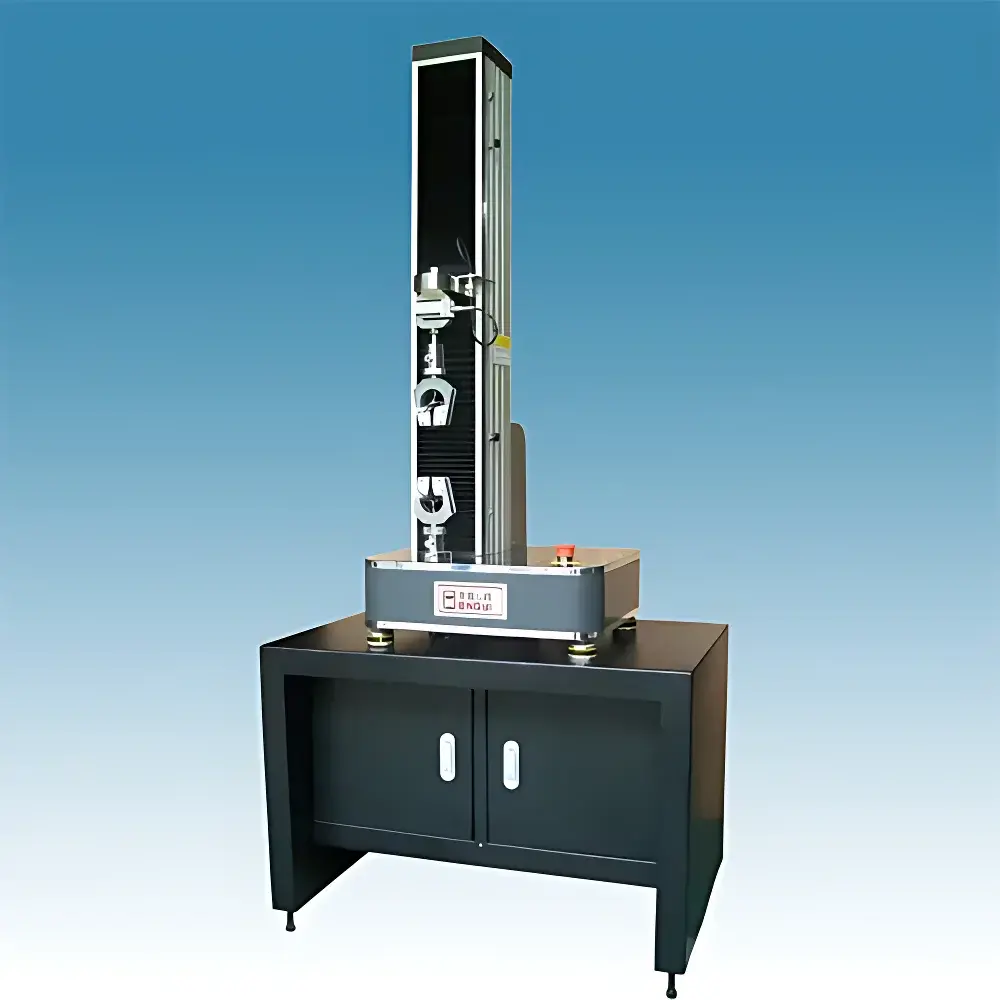
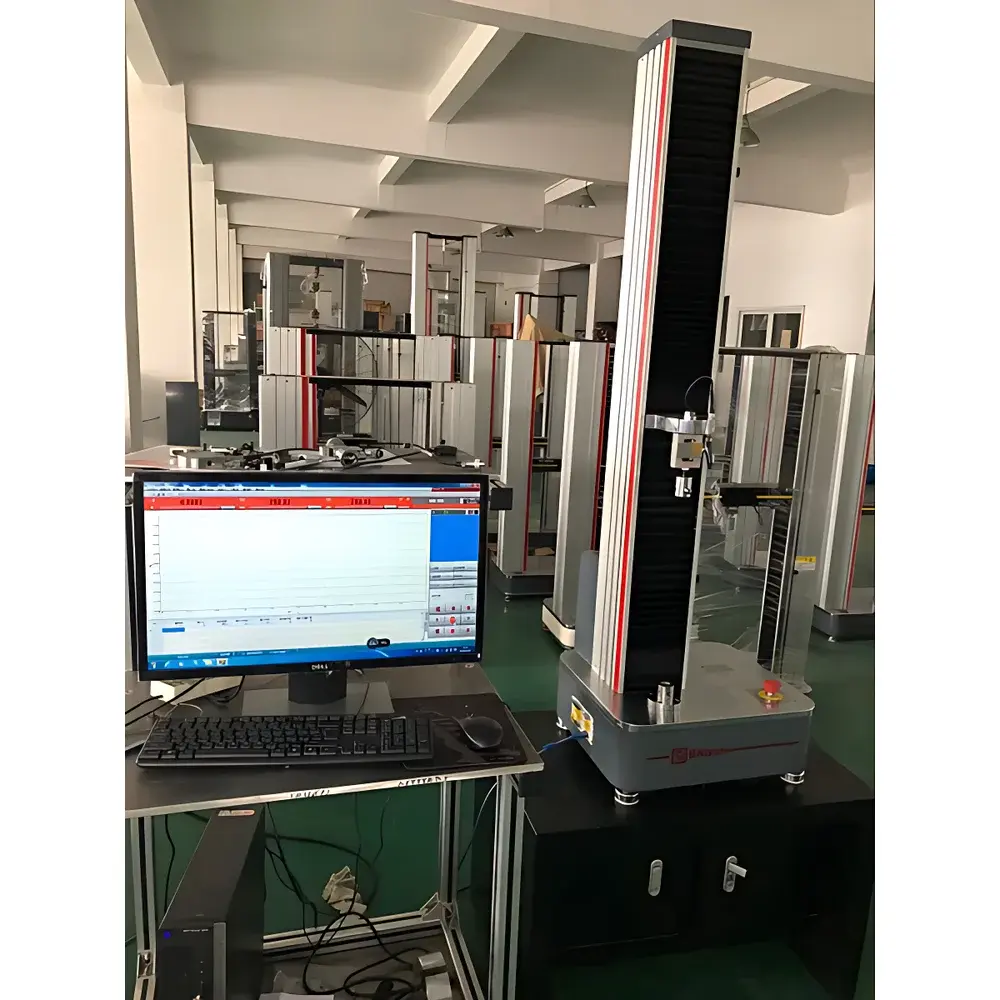
Hengyi HY-0580(db)pp Ceramic Tile Adhesive Tensile Bond Strength Tester
| Brand | Hengyi |
|---|---|
| Origin | Shanghai, China |
| Manufacturer Type | Direct Manufacturer |
| Country of Origin | China |
| Model | HY-0580(db)pp |
| Instrument Type | Electronic Universal Testing Machine |
| Load Capacity Options | 5N, 10N, 20N, 50N, 100N, 200N, 500N, 1000N, 5000N |
| Accuracy Class | 0.5 |
| Effective Test Width | 120 mm |
| Effective Test Height | 800 mm |
| Speed Range | 0.001–500 mm/min |
| Speed Accuracy | ±0.5% of indicated value |
| Force Resolution | ±500,000 counts at full scale (no internal range switching) |
| Force Measurement Range | 0.1–99% of full scale |
| Displacement & Strain Accuracy | ±0.5% of indicated value |
| Stress Control Rate Range | 0.005–6% FS/S |
| Strain Control Rate Range | 0.002–6% FS/S |
| Protection Features | Electronic limit switch, overload protection (10% above max load), auto-diagnostic system |
| Power Supply | 220 V AC, single-phase, 750 W |
| Dimensions (W×D×H) | 470 × 400 × 1510 mm |
| Weight | 95 kg |
Overview
The Hengyi HY-0580(db)pp Ceramic Tile Adhesive Tensile Bond Strength Tester is a single-column electronic universal testing machine engineered for high-precision static mechanical characterization of construction adhesives, particularly ceramic tile bonding systems. It operates on the principle of controlled uniaxial force application—measuring tensile bond strength via standardized pull-off testing per ISO 13007-1, EN 12004, GB/T 25181, and ASTM C627—where a rigid substrate (e.g., concrete or ceramic tile) is bonded to a test fixture and subjected to axial separation at a defined rate. The system delivers traceable, repeatable force-displacement data essential for quality assurance in adhesive formulation, batch release, and compliance verification across tile installation standards. Its modular architecture supports both tension and compression modes, enabling extended use beyond tile adhesives—including polymer-based sealants, grouts, and thin-set mortars—while maintaining metrological integrity across its full 5 N to 5,000 N load range.
Key Features
- Class 0.5 accuracy per ISO 7500-1 and ASTM E4, certified for calibration traceability to national standards;
- High-resolution force measurement with ±500,000-count A/D conversion—no internal range switching ensures consistent resolution across the entire 0.1–99% full-scale measurement window;
- Programmable crosshead speed from 0.001 to 500 mm/min, with closed-loop control and ±0.5% speed accuracy for precise strain-rate-dependent testing;
- Dual-mode motion control: fast coarse positioning and fine incremental adjustment, plus programmable return-to-start and automatic post-test reset;
- Integrated safety architecture including electronic travel limits, 110% overload cut-off, real-time system diagnostics, and multi-level emergency stop logic;
- Robust single-column frame (95 kg mass, rigid aluminum alloy construction) minimizing deflection-induced error during high-force tensile tests;
- Compliance-ready hardware interface supporting external extensometers, environmental chambers, and video extensometry add-ons for advanced deformation analysis.
Sample Compatibility & Compliance
The HY-0580(db)pp is configured specifically for standardized ceramic tile adhesive bond testing per ISO 13007-1:2013 (Annex A), EN 12004:2017, and GB/T 25181-2019. It accommodates standard specimen geometries—including 50 mm × 50 mm tile substrates bonded to concrete slabs or reference boards—with a 120 mm effective test width and 800 mm vertical clearance ensuring compatibility with full-thickness assembly configurations. All test protocols support automatic calculation of critical parameters: tensile bond strength (MPa), adhesive failure mode classification (cohesive, adhesive, mixed), and modulus of elasticity where applicable. The system meets requirements for GLP-compliant laboratories under ISO/IEC 17025:2017; raw data files include timestamped metadata, operator ID, calibration certificate references, and instrument configuration logs required for audit trails.
Software & Data Management
Bundled PC-based control software provides ISO 17025-aligned test sequencing, real-time curve visualization (force vs. displacement, stress vs. strain), and automated report generation compliant with ASTM E29, ISO 5725, and EU Construction Products Regulation (CPR) Annex ZA documentation templates. All test data are stored in non-proprietary CSV and XML formats with embedded digital signatures to prevent tampering. Audit trail functionality records user actions, parameter changes, and calibration events—fully satisfying FDA 21 CFR Part 11 requirements when configured with optional electronic signature modules. Software supports batch processing of up to 99 specimens per sequence, with pass/fail thresholds configurable per standard clause (e.g., minimum 0.5 MPa tensile strength for C1 adhesives per EN 12004).
Applications
- Quantitative evaluation of tensile bond strength for cementitious, dispersion-based, and reactive resin tile adhesives;
- Comparative assessment of aging effects (water immersion, thermal cycling, freeze-thaw) on bond integrity;
- R&D validation of novel polymer additives, nanofillers, or rheology modifiers in adhesive formulations;
- Quality control testing for factory production line release per ISO 9001 and EN 14411;
- Third-party certification testing for CE marking and UKCA conformity under CPR Article 4;
- Supporting technical documentation for ETAs (European Technical Assessments) and ICC-ES evaluations.
FAQ
What international standards does this tester fully support for ceramic tile adhesive testing?
It complies with ISO 13007-1, EN 12004, ASTM C627, GB/T 25181, JIS A 6201, and DIN 18156 for tensile bond strength, with automated parameter extraction per each standard’s specified calculation method.
Can the system be calibrated to meet ISO/IEC 17025 laboratory requirements?
Yes—the instrument includes NIST-traceable calibration certificates for force, displacement, and speed channels, and supports interval calibration logging with uncertainty budgets per ISO/IEC 17025 Clause 6.5.
Is third-party software integration supported for LIMS or ERP systems?
The device features RS-232, USB, and Ethernet interfaces with documented ASCII command protocol and OPC UA compatibility for seamless integration into enterprise data ecosystems.
Does the system provide failure mode analysis beyond numerical strength values?
Yes—integrated image capture (optional camera module) and synchronized video recording allow post-test visual classification of failure surfaces per ISO 13007-1 Annex B, distinguishing cohesive, interfacial, and substrate failures.
What maintenance intervals are recommended for long-term metrological stability?
Force sensor zero drift verification every 30 days; full recalibration annually or after 10,000 test cycles—both tracked automatically by the onboard diagnostic log.
Related Products



