
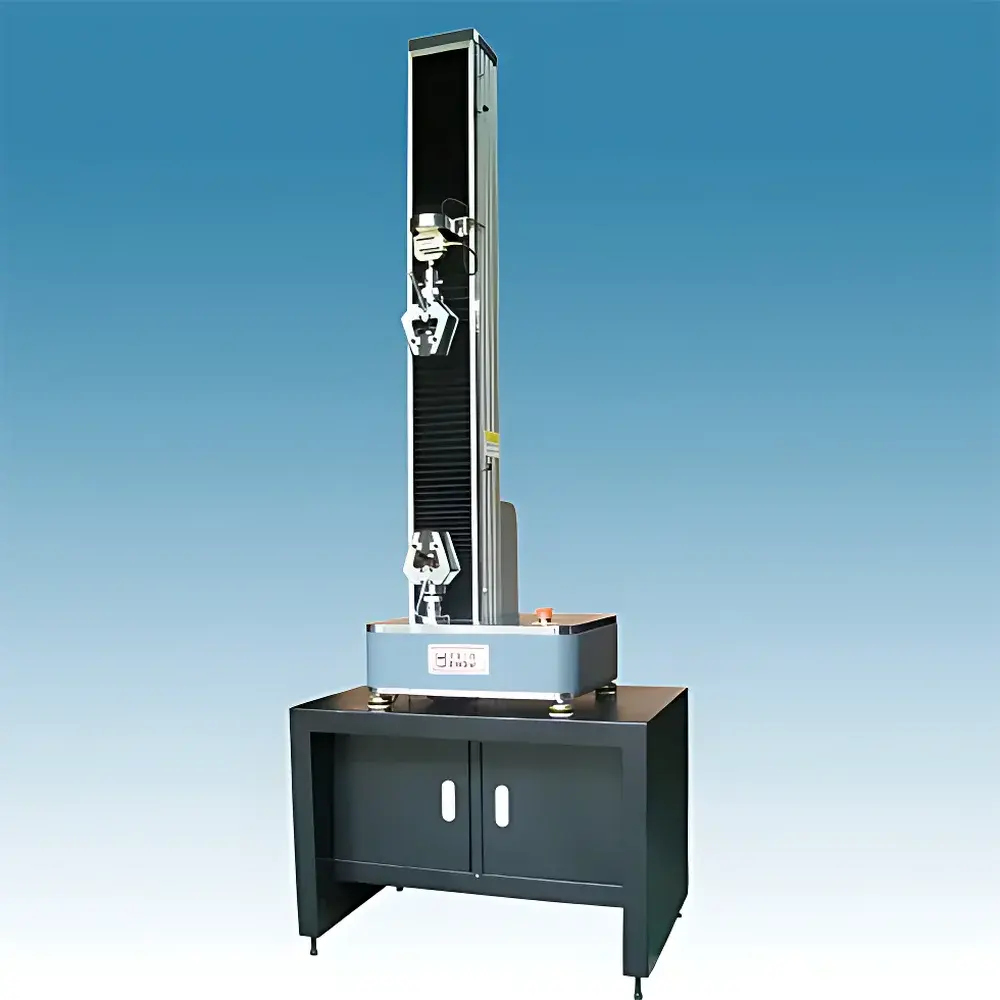
Hengyi HY-0580SWL Single-Column Electromechanical Tensile Testing Machine for Biomaterials
| Brand | Hengyi / Hengyitest |
|---|---|
| Origin | Shanghai, China |
| Manufacturer Type | Direct Manufacturer |
| Regional Category | Domestic (China) |
| Model | HY-0580SWL |
| Instrument Type | Electromechanical Tensile Testing Machine |
| Maximum Test Load | 5 kN |
| Force Measurement Range | 0.001–100% of Full Scale |
| Force Accuracy | ±0.5% of reading |
| Travel Distance | 800 mm |
| Displacement Resolution | 0.001 mm |
| Speed Range | 0.001–500 mm/min |
| Speed Accuracy | ±0.5% of set value |
| Position Accuracy | ±0.5% of reading |
| Strain Control Range | 0.002–6% FS/s |
| Stress Control Range | 0.005–6% FS/s |
| Load Cell Options | 1 N to 5000 N (interchangeable) |
| Effective Test Width | 120 mm |
| Power Supply | 220 V AC, 50 Hz, 750 W |
| Net Weight | 95 kg |
| Dimensions (W×D×H) | 470 × 400 × 1510 mm |
Overview
The Hengyi HY-0580SWL is a precision-engineered single-column electromechanical tensile testing machine specifically designed for biomechanical characterization of soft and hard biological materials, medical devices, and engineered biomaterials. It operates on the principle of controlled axial force application—applying uniaxial tension, compression, bending, shear, or peel loads at programmable rates—to quantify mechanical behavior under static and quasi-static conditions. Its architecture conforms to core requirements for regulatory-grade mechanical testing in preclinical R&D and quality assurance environments, supporting standardized test protocols per ISO 5832, ASTM F2118, ASTM F2125, ISO 1798 (for soft tissues), and ISO 14801 (for dental implants). The system delivers high reproducibility across load ranges from 1 N to 5 kN, with dual-range load cell compatibility enabling seamless transition between delicate soft-tissue specimens (e.g., decellularized scaffolds, hydrogels, vascular grafts) and rigid orthopedic constructs (e.g., spinal cages, intramedullary nails, cortical bone analogs).
Key Features
- Single-column rigid frame with high-stiffness aluminum alloy construction, optimized for minimal deflection during high-force testing up to 5 kN.
- Full-scale force measurement accuracy of ±0.5% of reading across 0.001–100% FS, validated per ISO 7500-1 Class 0.5 requirements.
- High-resolution displacement sensing with 0.001 mm resolution and ±0.5% positional accuracy over 800 mm travel, ensuring precise strain quantification.
- Wide-speed actuation capability: 0.001–500 mm/min, digitally controlled via closed-loop servo system with speed stability maintained within ±0.5% of setpoint.
- Modular load cell interface supporting interchangeable transducers (1 N, 5 N, 10 N, …, 5000 N), eliminating manual recalibration when switching specimen types.
- Integrated safety architecture including electronic limit switches, overload protection (>110% FS), emergency stop circuitry, and real-time self-diagnostic monitoring of drive voltage, current, and sensor integrity.
- Motorized crosshead with dual-speed (fast/slow) jog control and programmable return-to-start functionality—enabling rapid setup and repeatable test positioning.
- Compliance with electromagnetic compatibility (EMC) standards IEC 61326-1 and electrical safety standard IEC 61010-1 for laboratory instrumentation.
Sample Compatibility & Compliance
The HY-0580SWL accommodates diverse specimen geometries and mechanical classes without hardware modification. Standard fixtures include pneumatic wedge grips for high-friction polymer films, articulated clamps for irregular bone analogs, custom mandrels for suture loop testing, and three-point bending jigs compliant with ASTM D790. It supports testing of native and synthetic biomaterials—including porcine aortic valves, PCL electrospun membranes, titanium-coated PEEK spinal fusion devices, UHMWPE acetabular liners, and calcium phosphate bioceramics—under ambient laboratory conditions (20–40 °C, 20–80% RH). All force, displacement, and time data are timestamped and traceable to internal system clocks synchronized to UTC, fulfilling audit requirements for GLP-compliant studies and FDA-submitted mechanical validation dossiers (e.g., 510(k), IDE, PMA). Software output formats comply with ASTM E1434 for raw test data archiving and support export to CSV, XML, and HDF5 for downstream statistical analysis in MATLAB or Python-based biomechanical modeling pipelines.
Software & Data Management
Bundled HengyiTest v3.2 software provides full test method scripting, real-time curve overlay, and automated pass/fail evaluation against user-defined acceptance criteria (e.g., “Yield strength ≥ 120 MPa”, “Elongation at break ≥ 15%”). The platform implements role-based access control (RBAC), electronic signatures, and 21 CFR Part 11–compliant audit trails—including operator ID, parameter changes, calibration events, and raw data export logs. All test sequences are saved as encrypted .htx project files containing metadata (test standard, environmental conditions, fixture ID, operator notes) alongside binary-acquired sensor streams sampled at ≥1 kHz. Data integrity is preserved via checksum verification on file open/close and automatic backup to network-attached storage (NAS) or local RAID-1 arrays. Optional API integration enables direct command-and-control from LabVIEW or Python via TCP/IP socket protocol, facilitating automated multi-cycle fatigue testing or closed-loop feedback experiments.
Applications
- Mechanical validation of resorbable polymer implants (PLA, PLGA, PCL) per ISO 10993-12 degradation timelines.
- Tensile strength and modulus mapping of decellularized extracellular matrix scaffolds under hydrated conditions.
- Compression testing of vertebral body replacement devices under ASTM F2503 loading profiles.
- Peel adhesion assessment of tissue-adhesive hydrogels per ISO 10993-18.
- Cyclic fatigue life determination of nitinol stents using waveform-defined load-controlled protocols.
- Shear strength evaluation of bone–implant interfaces using push-out test configurations.
- Creep and stress-relaxation profiling of collagen–chitosan composite membranes at physiological temperature (37 °C, optional environmental chamber).
FAQ
What load cell options are available for the HY-0580SWL?
Standard configurations include 1 N, 5 N, 10 N, 20 N, 50 N, 100 N, 200 N, 500 N, 1000 N, 2000 N, 3000 N, and 5000 N transducers—all ISO 376 Class 0.5 certified and factory-calibrated with NIST-traceable certificates.
Does the system support ASTM or ISO standard test methods out-of-the-box?
Yes. Preloaded method templates cover ASTM D638 (tensile plastics), ASTM D790 (flexural), ISO 527-2 (tensile testing of plastics), ISO 1798 (foam tensile), and ISO 14801 (dental implant fatigue), with editable parameters for strain rate, hold times, and failure criteria.
Is environmental chamber integration supported?
The HY-0580SWL features RS-485 and analog I/O ports compatible with third-party temperature/humidity chambers (e.g., ESPEC, Angelantoni). Synchronized acquisition of environmental data with mechanical signals is enabled via HengyiTest’s external trigger and analog input channels.
What is the recommended calibration interval?
Per ISO/IEC 17025 guidance, annual calibration is recommended; however, user-performed daily verification using traceable reference weights and displacement gauges is advised prior to critical testing sessions.
Can test data be exported for statistical process control (SPC) analysis?
Yes. Raw data exports include full time-series sensor traces with millisecond timestamps, allowing direct import into JMP, Minitab, or custom Python/Pandas workflows for Cp/Cpk calculation, Weibull lifetime modeling, and ANOVA-based material batch comparison.



