
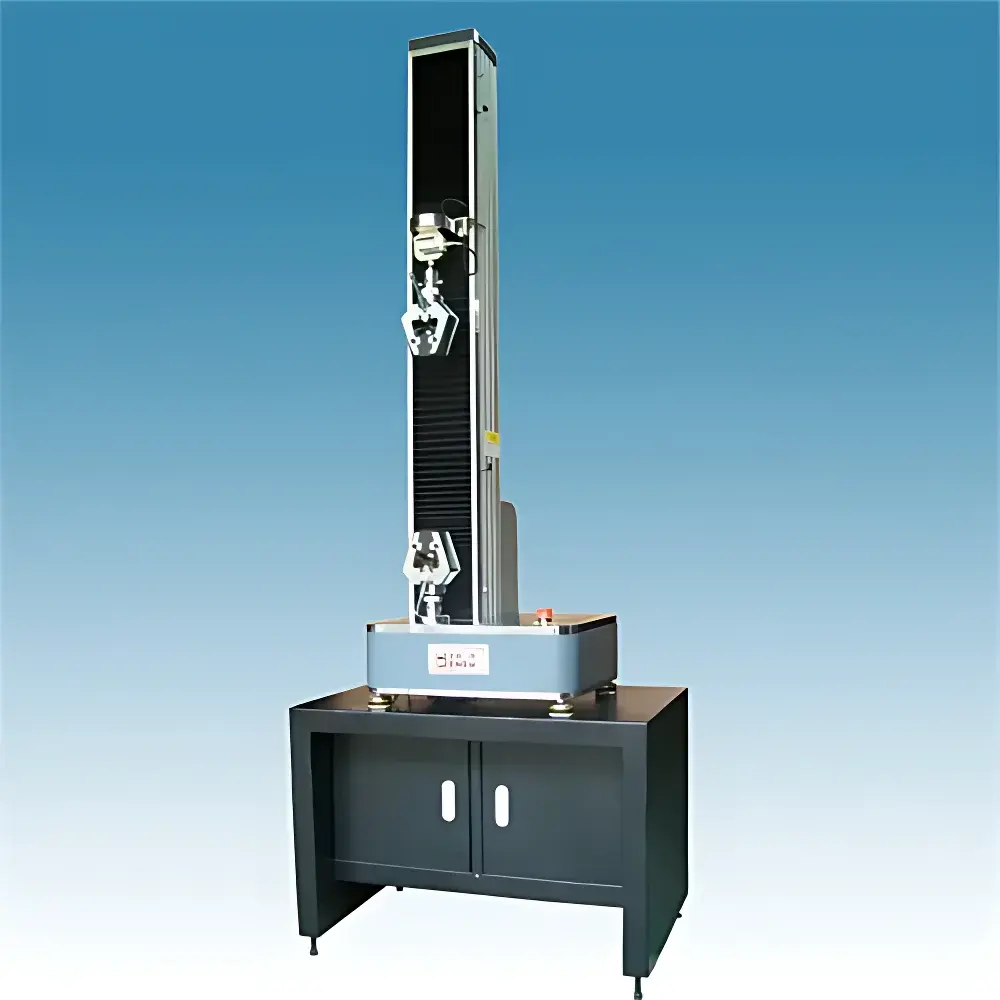
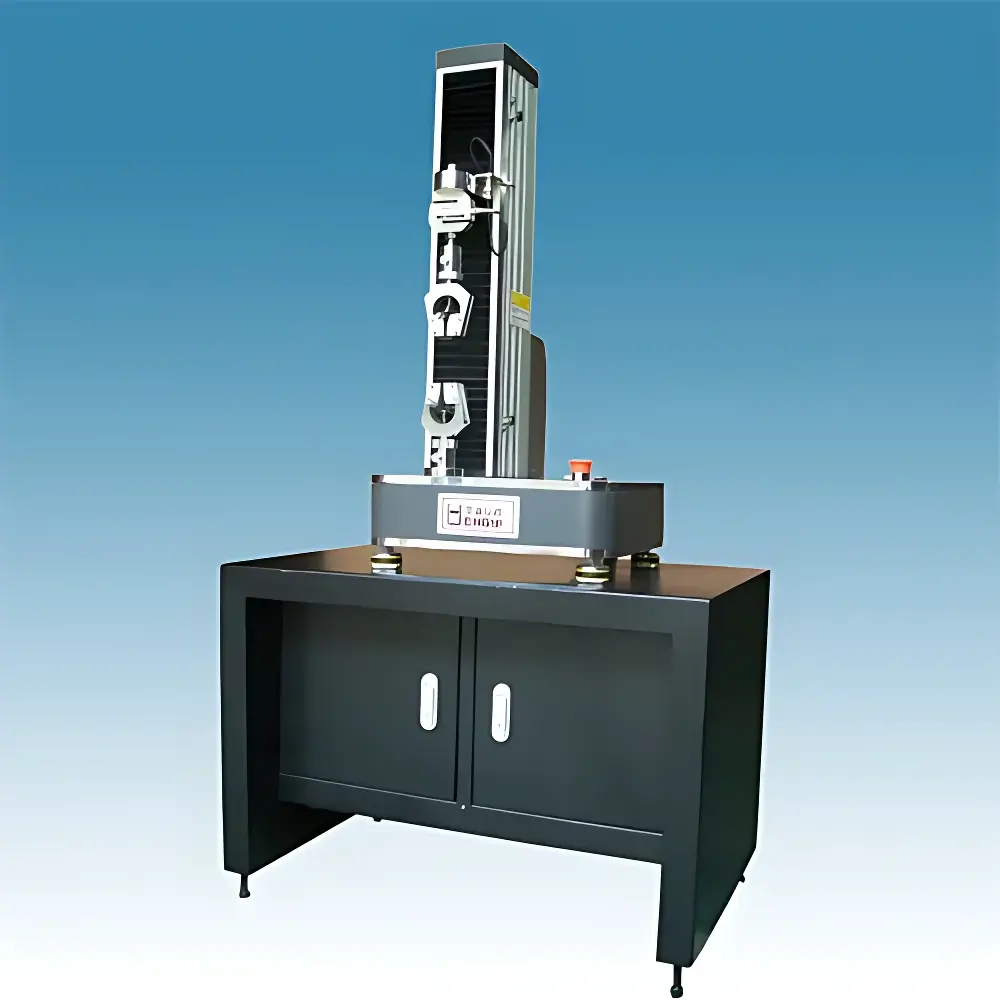
Hengyi HY-0580TMJI Bacterial Cellulose Membrane Tensile Testing Machine
| Brand | Hengyi / Hengyitest |
|---|---|
| Origin | Shanghai, China |
| Manufacturer Type | Direct Manufacturer |
| Regional Category | Domestic (China) |
| Model | HY-0580TMJI |
| Instrument Type | Electromechanical Tensile Testing Machine |
| Maximum Test Load | 5 kN |
| Force Measurement Range | 5 N – 5000 N |
| Force Accuracy | ±0.5% of full scale (FS) |
| Test Stroke | 800 mm |
| Displacement Resolution | 0.001 mm |
| Speed Range | 0.001 – 500 mm/min |
| Speed Accuracy | ±0.5% of indicated value |
| Position Accuracy | ±0.5% of indicated value |
| Effective Test Width | 120 mm |
| Load Cell Options | Multiple interchangeable transducers (1 N to 5000 N) |
| Control Modes | Stress-controlled, strain-controlled, and displacement-controlled |
| Safety Features | Electronic limit protection, overload auto-stop (>110% FS), real-time system diagnostics |
| Power Supply | 220 V AC, 50 Hz, 750 W |
| Dimensions (W×D×H) | 470 × 400 × 1510 mm |
| Weight | 95 kg |
Overview
The Hengyi HY-0580TMJI Bacterial Cellulose Membrane Tensile Testing Machine is a precision-engineered electromechanical universal testing system designed specifically for biomechanical characterization of soft and hard biological materials, biomaterials, and medical device components. It operates on the principle of controlled axial loading—applying uniaxial tensile, compressive, flexural, shear, or pull-out forces under static or quasi-static conditions—while capturing high-fidelity force-displacement data in real time. The system is calibrated to ISO 7500-1 Class 0.5 accuracy and conforms to international mechanical testing standards including ASTM E4, ASTM E8/E8M, ISO 6892-1, and EN 10002-1. Its architecture integrates a high-rigidity dual-column frame, brushless servo motor actuation, and closed-loop digital control—ensuring repeatability better than ±0.5% across the full force range (5 N to 5000 N). Designed for laboratory environments compliant with GLP and ISO/IEC 17025 requirements, the HY-0580TMJI supports traceable calibration, audit-ready data logging, and integration into regulated quality systems.
Key Features
- Modular load cell configuration: Interchangeable transducers (1 N, 5 N, 10 N, …, up to 5000 N) enable optimal resolution across material stiffness ranges—from hydrogels (kPa-level modulus) to cortical bone analogs (GPa-level strength).
- High-resolution motion control: Displacement resolution of 0.001 mm and speed regulation from 0.001 to 500 mm/min support both slow creep protocols and rapid failure testing.
- Multi-mode closed-loop control: Independent stress-, strain-, and displacement-rate control modes meet dynamic test requirements per ISO 5840-3 (cardiovascular implants) and ASTM F2193 (spinal fixation devices).
- Integrated safety architecture: Dual electronic limit switches, automatic overload cutoff (>110% FS), and real-time diagnostics monitor drive current, voltage, thermal load, and sensor integrity—halting operation upon anomaly detection.
- Standardized specimen handling: 120 mm effective test width accommodates ASTM D638 Type I–V, ISO 527-2, and YY/T 0662-compliant fixtures for screws, plates, stents, and tissue specimens.
- Robust mechanical design: 95 kg cast-iron base and reinforced aluminum alloy columns minimize vibration-induced noise, ensuring stable measurements during low-force soft-tissue testing.
Sample Compatibility & Compliance
The HY-0580TMJI is validated for mechanical evaluation of diverse biomedical substrates, including bacterial cellulose membranes, decellularized tissues, synthetic vascular grafts, hydrogel scaffolds, PCL/PLGA electrospun mats, titanium alloy orthopedic screws, PEEK spinal cages, and calcium phosphate bone cements. It satisfies regulatory test method requirements outlined in YY/T 1504-2016 (axial pullout of bone screws), YY/T 0342-2002 (bending stiffness of bone plates), YY/T 0662-2008 (asymmetric thread screw mechanics), and GB/T 228.1-2010 (metal tensile testing at ambient temperature). All firmware and data acquisition routines are structured to support ALCOA+ principles (Attributable, Legible, Contemporaneous, Original, Accurate, Complete, Consistent, Enduring, Available), facilitating compliance with FDA 21 CFR Part 11 when paired with qualified electronic signature modules.
Software & Data Management
The system ships with Hengyi TestMaster v4.2—a Windows-based, CE-certified application supporting multi-channel synchronized acquisition (force, displacement, extensometer, environmental feedback). Raw data is stored in vendor-neutral .csv and .xlsx formats with embedded metadata (operator ID, timestamp, calibration certificate ID, test standard reference). Audit trails record all user actions—including parameter edits, calibration events, and report exports—with immutable timestamps. Exported reports include stress-strain curves, modulus calculations (tangent, secant, Young’s), yield point detection (0.2% offset), ultimate tensile strength, elongation at break, bending rigidity (EI), and fatigue cycle summaries. Optional API integration enables direct data ingestion into LIMS platforms (e.g., LabWare, Thermo Fisher SampleManager) via RESTful endpoints.
Applications
- Mechanical validation of bacterial nanocellulose membranes for wound dressing applications—quantifying tensile strength, elongation, and hydration-dependent modulus shifts.
- Regulatory submission testing of Class III orthopedic implants per ISO 14801 (dental implants) and ASTM F2503 (implant labeling standards).
- Comparative biomechanics of native vs. engineered cartilage constructs under compressive loading (0.01–1 MPa, 0.1–10 mm/min).
- Accelerated fatigue assessment of suture anchors and meniscal repair devices using programmable cyclic loading profiles (1–10 Hz, R-ratio = 0.1).
- Material qualification of bioresorbable polymers (e.g., PLLA, Mg alloys) per ISO 10993-12 extraction protocols and subsequent mechanical decay tracking.
- Teaching laboratories: Standardized pedagogical workflows aligned with ASTM E2928-22 (biomaterials education guidelines) and ABET-accredited curriculum modules.
FAQ
Does the HY-0580TMJI comply with FDA 21 CFR Part 11 for electronic records and signatures?
Yes—when configured with optional audit-trail-enabled software licensing and external biometric authentication hardware, the system meets Part 11 requirements for record retention, operator accountability, and data integrity.
Can the machine perform cyclic fatigue testing?
It supports programmed sinusoidal, triangular, and trapezoidal waveforms with user-defined frequency, amplitude, and mean load—fully compliant with ISO 14801 Annex C for implant fatigue validation.
Is extensometer compatibility available?
Yes—the system includes analog and digital interfaces for clip-on, video, and non-contact extensometers (e.g., ARAMIS, Keyence LK-H series) with sub-micron strain resolution.
What calibration documentation is provided?
Each unit ships with a UKAS-accredited (or CNAS-equivalent) calibration certificate traceable to NIM (National Institute of Metrology, China), covering force, displacement, and speed axes across three verification points per range.
How is thermal drift compensated during long-duration creep tests?
The load cell electronics incorporate real-time temperature compensation algorithms (per ISO 376 Annex C), and ambient temperature monitoring is integrated into the test sequence logic to flag deviations exceeding ±2°C from baseline.



