
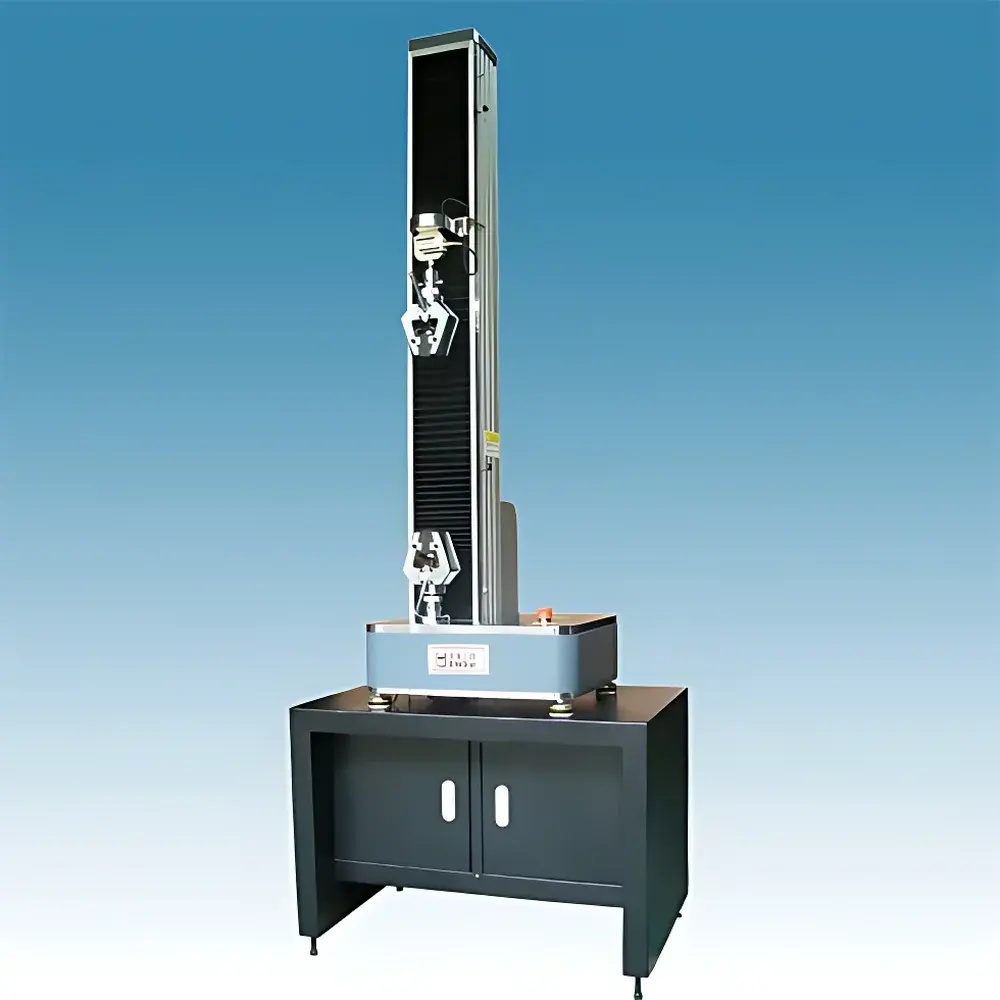
Hengyi HY-0580TYH Single-Column Plant Root Tensile Testing Machine
| Brand | Hengyi / Hengyitest |
|---|---|
| Origin | Shanghai, China |
| Manufacturer Type | Direct Manufacturer |
| Regional Classification | Domestic (China) |
| Model | HY-0580TYH |
| Instrument Type | Electronic Tensile Testing Machine |
| Maximum Test Load | 5 kN |
| Load Measurement Range | 0.001–100% of Full Scale |
| Load Accuracy | ±0.5% FS |
| Stroke | 800 mm |
| Displacement Resolution | 0.001 mm |
| Test Speed Range | 0.001–500 mm/min |
| Speed Accuracy | ±0.5% |
| Displacement Accuracy | ±0.5% |
| Safety Features | Electronic limit switches, emergency stop button |
| Power Supply | AC 220 V |
| Unit Weight | ~85 kg |
| Dimensions (W×D×H) | 590 × 355 × 1640 mm |
| Effective Width | 150 mm |
Overview
The Hengyi HY-0580TYH is a single-column, microprocessor-controlled tensile testing machine engineered for precise mechanical characterization of plant root systems and other low-to-moderate strength biological and soft materials. It operates on the fundamental principle of uniaxial force application—applying controlled tensile or compressive loads while synchronously measuring load, displacement, and deformation in real time. Designed to meet the biomechanical demands of agricultural research, soil science, and plant physiology laboratories, the system delivers high reproducibility in measuring root tensile strength, breaking force, elongation at break, and stress–strain behavior under quasi-static loading conditions. Its rigid yet compact architecture supports standardized static testing protocols aligned with ASTM D638, ISO 527, and GB/T 1040 series methodologies—adapted for non-standard biological specimens through customizable fixture configurations and programmable test profiles.
Key Features
- Single-column modular frame with precision-ground lead screw and high-rigidity crosshead assembly for minimal deflection during root pullout or axial tension tests.
- 5 kN load cell calibrated to ±0.5% full-scale accuracy, traceable to national metrological standards; optional higher-resolution transducers available for sub-newton sensitivity requirements.
- Adjustable stroke of 800 mm (extendable upon request), accommodating vertically oriented root specimens from shallow-rooted herbs to deep taproots of woody perennials.
- Wide-speed actuation range (0.001–500 mm/min) with closed-loop servo control ensures compliance with both slow quasi-static root anchorage assessments and rapid failure mode analysis.
- Integrated displacement encoder with 0.001 mm resolution enables accurate quantification of root elongation, slippage, and plastic deformation prior to fracture.
- Dual-safety architecture: hardware-based electronic limit switches plus software-enforced travel boundaries prevent overtravel and specimen overloading.
- Full PC-based control interface supporting multi-step test sequences, automatic return-to-start, and conditional termination (e.g., load threshold, displacement limit, or time-based stop).
Sample Compatibility & Compliance
The HY-0580TYH accommodates heterogeneous root morphologies—including fibrous, taproot, adventitious, and lateral root systems—via interchangeable grips: pneumatic vise clamps for intact root–soil cores, custom-designed root-holding fixtures with adjustable pressure pads, and low-force hook-and-loop interfaces for delicate seedling roots. Specimen mounting preserves natural hydration state and minimizes pre-test stress artifacts. The instrument complies with GLP-aligned data integrity requirements: all test parameters, raw sensor outputs, and operator actions are timestamped and logged in audit-trail-enabled databases. While not certified to FDA 21 CFR Part 11 out-of-the-box, its SQL-driven software architecture supports validation packages for regulated academic or governmental research environments adhering to ISO/IEC 17025 or CNAS accreditation criteria.
Software & Data Management
Control and analysis are performed via proprietary Windows-based software built on VB.NET and SQL Server Express. The platform acquires synchronized load–displacement–time datasets at configurable sampling rates up to 100 Hz. Real-time curve visualization includes auto-scaling axes, elastic modulus calculation (via tangent or secant methods), yield point detection (using ASTM E8/E8M offset method), and post-failure energy absorption integration. Users define reusable test templates—including preload conditioning, hold periods, and cyclic loading segments—for repeatable root fatigue or creep experiments. All results export to CSV, Excel, or PDF formats; curve annotations (e.g., proportional limit, ultimate tensile strength, rupture strain) are programmatically extractable for statistical analysis in R or Python. Data backups are automated, and user access levels (admin/operator/viewer) support multi-researcher lab workflows.
Applications
- Quantifying root tensile strength across species, genotypes, or growth conditions (e.g., drought stress, nutrient deficiency, mycorrhizal colonization).
- Evaluating root–soil interface adhesion and pullout resistance in erosion control studies and slope stabilization modeling.
- Characterizing mechanical properties of root-derived biomaterials (e.g., cellulose fibers, root-based hydrogels) for sustainable packaging R&D.
- Validating finite element models of root architecture by correlating simulated stress distributions with empirical tensile rupture data.
- Supporting breeding programs through high-throughput phenotyping of root mechanical resilience as a proxy for field anchorage performance.
- Teaching biomechanics fundamentals in undergraduate agronomy, forestry, and environmental engineering curricula.
FAQ
What types of root specimens can be tested without pre-treatment?
Fresh, field-excavated roots—intact or segmented—can be mounted directly using moisture-retaining clamps. Air-dried or frozen samples require rehydration protocols prior to testing to avoid brittle failure artifacts.
Is the system compatible with third-party data acquisition hardware?
Yes—the machine provides analog voltage outputs (±10 V) for load and displacement signals, enabling integration with external DAQ systems such as National Instruments or LabVIEW platforms.
Can test methods be exported and shared between laboratories?
Test templates (.xml-based configuration files) store all parameters including speed profiles, trigger conditions, and calculation algorithms, ensuring method portability across identical HY-0580TYH units.
Does the software support statistical batch analysis?
Built-in tools compute mean, SD, CV%, and confidence intervals across replicate specimens; ANOVA-ready output formats facilitate inter-group comparisons in crop science trials.
What maintenance schedule is recommended for long-term calibration stability?
Monthly visual inspection of grip surfaces and lead screw lubrication (white lithium grease + light mineral oil blend); annual load cell recalibration by an accredited metrology lab is advised for ISO-compliant reporting.



