
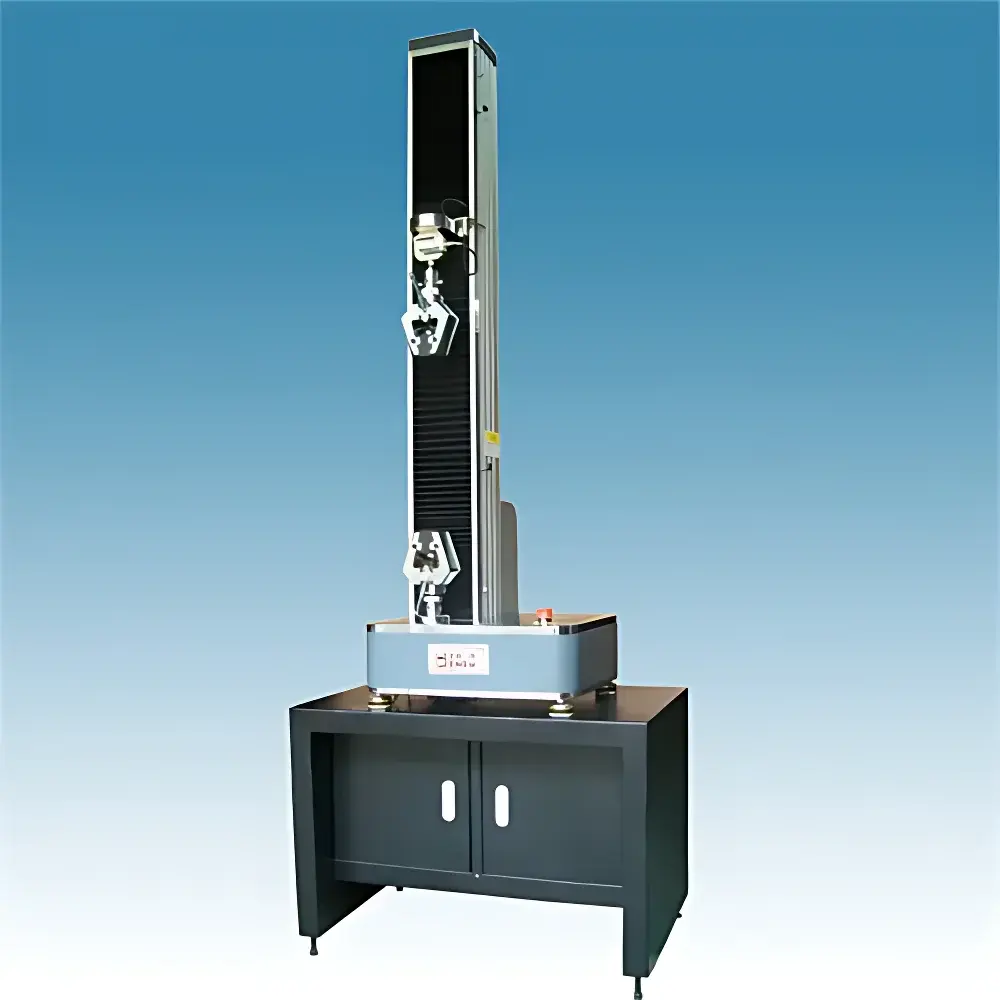
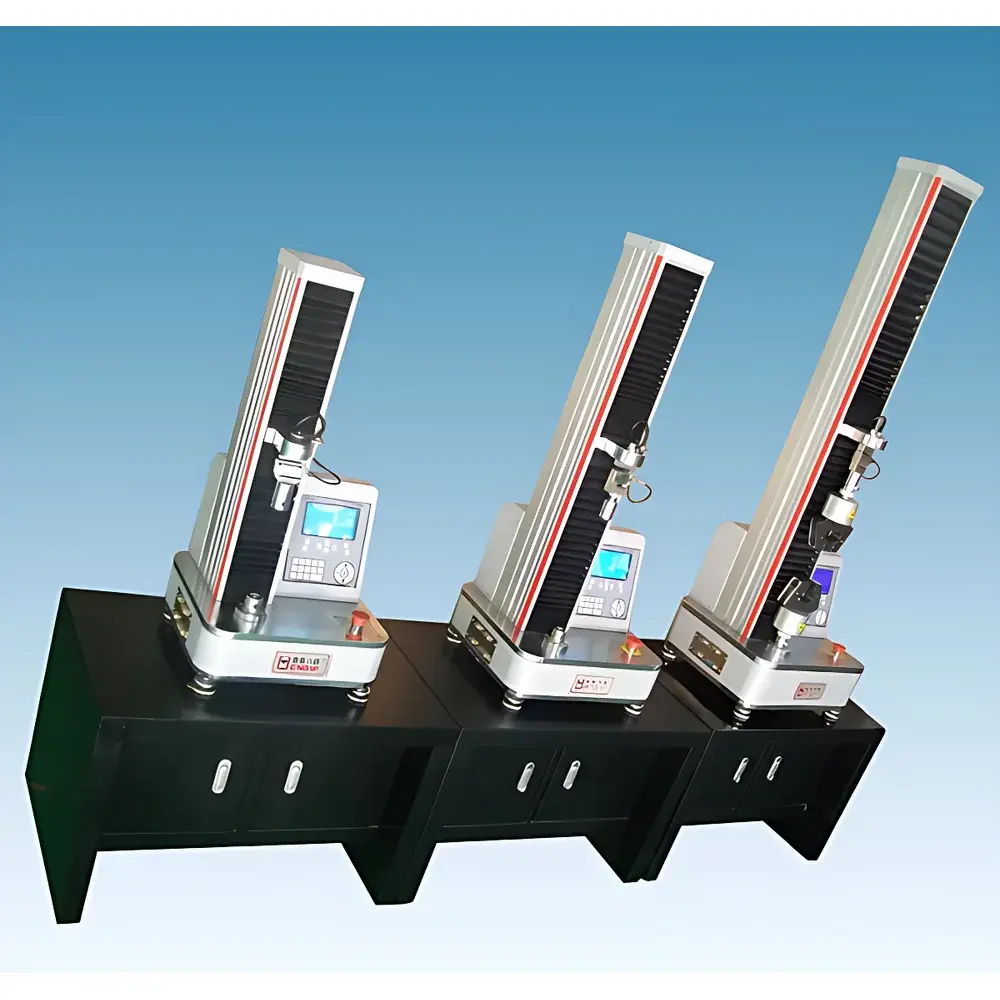
Hengyi HY-0580YUUI Single-Column Battery Cell Peel Testing Machine
| Brand | Hengyi / Hengyitest |
|---|---|
| Origin | Shanghai, China |
| Manufacturer Type | Direct Manufacturer |
| Regional Origin | Domestic (China) |
| Model | HY-0580YUUI |
| Instrument Type | Electronic Universal Testing Machine |
| Accuracy Class | ≤0.5 |
| Rated Load Options | 1N, 5N, 10N, 20N, 50N, 100N, 200N, 500N, 1000N, 2000N, 3000N, 5000N (interchangeable load cells) |
| Effective Force Measurement Range | 0.1–99.9999% of full scale |
| Force Resolution | ±500,000 counts (no internal range switching, constant resolution across full scale) |
| Effective Test Width | 120 mm |
| Effective Test Height | 800 mm |
| Test Speed Range | 0.001–500 mm/min (adjustable in real time) |
| Speed Accuracy | ±0.5% of indicated value |
| Displacement Measurement Accuracy | ±0.5% of indicated value |
| Strain Measurement Accuracy | ±0.5% of indicated value |
| Stress Control Rate Range | 0.005–6% FS/s |
| Strain Control Rate Range | 0.002–6% FS/s |
| Constant-Load/Displacement/Strain Holding Range | 0.5–99.9999% FS |
| Holding Accuracy | ±1% (for setpoints <10% FS), ±0.1% (for setpoints ≥10% FS) |
| Motor | Panasonic servo motor |
| Load Cell | Transducer Technologies (USA) |
| Encoder | Omron optical encoder |
| Power Supply | 220 V AC, single-phase, 750 W |
| Dimensions (W×D×H) | 470 × 400 × 1510 mm |
| Weight | 120 kg |
Overview
The Hengyi HY-0580YUUI Single-Column Battery Cell Peel Testing Machine is a precision-engineered electronic universal testing system designed specifically for quantitative mechanical characterization of photovoltaic cell interfacial adhesion—particularly the peel strength of metallized busbars, solder ribbons, and conductive pastes on silicon wafers and thin-film substrates. Built upon a rigid monolithic single-column frame architecture, it implements closed-loop servo-controlled force, displacement, and strain regulation to meet the stringent repeatability and traceability requirements of battery module qualification, R&D validation, and incoming material inspection. Its measurement principle relies on high-fidelity load-cell-based tensile force acquisition synchronized with sub-micron-resolution linear displacement feedback, enabling compliant execution of ASTM D903, ISO 8510-2, IEC 61215-2 MQT 17, and GB/T 31329–2014 (Photovoltaic Module Peel Strength Test Method). The system satisfies metrological compliance per GB/T 2611–2007 (General Technical Requirements for Testing Machines), GB/T 16491–2008 (Electronic Universal Testing Machines), and GB/T 16852.1–2008 (Static Uniaxial Testing Machine Calibration), supporting audit-ready operation under GLP and pre-GMP manufacturing environments.
Key Features
- Rigid single-column benchtop chassis with optimized torsional stiffness and minimal deflection under dynamic loading (≤0.5% accuracy class certified per ISO 7500-1)
- High-precision ground ball-screw transmission system with low-friction PTFE-coated nut assembly, ensuring smooth motion and long-term repeatability
- Panasonic AC servo drive with real-time adaptive PID tuning, delivering speed stability of ±0.5% across the full 0.001–500 mm/min range
- Transducer Technologies (USA) precision load cells—factory-calibrated, temperature-compensated, with overload protection up to 110% FS
- Omron high-resolution optical encoder (≥1 µm displacement resolution) integrated into the crosshead motion train
- Triple-closed-loop control architecture: independent force, displacement, and strain feedback channels with programmable ramp-hold-step profiles
- Integrated electronic limit switches and software-based overtravel protection to prevent mechanical damage during unattended operation
- Auto-return function with selectable high-speed (200 mm/min) or precision (0.1 mm/min) repositioning modes
- Real-time multi-curve display: force vs. displacement, force vs. time, stress vs. strain, and displacement vs. time—all exportable as CSV or XML
Sample Compatibility & Compliance
The HY-0580YUUI accommodates standardized peel specimens per IEC 61215-2 MQT 17 (180° peel test on laminated PV modules), ASTM F903 (peel resistance of flexible barrier materials), and ISO 8510-2 (adhesive bond peel testing). Customizable grip fixtures—including pneumatic, wedge-action, and spring-loaded peel jigs—support diverse substrate geometries (e.g., 156 mm × 156 mm, 166 mm × 166 mm, 182 mm × 182 mm wafers; ribbon widths from 1.5 mm to 5 mm). All hardware and firmware comply with electromagnetic compatibility (EMC) standards EN 61326-1 and safety standard EN 61010-1. Mechanical calibration certificates are traceable to NIM (National Institute of Metrology, China) and support third-party verification against ISO/IEC 17025 accredited laboratories.
Software & Data Management
The embedded Windows-based control software supports multilingual UI (English/Chinese), GLP-compliant audit trails, and FDA 21 CFR Part 11–ready user access controls (role-based permissions, electronic signatures, immutable data logs). Test methods can be saved as reusable templates with configurable pass/fail criteria, statistical reporting (mean, SD, CV%, min/max), and automatic calculation of peel strength (N/mm), interfacial fracture energy (J/m²), and cohesive failure percentage. Raw data—including time-stamped force, displacement, and strain arrays—is stored in encrypted SQLite databases with optional network backup to NAS or cloud storage via SMB protocol. Export formats include PDF test reports (with logo, operator ID, calibration date), Excel-compatible CSV, and MATLAB-readable MAT files.
Applications
- Quantitative peel strength evaluation of soldered interconnects on crystalline silicon and TOPCon solar cells
- Adhesion performance screening of conductive silver paste on textured SiNx-coated wafers
- Quality control of ethylene-vinyl acetate (EVA) encapsulant bonding to glass and backsheet layers
- Mechanical reliability assessment of heterojunction (HJT) cell metallization stacks under thermal cycling preconditioning
- Comparative analysis of laser-scribed edge isolation integrity in PERC and IBC architectures
- Research-grade interfacial fracture mechanics studies using digital image correlation (DIC)-synchronized peel tests
- Supplier qualification testing per JIS C 8992, UL 1703 Annex B, and TÜV Rheinland PV System Certification requirements
FAQ
What peel angles does the HY-0580YUUI support?
It is configured for standardized 90° and 180° peel configurations via interchangeable fixture kits—fully compliant with IEC 61215-2 MQT 17 and ASTM D903.
Can the system perform cyclic peel testing?
Yes—via programmable step-and-hold sequences, including load-controlled fatigue protocols with up to 10⁶ cycles and real-time crack propagation monitoring through derivative-based event detection.
Is calibration documentation provided with shipment?
Each unit ships with a factory calibration certificate (traceable to NIM), including as-tested values for force linearity, displacement accuracy, and speed fidelity—valid for 12 months under normal use.
Does the software support automated report generation for ISO/IEC 17025 accreditation?
Yes—the audit trail module records all operator actions, parameter changes, and calibration events with timestamps and user IDs, satisfying Clause 7.7.1 of ISO/IEC 17025:2017.
What is the maximum specimen thickness the standard grips can accommodate?
Standard pneumatic peel grips accept specimens up to 3.5 mm total thickness (substrate + adhesive layer); custom thick-specimen adapters extend capacity to 12 mm.



