
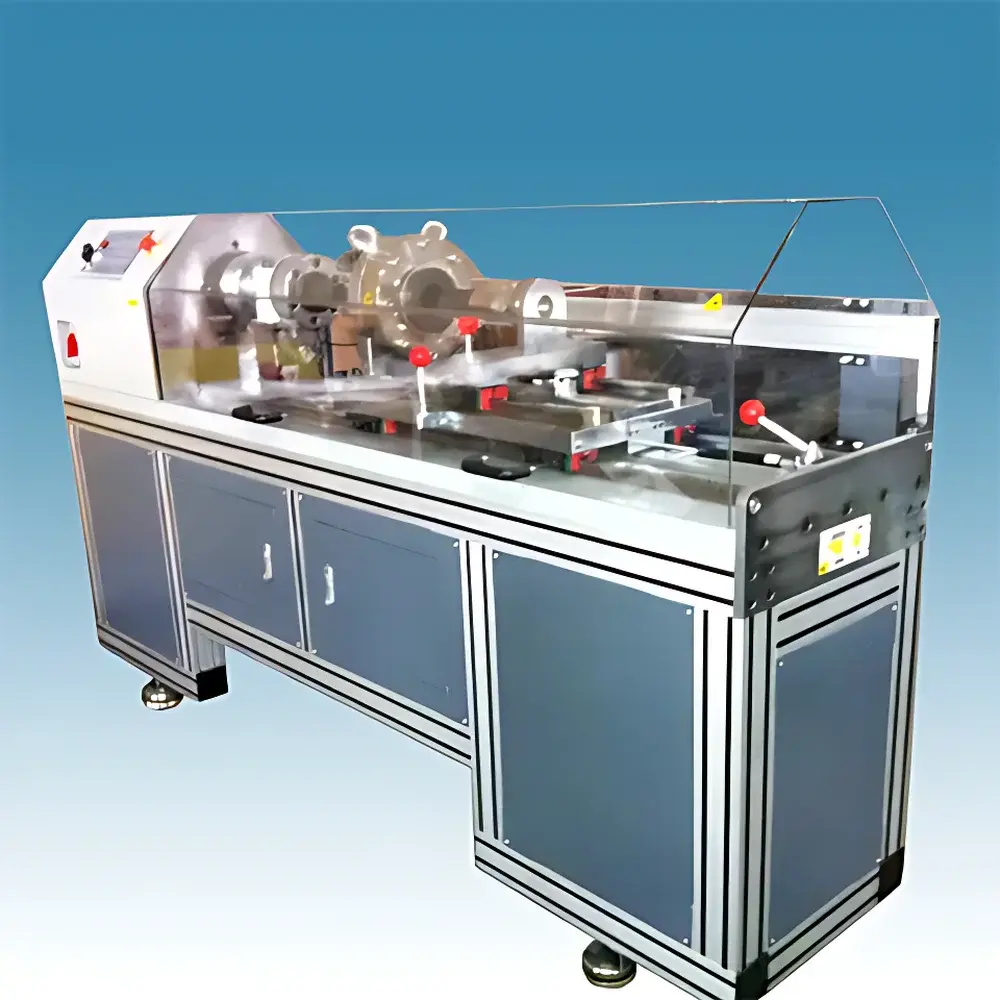
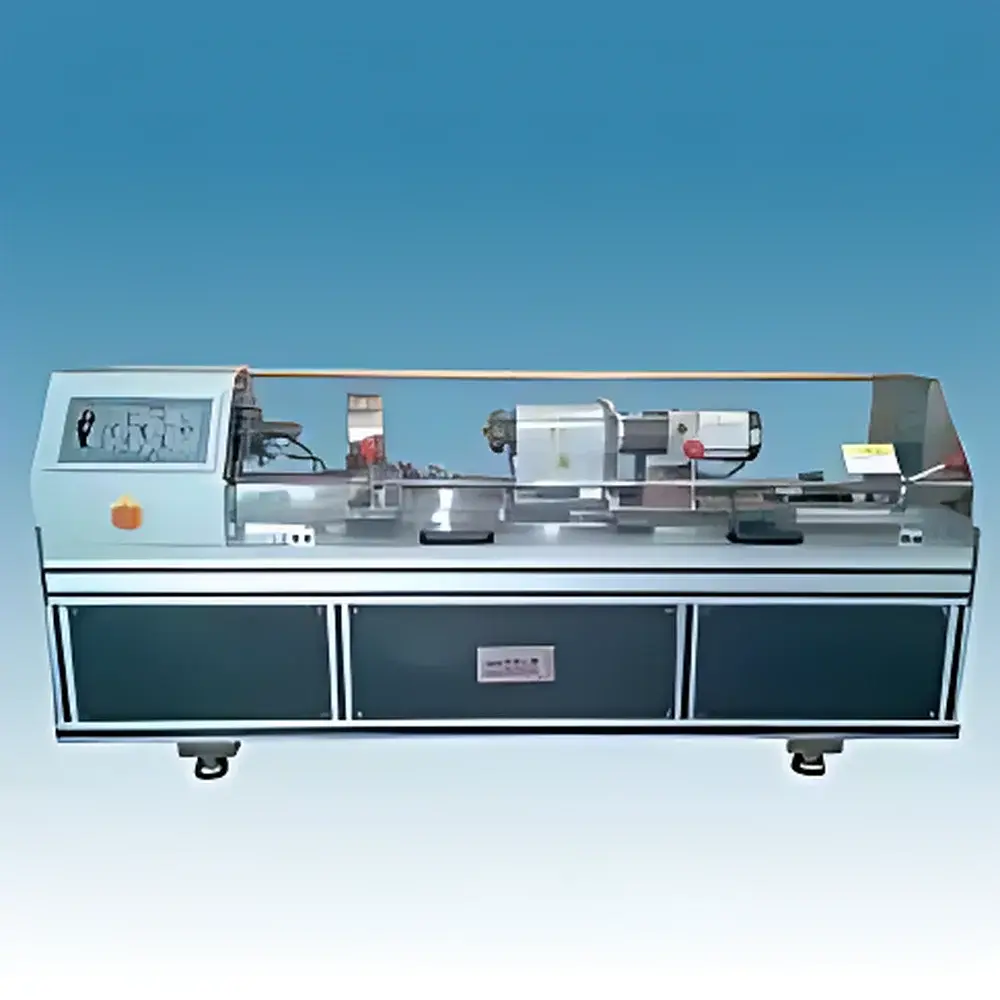
Hengyi HY-1000N·m Multi-Functional Fastener Friction Coefficient Tester
| Brand | Hengyi / Hengyitest |
|---|---|
| Origin | Shanghai, China |
| Manufacturer Type | Direct Manufacturer |
| Product Origin | Domestic (China) |
| Model | HY-1000N·mU7 |
| Max Torque | 1000 N·m |
| Torque Measurement Range | 1–1000 N·m |
| Torque Resolution | 1/500,000 |
| Torsional Angle Measurement Range | 0–100,000° (or continuous) |
| Motor Power | 5 kW |
| Torque Accuracy | ±1% FS (typical ±0.5% FS) |
| Angular Position Accuracy | ±1% FS (typical ±0.5% FS) |
| Rotational Speed Accuracy | ±0.5% |
| Axial Force Range | 3–300 kN |
| Clampable Thread Sizes | M8–M22 (customizable) |
| Test Space (Gauge Length) | 600 mm |
| Dimensions (L×W×H) | ≈1800 × 540 × 1250 mm |
| Weight | 1800 kg |
Overview
The Hengyi HY-1000N·m Multi-Functional Fastener Friction Coefficient Tester is a precision torsion testing system engineered for quantitative mechanical and tribological characterization of threaded fasteners under controlled axial-torque coupling conditions. It operates on the principle of simultaneous real-time measurement of axial preload (clamping force), total applied torque, thread torque, bearing surface torque, and corresponding angular displacement—enabling derivation of fundamental frictional parameters per ISO 16047 and GB/T 3098.9–2002. Unlike conventional torsion-only testers, this instrument implements dual-load-path architecture: a high-stiffness axial load train with 3–300 kN capacity and a coaxial torque train calibrated to 1000 N·m, both synchronized via a 32-bit ARM-based embedded control platform. The system employs a Japanese AC digital servo controller, high-reduction-ratio gearbox, and optical encoder feedback to achieve stable rotational speeds from 0.01°/min to 1000°/min (adjustable), with bidirectional torsion capability and programmable ramp-hold profiles.
Key Features
- Integrated dual-sensor architecture: High-accuracy torque transducer (±0.5% FS typical) and precision axial load cell (0.02% FS linearity) operating in parallel under closed-loop synchronization.
- Ultra-high torque resolution: 1 part in 500,000 full scale, enabling reliable detection of micro-friction transitions during thread engagement and breakaway events.
- Real-time coefficient derivation: Automated calculation of total friction coefficient (μtot), bearing surface coefficient (μb), thread coefficient (μt), and K-factor per ISO 16047 Annex A.
- Comprehensive mechanical parameter output: Yield torque, ultimate torque, proof load, effective torque, torque-angle hysteresis, and torsional stiffness—all traceable to NIST-traceable calibration standards.
- ARM32-based embedded control system with deterministic sampling (1 kHz minimum), eliminating PC-dependent latency and ensuring reproducibility across GLP/GMP environments.
- Modular夹具 design supporting M8–M22 threaded fasteners; optional custom tooling available for non-standard geometries including flanged bolts, locknuts, and blind-threaded assemblies.
Sample Compatibility & Compliance
This tester accommodates standard and non-standard fasteners per ISO 898-1, ASTM F568M, DIN 933/931, and JIS B1180. It supports static and dynamic test protocols—including constant-rate torsion, torque-controlled dwell, angle-controlled rupture, and low-cycle torsional fatigue (5–10,000 cycles). All measurement algorithms and data reporting comply with ISO/IEC 17025 requirements for testing laboratories. Raw torque-angle-force datasets are timestamped, digitally signed, and exportable in CSV, XML, and ASTM E1437-compliant formats. System validation documentation includes as-found/as-left calibration records, uncertainty budgets per GUM (JCGM 100), and traceability to national metrology institutes (NIM, China).
Software & Data Management
The proprietary Hengyi TestMaster™ software (v4.2+) provides ISO 17025-aligned test method templates, automated pass/fail evaluation against user-defined limits, and audit-trail-enabled operation per FDA 21 CFR Part 11 (electronic signatures, role-based access, immutable logs). Data acquisition supports multi-channel synchronous logging at up to 2 kHz, with real-time visualization of torque vs. angle, axial force vs. torque, and μt/μb evolution curves. Export modules generate PDF test reports with embedded metadata (operator ID, environmental conditions, calibration certificate IDs), compliant with internal QA workflows and external regulatory submissions.
Applications
- Aerospace: Verification of bolted joint integrity in turbine housings, wing spar attachments, and composite-to-metal interfaces per SAE ARP1285 and NASM1312-7.
- Automotive: Development and validation of friction-modified coatings (e.g., zinc flake, MoS2) for engine head bolts, suspension components, and EV battery module fasteners.
- Energy: Testing of high-strength anchor bolts in wind turbine foundations and pressure vessel closures per ASME BPVC Section VIII.
- R&D Labs: Fundamental studies on lubricant efficacy, surface roughness effects on thread friction, and statistical analysis of coefficient variability across batch lots.
- Quality Control: In-line verification of tightening process windows for automotive assembly lines and aerospace MRO facilities.
FAQ
Does the system support ASTM F2268 and ISO 16047 Annex B for statistical analysis of friction coefficients?
Yes. The software includes built-in statistical engines for calculating mean μ values, standard deviation, Cpk, and confidence intervals per ISO 16047 Clause 9 and ASTM F2268 Annex A.
Can the machine perform cyclic torsion tests with variable amplitude and mean torque?
Yes. The servo controller supports programmable sinusoidal, trapezoidal, and random-profile torsional loading with independent control of peak torque, mean torque, frequency (0.01–5 Hz), and cycle count.
Is third-party calibration certification included with delivery?
Each unit ships with a factory calibration certificate issued by CNAS-accredited metrology lab (Certificate No. CNAS LXXXXX), covering torque, axial force, and angular position channels, valid for 12 months.
What safety features prevent over-torque or specimen ejection during failure?
The system integrates hardware torque limit switches, emergency stop circuitry compliant with IEC 60204-1, and automatic unload-on-failure logic that halts rotation and retracts the axial actuator within 20 ms of detected rupture.
Is remote diagnostics and firmware update capability supported?
Yes. Secure SSH-based remote access (with customer-configurable firewall rules) enables real-time performance monitoring, log retrieval, and over-the-air firmware updates validated via SHA-256 signature verification.



