
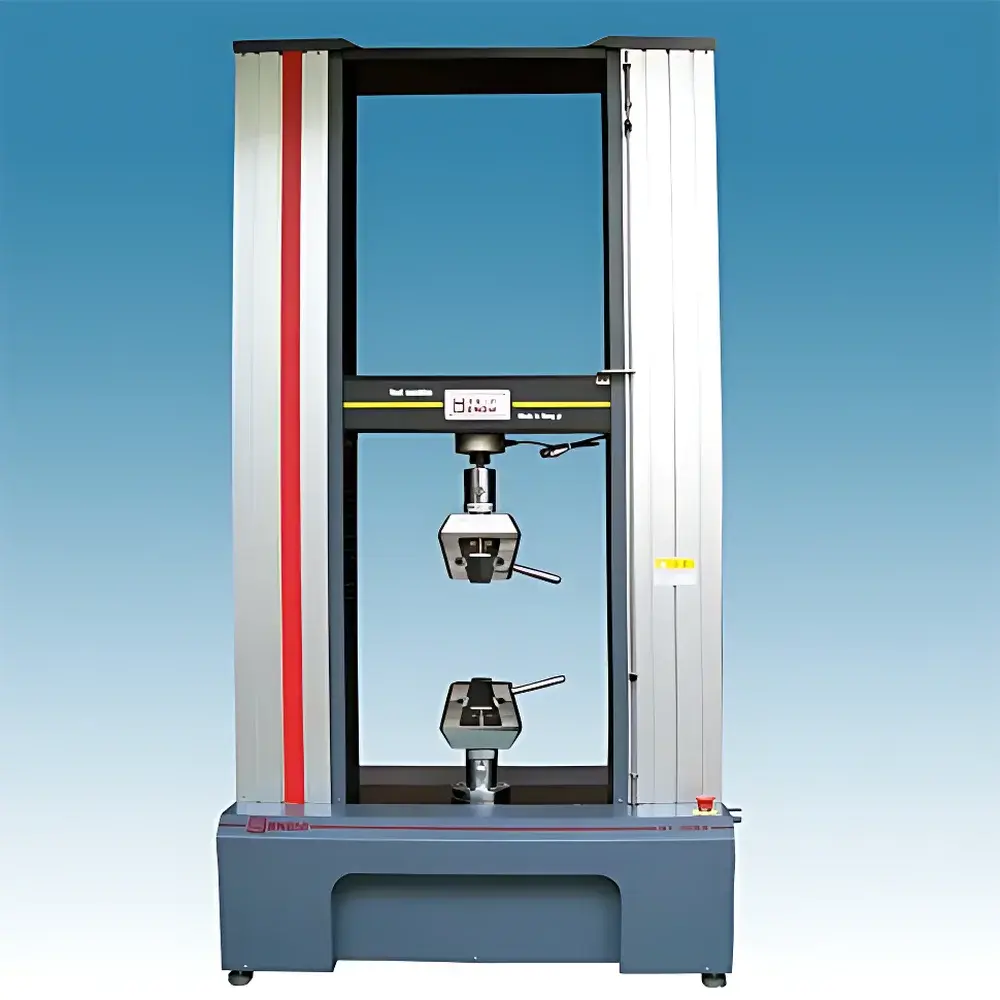
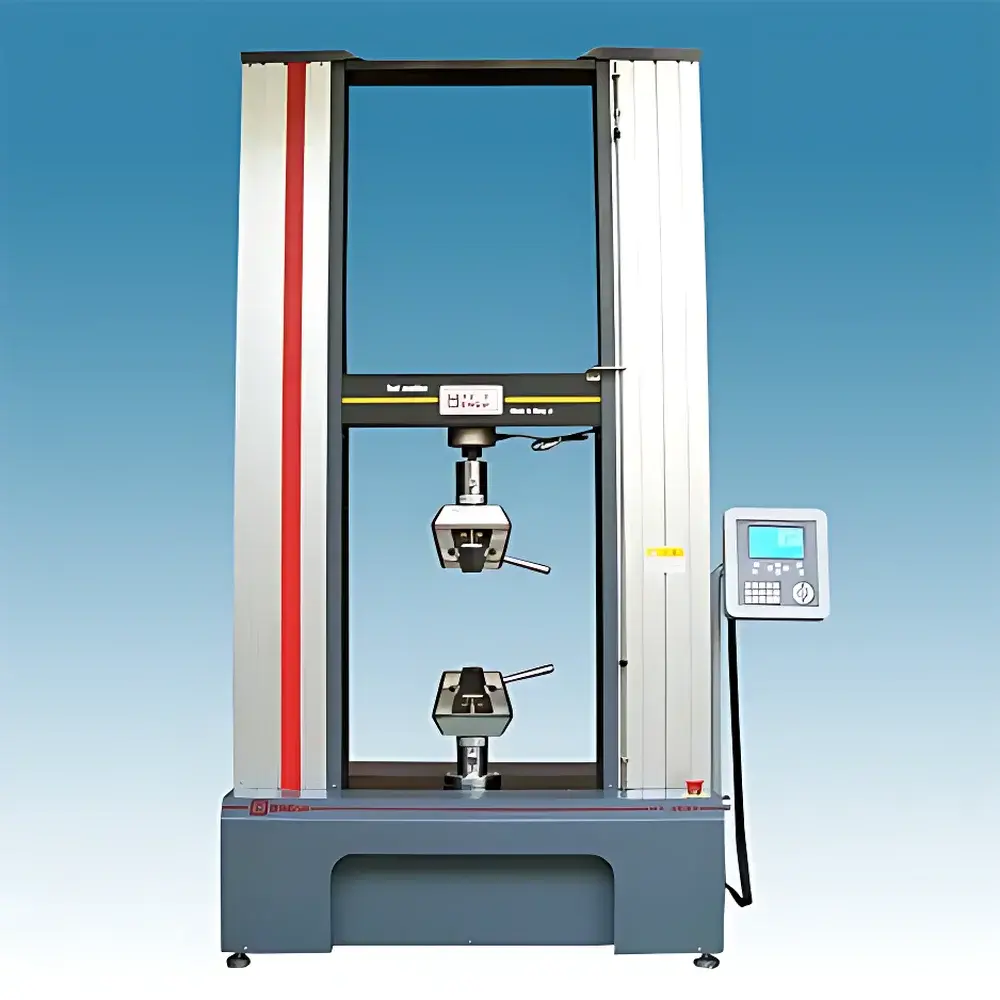
Hengyi HY-10080YUN Universal Testing Machine for Welded Metal Joint Tensile Fracture Strength
| Brand | Hengyi / Hengyitest |
|---|---|
| Origin | Shanghai, China |
| Manufacturer Type | Direct Manufacturer |
| Regional Category | Domestic (China) |
| Model | HY-10080YUN |
| Instrument Type | Electromechanical Universal Testing Machine |
| Load Capacity Options | 1 N to 100 kN (multi-sensor configurable) |
| Accuracy Class | ≤ 0.5% |
| Effective Test Width | 600 mm (expandable) |
| Effective Test Height | 800 mm (extendable) |
| Speed Range | 0.001–500 mm/min |
| Speed Accuracy | ±0.5% of indicated value |
| Displacement Measurement Accuracy | ±0.5% of indicated value |
| Strain Measurement Accuracy | ±0.5% of indicated value |
| Stress/Strain Control Rate Range | 0.002–6% FS/s |
| Load Resolution | ±500,000 counts at full scale,不分档 (no range switching) |
| Power Supply | 220 V AC, 2000 W |
| Host Weight | 1250 kg |
| Dimensions (W×D×H) | 1000 × 680 × 2200 mm |
Overview
The Hengyi HY-10080YUN is a high-stiffness, dual-column electromechanical universal testing machine engineered for static mechanical characterization of metallic welded joints and structural components under tension, compression, bending, shear, and peel loading conditions. Based on closed-loop servo-controlled load cell feedback and precision ball-screw actuation, it operates in accordance with fundamental principles of uniaxial quasi-static mechanics—applying controlled force or displacement while continuously measuring load, extension, and deformation in real time. Designed primarily for quality assurance in automotive manufacturing, aerospace component validation, and welding process development labs, the system complies with core mechanical test standards including ASTM E8/E21 (tensile testing of metals), ISO 6892-1 (metallic materials – tensile testing), and GB/T 228.1 (Chinese national standard for metallic tensile testing). Its modular architecture supports seamless integration into GLP-compliant environments where traceability, repeatability, and audit-ready data integrity are mandatory.
Key Features
- High-precision load measurement with ≤0.5% accuracy class across full range (1 N–100 kN), supported by multi-range load cells—each calibrated to ISO/IEC 17025-accredited procedures
- True dual-mode control: simultaneous and switchable stress, strain, and displacement control modes with automatic transition during test execution
- Ultra-wide speed range (0.001–500 mm/min) with ±0.5% speed fidelity—enabling low-strain-rate creep studies and high-speed rupture analysis
- Robust龙门 (portal-type) frame construction (1250 kg mass) minimizing deflection under peak loads; adjustable test width (600 mm standard, extendable) and height (800 mm standard, extendable)
- Integrated safety architecture: electronic limit switches, overload protection (110% FS cut-off), emergency stop circuitry, and real-time diagnostic monitoring of drive voltage, current, and sensor health
- Motorized crosshead with dual-speed jog function and programmable return-to-start capability—supporting both manual intervention and fully automated test sequences
Sample Compatibility & Compliance
The HY-10080YUN accommodates standardized tensile specimens per ASTM E8 (dog-bone, flat, or round bar geometries), weld coupons (e.g., transverse tensile test specimens per AWS D1.1), sheet metal lap-shear joints, and stamped automotive subassemblies. Fixture adaptability includes wedge-action grips for high-friction metallic samples, pneumatic clamps for thin foils, and custom-designed fixtures for non-standard weld configurations (e.g., fillet weld pull tests, plug weld shear tests). All mechanical test protocols adhere to internationally recognized compliance frameworks: ISO 148-1 (Charpy impact correlation), ISO 527 (plastics tensile), and EN 15614-1 (welding procedure qualification). Data acquisition meets FDA 21 CFR Part 11 requirements when paired with compliant software—supporting electronic signatures, audit trails, and role-based access control.
Software & Data Management
Bundled PC-based control software provides ISO/IEC 17025-aligned test method templates—including preconfigured routines for weld tensile strength (UTS), yield strength (YS), elongation at break (%EL), reduction in area (RA), and Young’s modulus (E). Real-time curve overlays (load–displacement, stress–strain, force–time) support comparative analysis across batches or heat treatments. Raw data exports in CSV, XML, and PDF formats ensure interoperability with LIMS and ERP systems. The software maintains full audit trail functionality—recording operator ID, timestamp, calibration status, environmental metadata (optional via external sensors), and any parameter override events. Optional modules enable automated report generation compliant with internal QA documentation standards and third-party certification bodies (e.g., TÜV, SGS, BV).
Applications
- Tensile fracture evaluation of resistance spot welds, MIG/TIG butt welds, and laser-welded aluminum alloys in EV battery enclosures
- Compressive yield behavior of welded structural steel I-beams per EN 1993-1-1
- Bending stiffness and failure mode analysis of welded tubular chassis joints
- Shear strength quantification of dissimilar-metal weld interfaces (e.g., Al–steel friction stir welds)
- Creep rupture testing of high-temperature alloy weldments under sustained load (0.001 mm/min regime)
- Validation of post-weld heat treatment (PWHT) efficacy through comparative modulus recovery metrics
FAQ
What standards does the HY-10080YUN support for welded joint testing?
It natively supports ASTM E8, ISO 6892-1, AWS D1.1 Annex D (tensile testing of welds), and GB/T 2651—covering specimen geometry, loading rate, and acceptance criteria for fracture location and strength reporting.
Can the system perform cyclic loading or fatigue tests?
No—the HY-10080YUN is designed exclusively for static (quasi-static) mechanical testing. For dynamic or high-cycle fatigue applications, a dedicated electrodynamic fatigue testing system is recommended.
Is calibration certification included with delivery?
Yes—each unit ships with a factory calibration certificate traceable to CNAS-accredited primary standards, valid for 12 months under normal operating conditions.
How is data integrity ensured during long-duration tests?
The embedded controller buffers all sensor data locally at 1 kHz sampling rate; lossless transmission to host PC occurs via industrial Ethernet, with optional RAID-backed storage for mission-critical test archives.
What maintenance intervals are recommended for optimal performance?
Lubrication of ball screws and inspection of grip jaw inserts every 500 operational hours; annual verification of load cell linearity and displacement encoder accuracy by authorized service engineers.



