
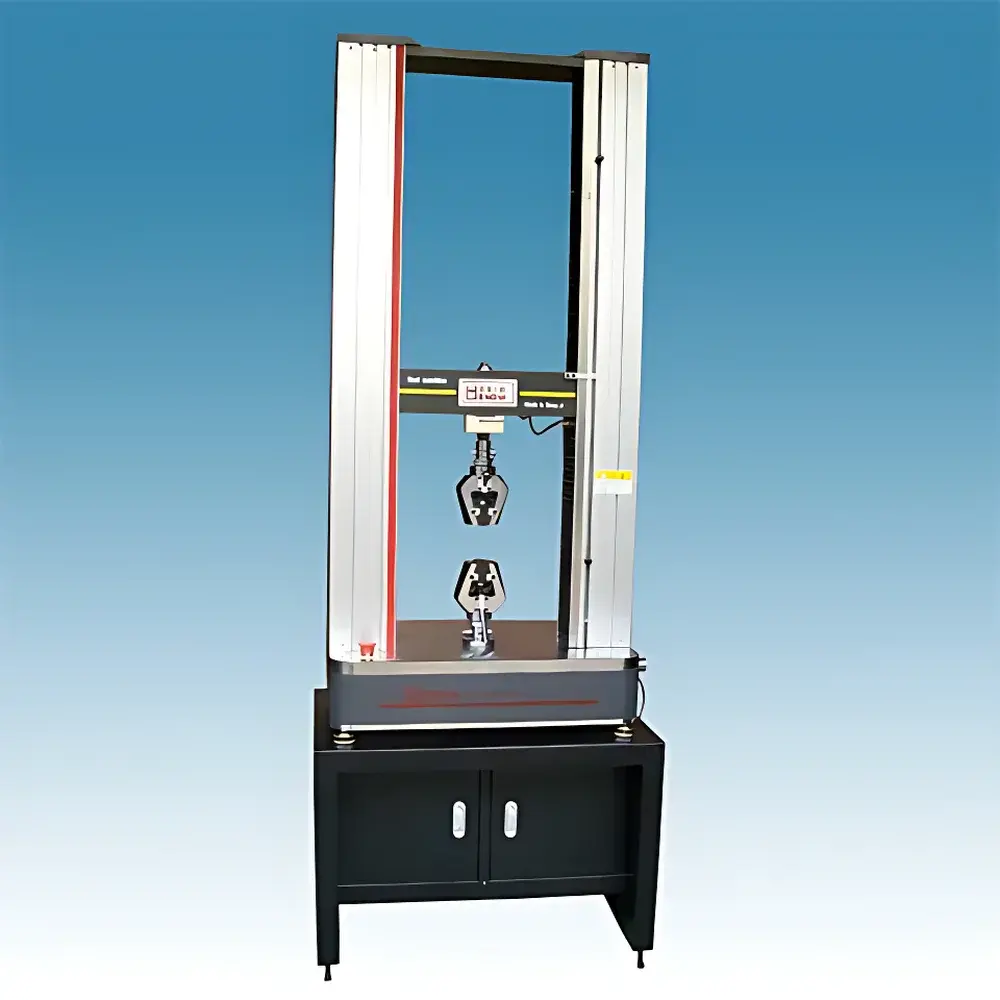
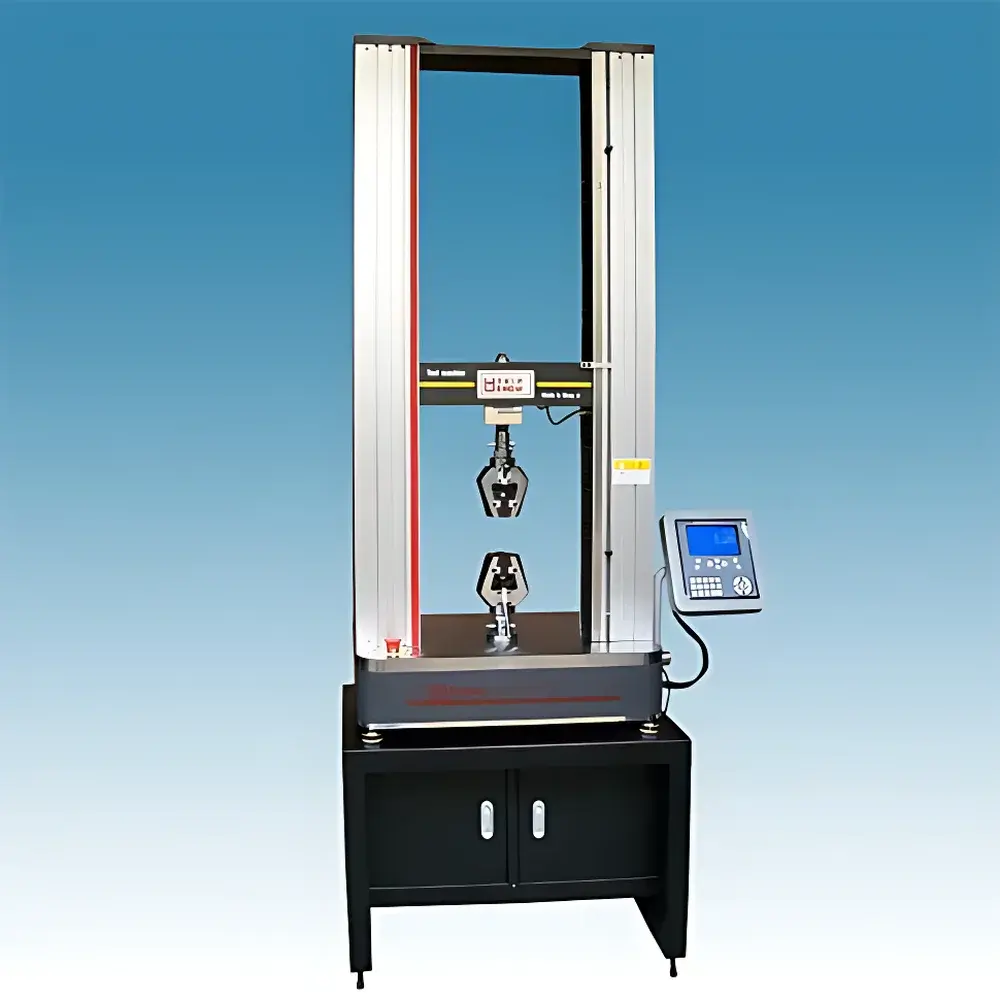
Hengyi HY-1080Q Universal Tensile Testing Machine
| Brand | Hengyi / Hengyitest |
|---|---|
| Origin | Shanghai, China |
| Manufacturer Type | Direct Manufacturer |
| Regional Category | Domestic (China) |
| Model | HY-1080Q |
| Instrument Type | Electromechanical Universal Testing Machine |
| Maximum Load Capacity | 10,000 N |
| Accuracy Class | 0.5 |
| Effective Test Width | 380 mm |
| Effective Test Height | 800 mm |
| Test Speed Range | 0.001–500 mm/min |
| Speed Accuracy | ±0.5% of indicated value |
| Displacement Measurement Accuracy | ±0.5% of indicated value |
| Strain Measurement Accuracy | ±0.5% of indicated value |
| Force Resolution | ±500,000 counts at full scale (no internal range switching) |
| Force Measurement Range | 0.1%–100% FS |
| Stress Control Rate Range | 0.005–6 %FS/S |
| Strain Control Rate Range | 0.002–6 %FS/S |
| Load/Displacement/Strain Holding Accuracy | ±1% (if setpoint <10% FS), ±0.1% (if ≥10% FS) |
| Overload Protection | Activates at >110% FS |
| Power Supply | 220 V AC, single-phase, 750 W |
| Host Dimensions | 700 × 420 × 1510 mm |
| Net Weight | 145 kg |
Overview
The Hengyi HY-1080Q Universal Tensile Testing Machine is a high-rigidity, electromechanical materials testing system engineered for precision mechanical property characterization of metals, polymers, composites, elastomers, textiles, adhesives, and biomedical specimens. Based on the servo-controlled uniaxial loading principle, it applies controlled tensile, compressive, flexural, peel, puncture, shear, and indentation forces to standardized or custom test specimens while simultaneously acquiring synchronized force, displacement, and strain data. Its modular architecture integrates a rigid dual-column frame with high-frequency hardened guide rods, preloaded ground ball screws (Ulrinov brand), and a triangulated load path geometry—minimizing frame deflection and ensuring metrological integrity across the full 10,000 N load range. Designed in compliance with ISO 7500-1:2018 (static calibration of uniaxial testing machines) and ASTM E4-23 (verification of force-measuring instruments), the HY-1080Q delivers Class 0.5 accuracy per ISO 7500-1, making it suitable for R&D validation, QC release testing, and GLP-compliant documentation workflows.
Key Features
- High-stiffness portal frame constructed from precision-machined aluminum alloy housing with automotive-grade baked enamel finish—resistant to oxidation, UV degradation, and mechanical abrasion over extended service life.
- 10,000 N load cell from Transcell (USA), featuring 0.02% FS linearity and thermal drift compensation via proprietary strain gauge design and heat-treated alloy steel body.
- Full-digital AC servo drive system (Panasonic/Inovance) with real-time adaptive gain tuning, enabling smooth low-speed control (down to 0.001 mm/min) and dynamic response stability under varying inertial loads.
- Triple-stage synchronous belt reduction transmission (Taiwan-made HTD profile belts + precision gearmotor), eliminating backlash, minimizing maintenance, and ensuring long-term repeatability without lubrication.
- Dual-mode crosshead positioning: motorized fine adjustment (0.001 mm resolution) plus manual rapid return; electronic limit switches and software-enforced travel boundaries prevent overtravel damage.
- Integrated safety logic includes overload cutoff (>110% FS), emergency stop circuitry, automatic post-test return, and programmable stop conditions (time, load, deformation, or fracture detection).
Sample Compatibility & Compliance
The HY-1080Q accommodates specimens up to 380 mm wide and 800 mm tall, supporting standardized geometries per ASTM D638 (tensile plastics), ASTM D790 (flexural rigidity), ISO 527-2, ISO 178, GB/T 1040, GB/T 9341, and JIS K7113. Optional fixtures—including pneumatic vise grips, wedge-action clamps, bend supports, peel rollers, and puncture probes—are available for application-specific mounting. All mechanical and electrical subsystems conform to IEC 61000-6-2 (EMC immunity) and IEC 61000-6-4 (EMC emissions). The system supports audit-ready operation under FDA 21 CFR Part 11 when paired with validated HYtestV7.0 software configuration, including electronic signatures, change logs, and role-based access control.
Software & Data Management
HYtestV7.0 is a multilingual (English, German, French, Spanish, Japanese, Korean, Russian, Portuguese, Chinese), standards-driven test platform built on a deterministic real-time kernel. It features USB 2.0 isolated communication (Philips ARM9 CPU + military-grade 24-bit ADC), enabling noise-immune data acquisition at up to 1 kHz sampling rate. The software supports automated calculation of ultimate tensile strength (UTS), yield strength (Rp0.2, ReH/ReL), Young’s modulus, elongation at break, Poisson’s ratio, secant modulus, compression set, and tear resistance—all traceable to ISO 5893, ASTM E8/E21, and EN 10002-1. Raw data exports to CSV, XML, or SQL databases; reports comply with ISO/IEC 17025 documentation requirements and include metadata stamps (operator ID, calibration date, environmental conditions). Audit trails record all parameter modifications, test executions, and result approvals.
Applications
- Quality assurance of structural polymers (PP, PE, PET, PC) and fiber-reinforced composites in automotive and aerospace supply chains.
- Mechanical screening of hydrogels, sutures, catheters, and wound dressings per ISO 10993-12 and USP .
- Validation of adhesive bond strength (ASTM D1002, D3164) and peel resistance (ASTM D903, D1876) in packaging and electronics assembly.
- Characterization of elastomeric seals and gaskets under compression set (ASTM D395) and stress relaxation (ISO 3384).
- Educational use in university materials science labs for hands-on instruction in Hooke’s law, plasticity theory, and fracture mechanics fundamentals.
FAQ
What international standards does the HY-1080Q support for test method execution?
It natively implements test protocols aligned with ASTM E4, ASTM D638, ASTM D790, ISO 7500-1, ISO 527, ISO 178, GB/T 1040, and JIS K7113—with customizable method templates for proprietary or industry-specific procedures.
Is the system compliant with regulatory data integrity requirements?
Yes—when deployed with validated HYtestV7.0 configuration, it meets ALCOA+ principles and supports 21 CFR Part 11 compliance through electronic signatures, immutable audit trails, and secure user authentication.
Can the machine perform cyclic or fatigue testing?
The base configuration supports static and quasi-static tests only; low-cycle fatigue (LCF) capability requires optional waveform generator module and enhanced controller firmware (sold separately).
What maintenance intervals are recommended for long-term accuracy retention?
Annual verification against traceable reference load cells and displacement calibrators is advised; routine inspection of belt tension, screw lubrication, and grip jaw wear should occur every 500 operational hours.
Does the system support third-party instrument integration?
Yes—via TCP/IP or Modbus RTU interfaces, enabling synchronization with environmental chambers, extensometers (e.g., MTS 632 series), or inline vision systems for dimensional feedback control.



