
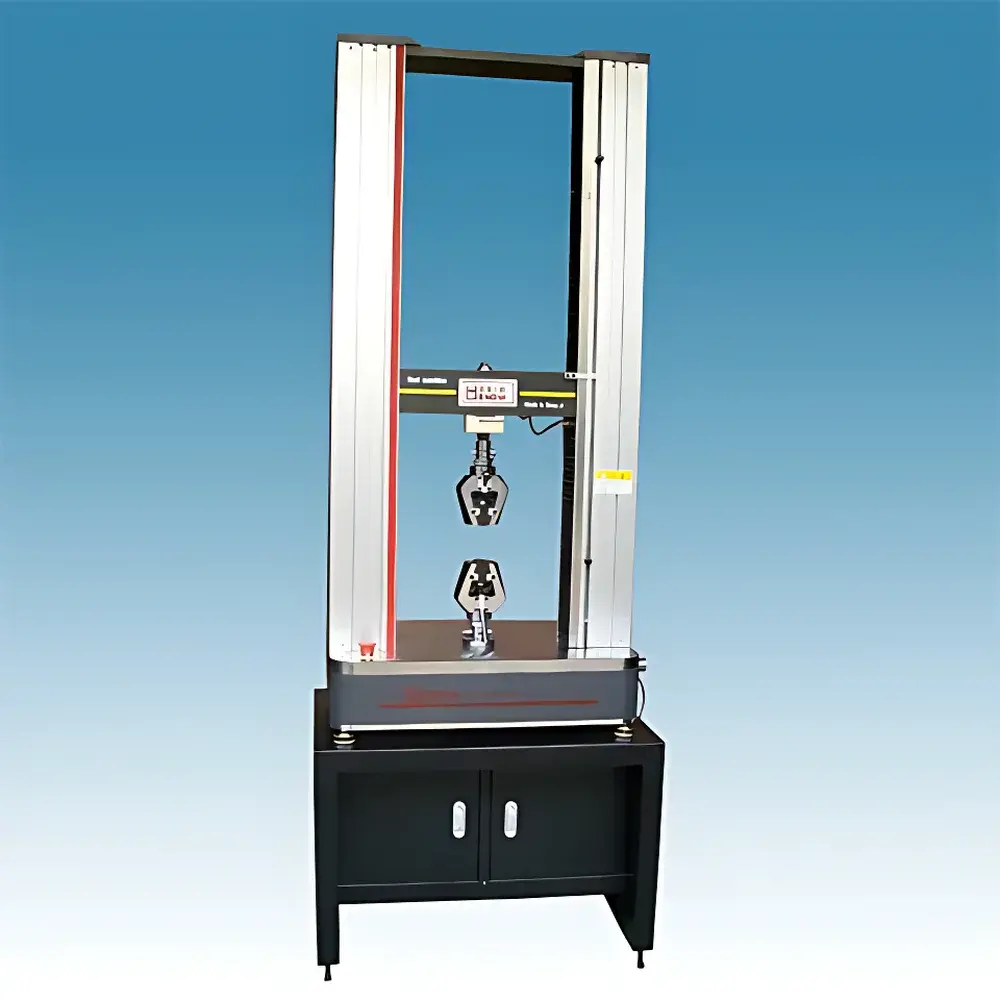
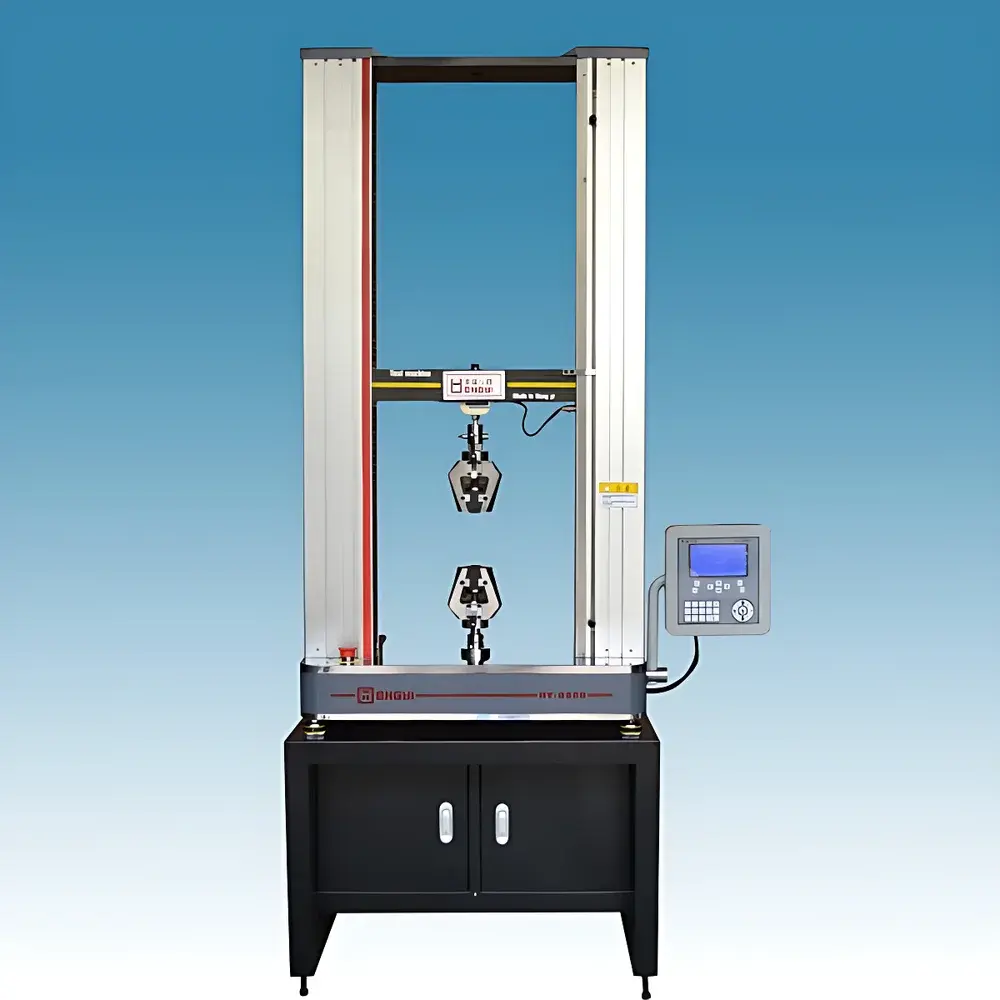
Hengyi HY-1080WT Universal Tensile Testing Machine
| Brand | Hengyi (hengyitest) |
|---|---|
| Origin | Shanghai, China |
| Manufacturer Type | Direct Manufacturer |
| Regional Category | Domestic (China) |
| Model | HY-1080WT |
| Instrument Type | Electromechanical Universal Testing Machine |
| Load Capacity Options | 1N–10kN (multi-sensor configurable) |
| Accuracy Class | ≤0.5% of full scale |
| Effective Test Width | 380 mm (expandable) |
| Effective Vertical Travel | 800 mm (extendable) |
| Speed Range | 0.001–500 mm/min |
| Speed Accuracy | ±0.5% of indicated value |
| Force Resolution | ±500,000 counts (full-scale, no range switching) |
| Displacement & Strain Measurement Accuracy | ±0.5% of indicated value |
| Stress/Strain Control Rate Range | 0.002–6% FS/S |
| Load Protection | 110% overload auto-shutdown |
| Power Supply | 220 V AC, single-phase, 750 W |
| Dimensions (W×D×H) | 700 × 420 × 1510 mm |
| Weight | 180 kg |
Overview
The Hengyi HY-1080WT is a high-rigidity, dual-column electromechanical universal testing machine engineered for static mechanical characterization under tension, compression, flexure, shear, peel, tear, and cyclic loading conditions. Based on the servo-controlled closed-loop principle, it applies precisely regulated axial force via a pair of preloaded precision ball screws driven by a Panasonic AC servo motor and digital drive system. Force is measured using a U.S.-sourced bidirectional load cell with automatic transducer recognition and thermal drift compensation. Displacement and strain are acquired through high-fidelity encoder feedback and optional extensometry—enabling traceable, repeatable quantification of mechanical properties including ultimate tensile strength, yield point (0.2% offset), Young’s modulus (E), elongation at break, compressive strength, flexural modulus, and Poisson’s ratio across diverse material classes.
Key Features
- Robust dual-column portal frame with integrated crosshead guidance—designed for minimal deflection and high lateral stiffness (customizable dual-test-space configuration available).
- Panasonic AC servo motor and driver system—maintenance-free operation with high torque density and sub-millisecond response time.
- Two pre-tensioned, ground-precision ball screws (imported)—ensuring axial alignment stability and long-term repeatability over >100,000 test cycles.
- U.S.-manufactured bidirectional load cell with automatic sensor identification—supports seamless calibration verification and multi-range force transducer interchangeability.
- Digital controller with multilingual UI (English, Chinese, Spanish, German, French) and unit-system switching (SI, imperial, metric)—operable in open-loop speed control or closed-loop stress/strain/displacement modes.
- Ergonomic handheld remote control—enabling intuitive jog, start/stop, and safety-initiated emergency halt without PC dependency.
Sample Compatibility & Compliance
The HY-1080WT accommodates specimens ranging from ultra-thin polymer films (≥10 µm) to rigid metallic rods (≤Φ15 mm), compliant with standard specimen geometries per ASTM D638, ISO 527-2, ASTM D790, ISO 178, ASTM D3039, ISO 527-4, ASTM D1876 (T-peel), ASTM D624 (tear), and ISO 1133 (melt flow index auxiliary testing). It supports regulatory workflows aligned with GLP and GMP environments: audit trails, user access levels, electronic signatures (via optional software module), and data integrity features conforming to FDA 21 CFR Part 11 requirements when paired with validated Hengyi TestSuite™ software. Calibration documentation—including Shanghai Institute of Measurement and Testing Technology (SIMT) certification—is provided upon request for metrological traceability to national standards.
Software & Data Management
Hengyi TestSuite™ v4.x (Windows-based) delivers real-time acquisition, parametric test method scripting, and automated report generation (PDF/Excel/XML). The software implements ISO 17025-aligned uncertainty calculation per force, displacement, and strain channels; stores raw waveform data at ≥1 kHz sampling rate; and supports custom pass/fail criteria with tolerance band overlays. All test files include embedded metadata: operator ID, environmental timestamp, calibration certificate ID, sensor serial number, and hardware firmware version. Export formats comply with ASTM E1434 and ISO/IEC 17025 data exchange protocols. Optional cloud synchronization enables secure, role-based remote review and cross-laboratory comparison.
Applications
- Polymers & elastomers: tensile modulus, yield behavior, hysteresis in cyclic loading, creep compliance (ISO 899-1).
- Thin conductive materials: PV ribbon tensile strength, solder joint pull strength, flexible PCB peel resistance.
- Biomaterials: suture tensile strength (ASTM D2256), hydrogel compression modulus, stent radial strength (ISO 25539-2).
- Packaging & paper: seal peel strength (ASTM F88), burst resistance (ISO 2758), edge crush test (ECT) simulation.
- Composites: interlaminar shear strength (ILSS), flexural performance of CFRP laminates (ASTM D7264).
- Medical devices: catheter kink resistance, balloon burst pressure correlation, orthopedic implant fixation strength.
FAQ
What is the maximum allowable specimen height for vertical testing?
The standard effective test space is 800 mm, but column extensions are available to accommodate specimens up to 1,500 mm tall—subject to load capacity derating per ISO 7500-1 Annex C.
Can the system perform constant-rate-of-travel (CRT) and constant-rate-of-extension (CRE) tests simultaneously?
No—CRT and CRE are mutually exclusive control modes. However, the controller supports dynamic mode switching within a single test sequence (e.g., ramp-to-load → hold → ramp-to-strain) via programmable step profiles.
Is third-party calibration support available outside China?
Yes—Hengyi maintains authorized service partners in Germany, USA, and Singapore certified to ISO/IEC 17025 for on-site recalibration and uncertainty reporting.
Does the system meet CE marking requirements for export to the EU?
The HY-1080WT complies with Machinery Directive 2006/42/EC, EMC Directive 2014/30/EU, and Low Voltage Directive 2014/35/EU. CE Declaration of Conformity and technical file documentation are supplied with each unit.
How is thermal drift compensated during long-duration creep tests?
The load cell incorporates temperature-compensated semiconductor strain gauges and real-time zero-tracking algorithms. For extended tests (>2 hrs), optional environmental chamber integration (−40°C to +200°C) with active thermal shielding is recommended.



