
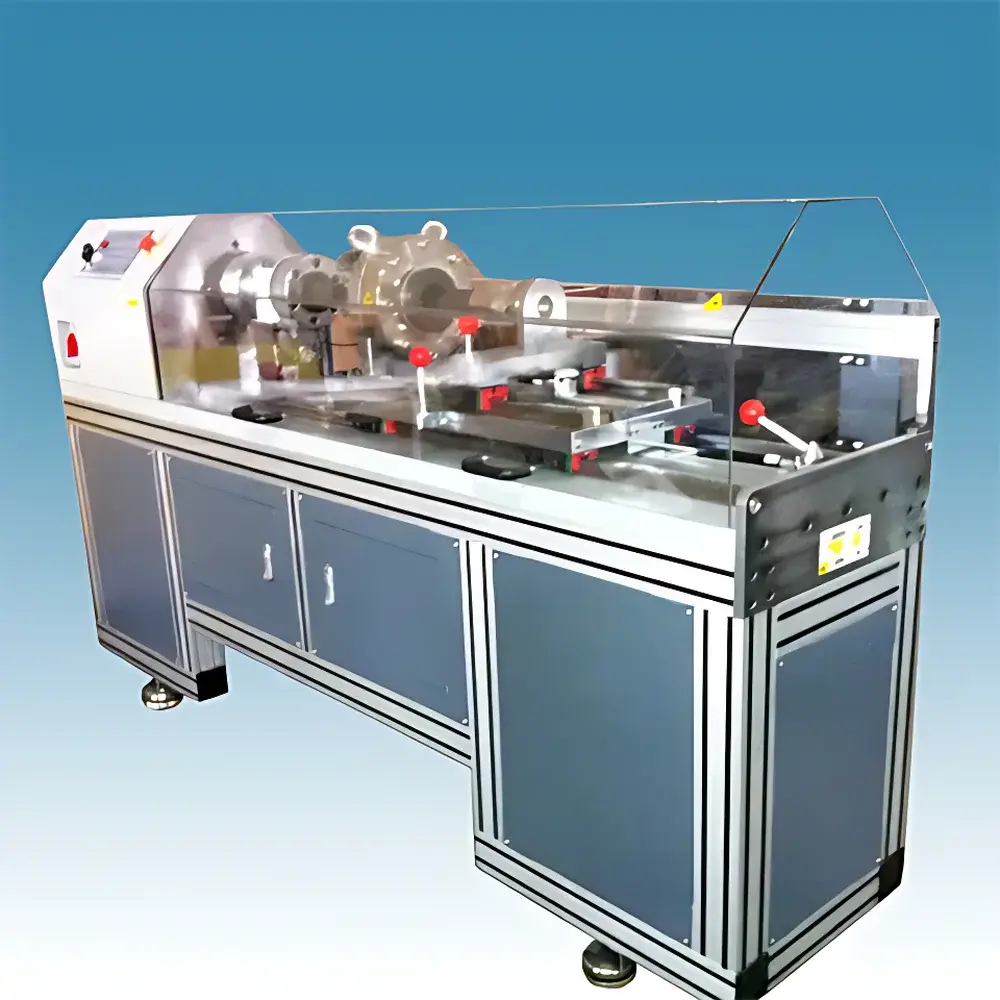
Hengyi HY-2000N.MFFG Composite-Sensor Thread Friction Coefficient Testing Machine for Fasteners
| Brand | Hengyi / Hengyitest |
|---|---|
| Origin | Shanghai, China |
| Manufacturer Type | Direct Manufacturer |
| Regional Category | Domestic (China) |
| Model | HY-2000N.MFFG |
| Max Torque | 2000 N·m |
| Torque Measurement Range | 2–2000 N·m |
| Torque Resolution | 1/50000 |
| Torsional Angle Measurement Range | 0–100000° (or continuous) |
| Motor Power | 5 kW |
Overview
The Hengyi HY-2000N.MFFG Composite-Sensor Thread Friction Coefficient Testing Machine is a high-precision torsion testing system engineered for quantitative mechanical characterization of threaded fasteners under controlled preload and rotational loading. It operates on the principle of simultaneous multi-axis force-torque-angle acquisition using integrated composite transducers—specifically designed to decouple axial clamping force (tensile load), total applied torque, thread torque, and bearing surface torque in real time. This architecture enables direct calculation of critical frictional parameters per ISO 16047, GB/T 3098.9–2010, and GB/T 16823.3–2010, including total coefficient of friction (µtot), thread coefficient of friction (µth), bearing surface coefficient of friction (µb), K-factor, yield torque and axial force, ultimate failure torque and tensile load, and angular displacement at key mechanical transitions. The machine is purpose-built for industries where bolted joint integrity is mission-critical: aerospace assembly, naval engineering, power generation infrastructure, rail vehicle manufacturing, and structural steel fabrication.
Key Features
- Composite-sensor architecture with synchronized measurement of axial force (5–500 kN), total torque (2–2000 N·m), thread torque (up to 1000 N·m), and torsional angle (0–100000° or continuous)
- High-resolution torque sensing with 1/50,000 resolution and ≤ ±0.5% full-scale accuracy across all torque ranges
- Stable low-speed control (5–40 rpm standard; up to 200 rpm optional) with no stick-slip behavior, ensuring smooth ramping during yield and failure testing
- Robust mechanical frame with 1000 mm maximum jaw spacing and 1800 kg operational mass for minimal deflection under peak load
- Modular HYtest controller and software platform supporting closed-loop torque, angle, or hybrid control modes
- Compliance-ready data logging with timestamped, audit-trail-enabled records suitable for GLP/GMP environments
Sample Compatibility & Compliance
The HY-2000N.MFFG accommodates threaded fasteners from M10 to M30 as standard, with custom jaw configurations available for non-standard geometries (e.g., countersunk heads, flange bolts, or double-end studs). Test specimens include hex bolts, socket cap screws, structural anchor bolts, and aerospace-grade NAS/MS-series fasteners. The system conforms to internationally recognized standards for fastener mechanical property evaluation, including ISO 16047 (determination of torque–tension characteristics), ISO 2320 (calibration of torque measuring devices), ISO 898-1 (mechanical properties of fasteners), EN 14399-1 & -3–6 (preloaded high-strength assemblies), and GB/T 16823.3–2010 (Chinese national standard for coefficient of friction testing). All measurement algorithms are traceable to SI units via factory calibration certificates aligned with ISO/IEC 17025 requirements.
Software & Data Management
The HYtest software suite provides full test sequence programming, real-time visualization of force–torque–angle interdependencies, and automated parameter extraction per defined standard protocols. Raw data streams (force, torque, angle, time) are saved in ASCII CSV format with metadata headers, enabling third-party analysis in MATLAB, Python, or statistical packages. The system supports 21 CFR Part 11-compliant user access control, electronic signatures, and immutable audit trails—including operator ID, calibration status, environmental conditions (if external sensors are connected), and version-stamped firmware/software logs. Export modules generate PDF reports with embedded graphs, pass/fail flags against specification limits, and customizable cover pages for QA documentation.
Applications
- Determination of µth and µb for lubricant qualification and batch release in fastener manufacturing
- Yield point detection and plastic deformation analysis during tightening of high-strength structural bolts (e.g., ASTM A325/A490, ISO 898-1 Class 10.9/12.9)
- K-factor validation for torque-controlled assembly processes in automotive and aerospace production lines
- Comparative friction studies across coating systems (zinc flake, phosphate, PTFE, dry film lubricants)
- Calibration and verification of torque wrenches and electronic tightening tools per ISO 6789-2
- Research into thread galling susceptibility, embedment relaxation, and creep behavior under sustained preload
FAQ
What standards does this machine directly support?
ISO 16047, GB/T 3098.9–2010, GB/T 16823.3–2010, ISO 2320, ISO 898-1, EN 14399-1 & -3–6.
Can it measure both thread and bearing surface friction independently?
Yes—via dual-torque composite sensor architecture that isolates thread torque and bearing surface torque from total applied torque and axial force.
Is the system compliant with FDA 21 CFR Part 11 for regulated laboratories?
Yes—when configured with role-based user accounts, electronic signatures, and audit-trail logging enabled.
What is the maximum axial force capacity?
500 kN (50 metric tons), with measurement accuracy ≤ ±0.5% FS.
Does the machine support automated test sequencing for unattended operation?
Yes—HYtest software allows scripting of multi-step protocols including ramp-hold-failure cycles, conditional branching, and pass/fail logic based on real-time parameter thresholds.



