
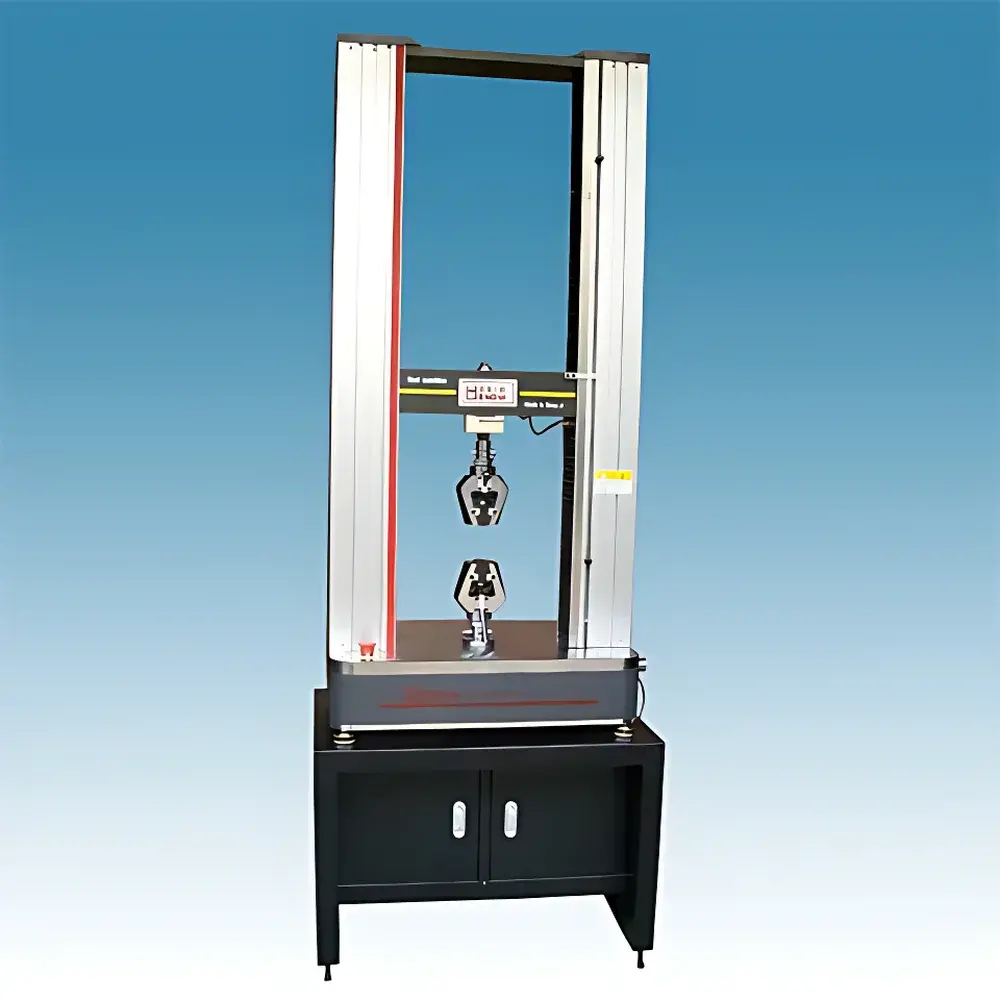
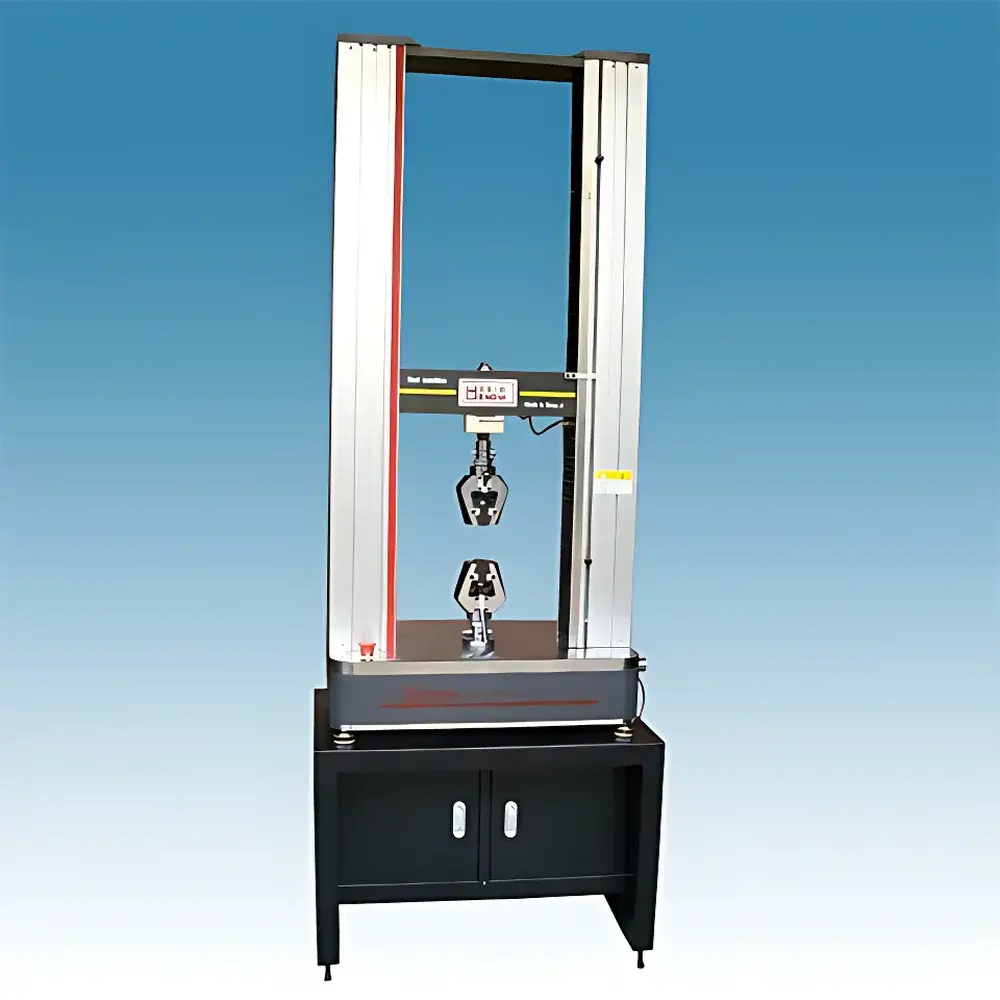
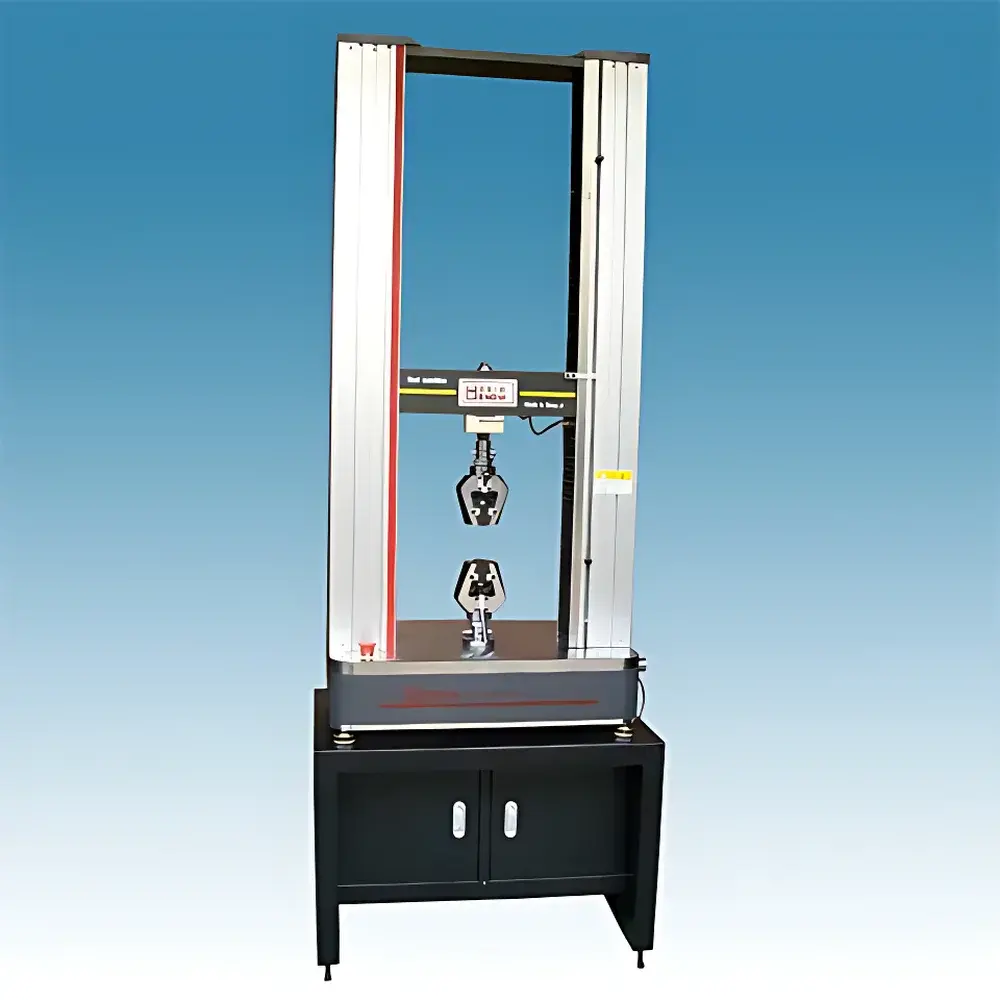
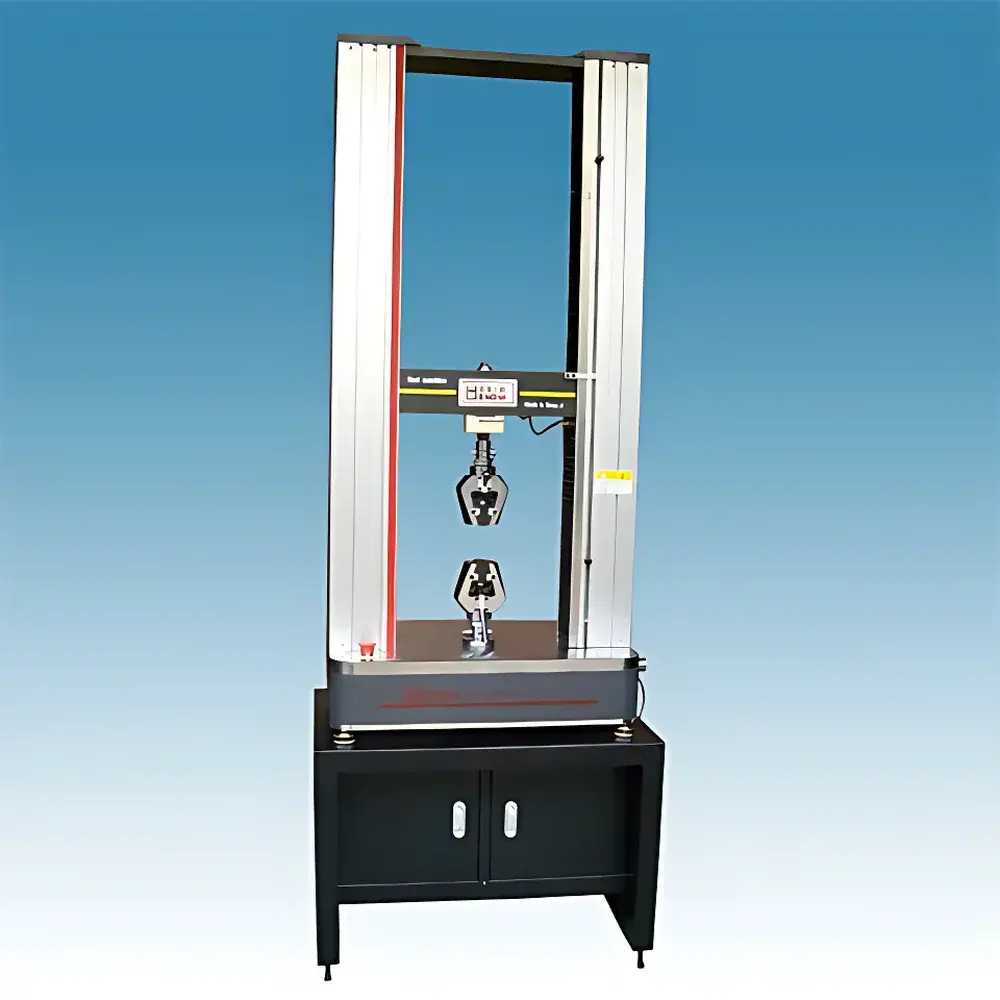
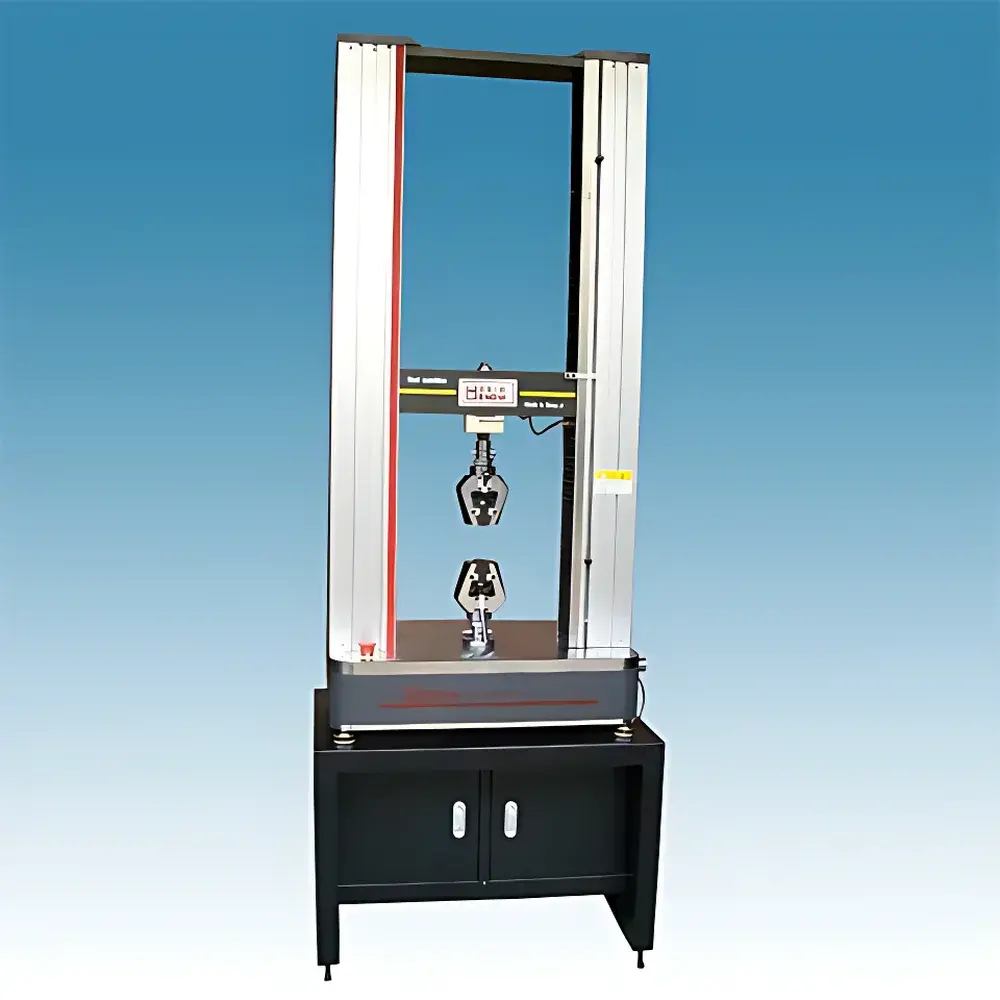
Hengyi HY-2080Q Universal Testing Machine (Dual-Column, Servo-Controlled)
| Brand | Hengyi / Hengyitest |
|---|---|
| Origin | Shanghai, China |
| Manufacturer Type | Direct Manufacturer |
| Instrument Type | Electromechanical Tensile Tester |
| Load Capacity Options | 1N–20kN (multi-range selectable) |
| Accuracy Class | ≤0.5% FS |
| Test Speed Range | 0.001–500 mm/min (continuous, closed-loop controlled) |
| Effective Test Width | 380 mm (expandable) |
| Effective Vertical Travel | 800 mm (extendable) |
| Force Resolution | ±500,000 counts full scale,不分档 (no range switching) |
| Displacement Accuracy | ±0.5% of reading |
| Strain Measurement Accuracy | ±0.5% of reading |
| Control System | High-speed DSP platform with USB 1.1 interface (12 Mb/s), hot-pluggable standard USB peripherals |
| Safety Protections | Dual electronic limit switches, overload protection (110% FS), emergency stop, real-time system diagnostics |
| Power Supply | 220 V AC, single-phase, 750 W |
| Dimensions (W×D×H) | 700 × 420 × 1510 mm |
| Weight | 180 kg |
Overview
The Hengyi HY-2080Q is a dual-column, electromechanical universal testing machine engineered for high-fidelity static mechanical characterization of materials across research, quality control, and production environments. Based on the principle of controlled force and displacement application via precision servo-motor-driven ball screws, the system delivers traceable, repeatable mechanical data under tension, compression, bending, shear, peel, tear, and cyclic loading conditions. Its modular architecture supports standardized test methods aligned with ASTM E4, ASTM D638, ISO 527, ISO 6892-1, GB/T 228.1, and USP <1041> for mechanical testing of pharmaceutical packaging and medical devices. Designed for laboratory-grade reliability without compromise, the HY-2080Q integrates a high-rigidity aluminum-alloy frame, preloaded imported ball screws, and a bidirectional load cell with automatic calibration recognition — ensuring long-term dimensional stability and measurement integrity.
Key Features
- High-performance Panasonic AC servo motor and driver system — maintenance-free, low-noise, and thermally stable for extended duty cycles.
- Dual precision preloaded ball screws (imported) — minimize axial play and backlash, enabling sub-micron positioning resolution and consistent speed fidelity across the full 0.001–500 mm/min range.
- U.S.-sourced, high-accuracy bidirectional load cell — auto-recognized by controller, supporting seamless range switching from 1 N to 20 kN without recalibration.
- DSP-based real-time control platform — 4-layer PCB design with optimized EMI shielding, 12 Mb/s USB 1.1 bulk-transfer interface, and hot-pluggable peripheral support for future expansion.
- Comprehensive safety architecture — dual independent electronic limit switches, hardware-triggered emergency stop, 110% overload cut-off, and continuous self-diagnostic monitoring of drive voltage, current, and thermal status.
- Intuitive dual-mode controller — supports both open-loop jog operation and closed-loop PID-controlled testing modes, with multilingual UI (English, German, French, Spanish, Chinese) and SI/metric/imperial unit conversion.
Sample Compatibility & Compliance
The HY-2080Q accommodates a broad spectrum of specimen geometries and material classes — from thin polymer films (≥10 µm thick), elastomeric biomaterials, and metallic foils (Cu/Al/PV ribbon), to rigid composites, orthopedic fixation components, and pharmaceutical blister packs. Standardized fixtures include tensile grips (pneumatic, wedge, pneumatic vise), compression platens, 3-/4-point bend assemblies, peel bars, and shear fixtures — all compatible with ISO 2041 and ASTM E1012 alignment protocols. The system meets GLP documentation requirements through optional audit-trail-enabled software (compliant with FDA 21 CFR Part 11 when paired with validated PC configuration). Calibration traceability follows ISO/IEC 17025 guidelines, with optional factory-issued Shanghai Metrology Institute certificate (CNAS-accredited).
Software & Data Management
Control and analysis are performed via Windows-based HengyiTest software, built on VB.NET and SQL Server Compact Engine for deterministic data handling and query scalability. Real-time plotting supports dynamic axis scaling, multi-curve overlay, and parameter tagging (e.g., yield point, 0.2% offset, ultimate tensile strength, modulus at 10–50% strain). All raw channel data (load, displacement, extensometer, time) are stored in binary-encoded .HDT files with embedded metadata (operator ID, sample ID, environmental timestamp, fixture ID). Export options include CSV, PDF reports (with customizable templates), and image-embedded vector plots. User-defined test methods can be saved as XML-configurable protocols — supporting method validation, version control, and cross-laboratory reproducibility. Optional network deployment enables centralized instrument management and role-based access control.
Applications
- Materials R&D: Determination of Young’s modulus (E), Poisson’s ratio, yield strength (Rp0.2), tensile/compressive strength, elongation at break, and stress–strain hysteresis in polymers, elastomers, and composites.
- Medical Device QA: Peel strength of sterile barrier packaging (ISO 8559), tensile integrity of suture threads (ISO 10993-12), compression resistance of orthopedic foam implants, and mechanical fatigue of endoscopic components.
- Electronics Manufacturing: Bond strength evaluation of photovoltaic interconnect ribbons, flexural rigidity of FPCBs, and shear adhesion of underfill epoxies.
- Automotive & Aerospace: Fastener proof loading (ISO 898-1), composite laminate interlaminar shear (ASTM D2344), and rubber bushing compression set (ASTM D395).
- Academic & Accredited Labs: Teaching mechanical behavior fundamentals, validating finite element models, and generating reference datasets compliant with ISO/IEC 17025 accreditation scopes.
FAQ
What standards does the HY-2080Q support out-of-the-box?
Preconfigured test methods cover ASTM D638 (plastics tensile), ASTM D790 (flexural), ISO 527-2, ISO 604, ISO 7500-1 (calibration), and GB/T 228.1. Custom method creation is fully supported via scriptable parameters.
Can the system perform closed-loop strain control?
Yes — using optional contact or non-contact extensometers (e.g., video-based DIC or clip-on LVDT), the controller executes strain-rate control per ISO 6892-1 Annex C with rate accuracy ±0.5% FS/S above 0.05% FS/S.
Is third-party calibration certification included?
Standard delivery includes factory verification report. CNAS-accredited Shanghai Metrology Institute calibration certificate is available as optional add-on (traceable to NIM, China).
How is data integrity ensured during long-duration tests?
All measurements are timestamped with microsecond resolution; power-loss recovery mode preserves last valid state and resumes from checkpoint upon reboot. Database journaling prevents corruption during unexpected shutdowns.
What maintenance is required for long-term accuracy?
Quarterly lubrication of ball screws with lithium-based grease (mixed with light machine oil), biannual visual inspection of load cell mounting and grip alignment, and annual verification of encoder linearity and zero-drift — documented per ISO 9001 maintenance logs.



