
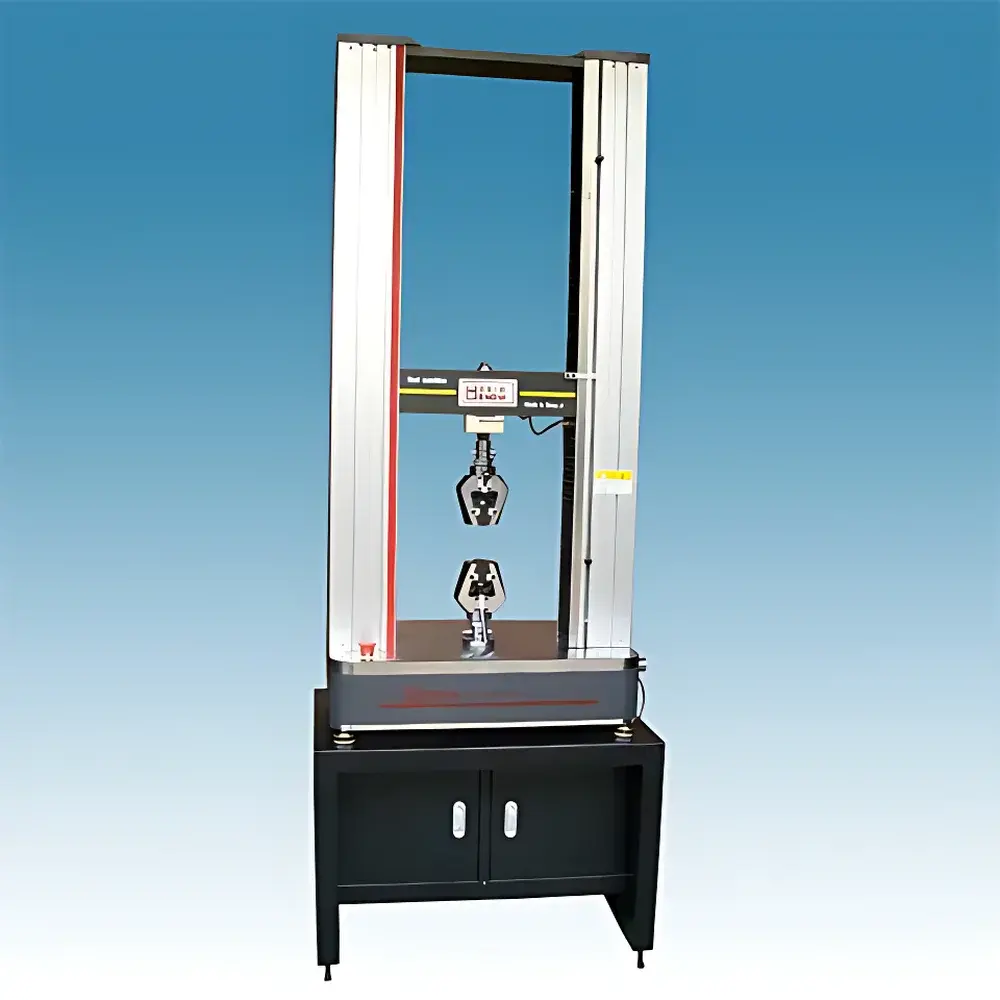
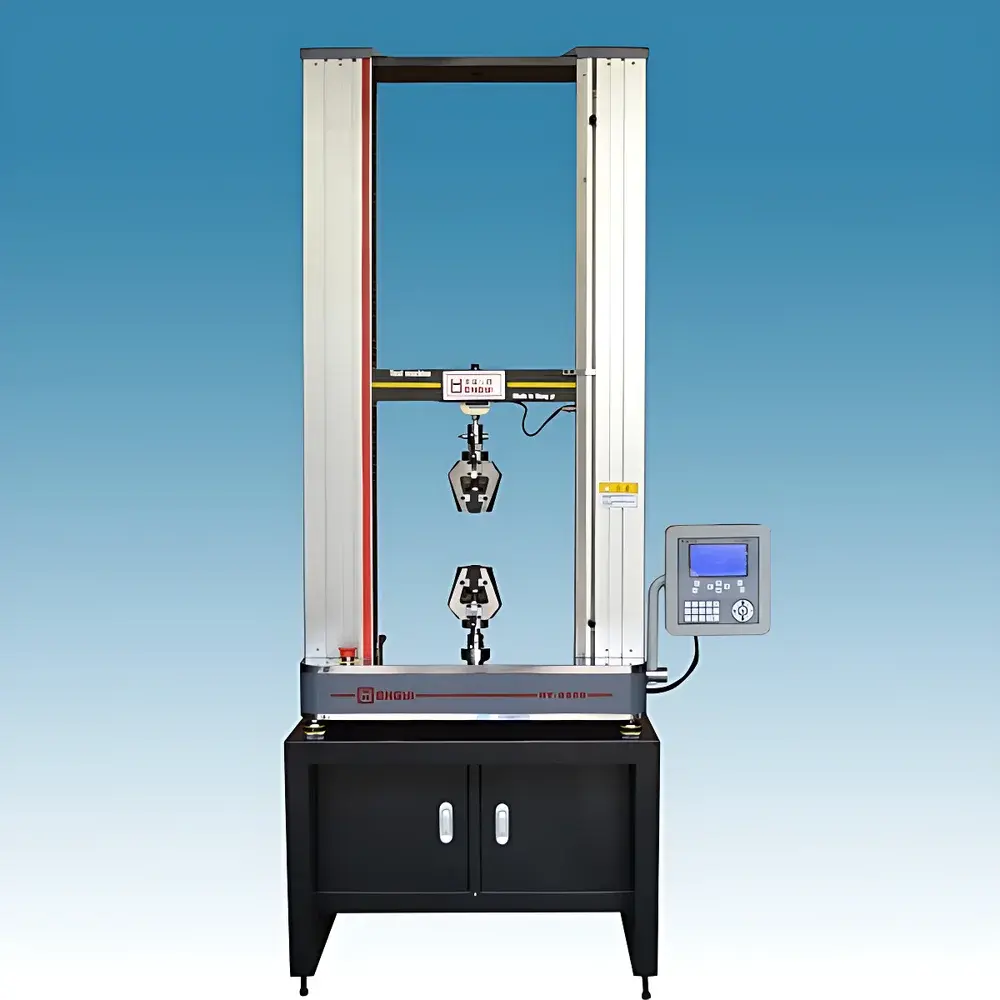
Hengyi HY-3080TYHH Three-Point Bending Tester for Cemented Carbides
| Brand | Hengyi / Hengyitest |
|---|---|
| Origin | Shanghai, China |
| Manufacturer Type | Direct Manufacturer |
| Regional Classification | Domestic (China) |
| Model | HY-3080TYHH |
| Instrument Type | Electromechanical Universal Testing Machine |
| Load Capacity Options | 1 N to 30 kN (multi-range configurable) |
| Accuracy Class | ≤ 0.5% of reading |
| Force Resolution | ±500,000 counts (full-scale, no range switching) |
| Effective Test Width | 380 mm (expandable) |
| Effective Vertical Travel | 800 mm (extendable) |
| Speed Range | 0.001–1000 mm/min (continuous, closed-loop controlled) |
| Speed Accuracy | ±0.5% of set value |
| Displacement Measurement Accuracy | ±0.5% of reading |
| Strain Control Rate Range | 0.002–6% FS/S |
| Stress Control Rate Range | 0.005–6% FS/S |
| Constant-Load/Displacement/Strain Accuracy | ±0.1% FS (≥10% FS), ±1% FS (<10% FS) |
| Safety Protection | Electronic limit switches, overload cutoff (110% FS), real-time system diagnostics |
| Power Supply | 220 V AC, single-phase, 0.75 kW |
| Host Dimensions | 700 × 420 × 1600 mm |
| Net Weight | 210 kg |
Overview
The Hengyi HY-3080TYHH Three-Point Bending Tester is a high-precision electromechanical universal testing machine engineered for standardized flexural strength evaluation of cemented carbides and other brittle or semi-brittle engineering materials. It operates on the principle of three-point bending per ASTM C78, ISO 14704, and GB/T 33806—applying a concentrated load at the midspan of a simply supported beam specimen while measuring force, displacement, and deflection in real time. Designed with a rigid double-column龙门 (gantry) frame, preloaded high-accuracy ball screws, and bidirectional load cells calibrated to ISO 7500-1 Class 0.5, the system ensures mechanical stability and measurement repeatability essential for quality control in hardmetal manufacturing, R&D labs, and third-party certification bodies.
Key Features
- Modular dual-column gantry structure with high torsional rigidity and minimal frame deflection under load
- Brushless servo motor and digital servo driver delivering precise speed control from 0.001 to 1000 mm/min (±0.5% accuracy)
- Twin pre-tensioned precision ground ball screws enabling smooth, backlash-free axial motion and long-term dimensional stability
- High-fidelity bidirectional load cell(s) available in 13 selectable capacities (1 N – 30 kN), all traceable to national standards
- Digital controller supporting open-loop and closed-loop operation, with multi-language UI (English, German, French, Spanish, Chinese) and unit conversion (N/kN/lbf, mm/in, MPa/psi)
- Integrated handheld remote control for rapid setup, jog positioning, and emergency stop functionality
- Real-time synchronized acquisition of force, large/small deformation (via extensometer or encoder), and crosshead displacement
- Automated test logic: programmable fracture detection (based on slope threshold or force drop), auto-return to origin, and conditional termination (time, load, or displacement)
Sample Compatibility & Compliance
The HY-3080TYHH accommodates a broad spectrum of specimens relevant to advanced material characterization—including sintered tungsten carbide (WC-Co) inserts, ceramic-matrix composites, hardened tool steels, thin metallic foils (Cu, Al), photovoltaic interconnect ribbons, biomedical alloys (Co-Cr, Ti-6Al-4V), polymer laminates, and fiber-reinforced thermosets. Its adjustable support span (standard 20–100 mm, customizable), interchangeable bending fixtures, and modular test space (380 mm width × 800 mm height) ensure adaptability across ISO 178, ASTM D790, EN 206, and JIS K 7203 protocols. The system meets mechanical safety requirements per ISO 12100 and incorporates hardware-based electronic limit protection, overload cut-off (110% FS), and self-diagnostic routines for drive, sensor, and power subsystems—supporting GLP-compliant operation in regulated environments.
Software & Data Management
Control and analysis are executed via Hengyi’s proprietary Windows-based software platform, built on VB.NET and SQL Server architecture for deterministic data handling and audit-trail integrity. The interface supports method-driven testing: users define custom test sequences—including ramp-hold-relax cycles, multi-stage stress-strain protocols, and conditional branching—without coding. All raw data (force, displacement, time, extensometer output) are stored in encrypted binary + CSV dual format with embedded metadata (operator ID, timestamp, calibration certificate ID, environmental conditions). Exported reports comply with FDA 21 CFR Part 11 requirements when configured with user authentication, electronic signatures, and immutable audit logs. Curve analysis tools include automatic yield point detection (0.2% offset), tangent modulus calculation, flexural modulus derivation (per ISO 14125), and comparative overlay of up to 16 curves with statistical summary (mean, SD, CV%).
Applications
This tester serves critical roles across industrial QA/QC and academic research domains: quantifying transverse rupture strength (TRS) of sintered carbide blanks per ISO 3327; evaluating flexural fatigue behavior of dental prosthetic frameworks; validating bending stiffness of flexible PCB substrates; assessing delamination resistance in aerospace-grade carbon fiber laminates; and characterizing fracture toughness of additively manufactured Ni-based superalloys. It is routinely deployed in metrology institutes (e.g., CNAS-accredited labs), tier-1 automotive suppliers (for brake pad backing plates), solar cell manufacturers (for ribbon tensile-bend coupling), and university materials science departments conducting structure-property correlation studies under controlled humidity and temperature conditions.
FAQ
What standards does the HY-3080TYHH support for cemented carbide bending tests?
ASTM C78, ISO 14704, GB/T 33806, and ISO 3327 for transverse rupture strength determination.
Can the system perform both three-point and four-point bending configurations?
Yes—four-point bending fixtures are available as optional accessories, enabling pure moment region evaluation per ASTM D6272.
Is the load cell calibration traceable to national metrology institutes?
All load cells ship with factory calibration certificates traceable to CNAS-accredited laboratories; optional UKAS or DAkkS-certified calibration is available upon request.
Does the software support automated report generation compliant with ISO/IEC 17025?
Yes—the reporting module includes customizable templates, automatic uncertainty propagation (GUM-compliant), and digital signature fields meeting ILAC P14 requirements.
What maintenance is required for long-term accuracy retention?
Annual verification of force and displacement metrology chains is recommended; no routine lubrication or mechanical adjustment is needed due to maintenance-free servo and sealed ball screw design.



