
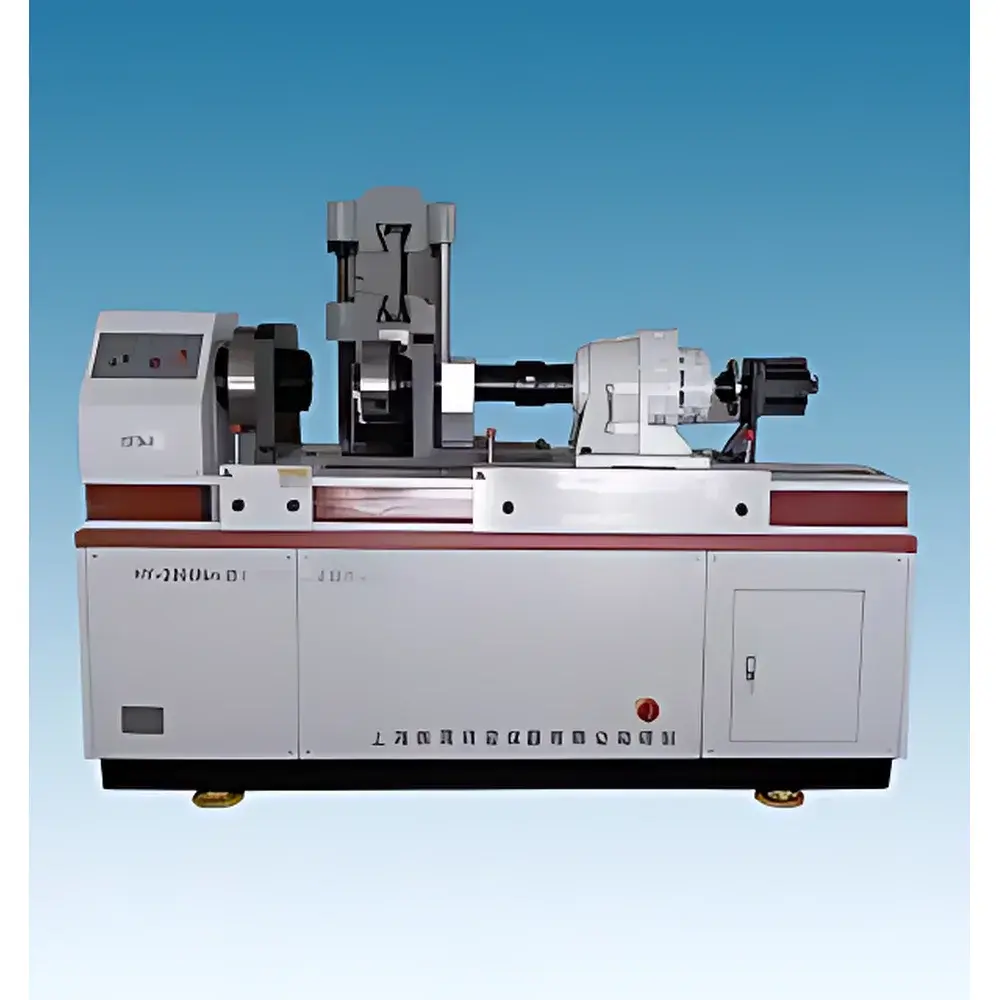
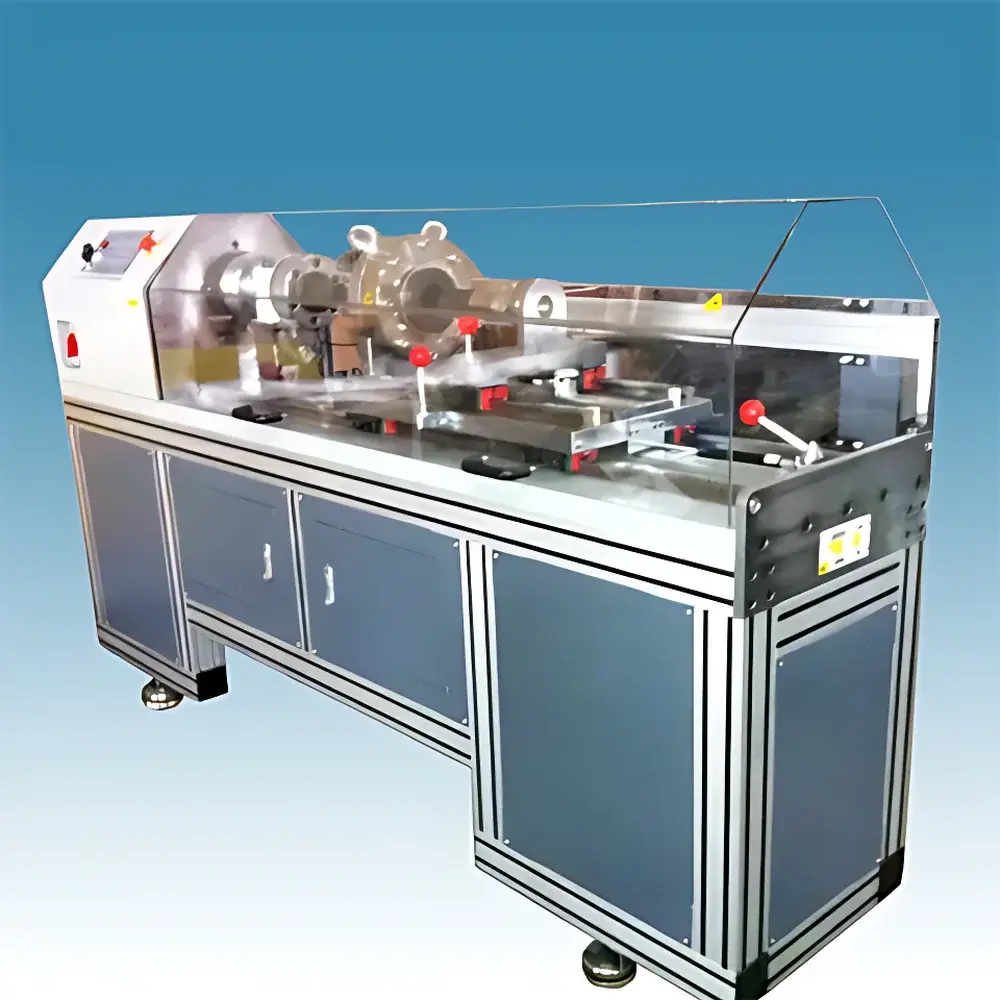
Hengyi HY-5000N·m High-Strength Bolt Torque Coefficient Testing Machine
| Brand | Hengyi / Hengyitest |
|---|---|
| Origin | Shanghai, China |
| Manufacturer Type | Direct Manufacturer |
| Product Origin | Domestic (China) |
| Model | HY-5000N·m |
| Max Torque | 2000 N·m |
| Torque Measurement Range | 2–2000 N·m |
| Torque Resolution | 1/500,000 |
| Torsion Angle Measurement Range | 0–100,000° (or continuous) |
| Motor Power | 5 kW |
| Axial Force Range | 10–1000 kN |
| Torque Measurement Accuracy | ±0.5% FS (typical) |
| Torsion Angle Accuracy | ±0.5% FS (typical) |
| Rotational Speed Range | 0–1000°/min |
| Gauge Length Adjustment | Up to 1000 mm |
| Specimen Clamping Range | M10–M30 (customizable up to M36) |
| Host Dimensions (L×W×H) | ~3500 × 540 × 1250 mm |
| Weight | 3000 kg |
Overview
The Hengyi HY-5000N·m High-Strength Bolt Torque Coefficient Testing Machine is a precision-engineered, horizontally configured torsion testing system designed specifically for the mechanical characterization of high-strength fasteners in accordance with international standards including GB/T 16823.3, ISO 898-1, ASTM F606, ASTM F2281, and DIN 267-27. It operates on the principle of controlled quasi-static torsional loading combined with simultaneous axial force measurement—enabling concurrent acquisition of torque, angle of twist, axial preload, and rotational displacement. This dual-axis (torque + axial force) measurement architecture supports full traceability of bolt tightening behavior, including torque coefficient (K-value), prevailing torque, breakaway torque, yield torque, ultimate torque, and elastic region torsional stiffness. The system is engineered for structural integrity testing in quality assurance laboratories, R&D centers, and manufacturing environments where compliance with ISO/IEC 17025, GLP, and automotive OEM specifications (e.g., VW 33931, Ford WSS-M3Q179-A1) is mandatory.
Key Features
- Horizontal load frame with reinforced steel base and high-rigidity welded structure, supporting static and dynamic torsional loads up to 2000 N·m and axial forces up to 1000 kN
- Dual-sensor architecture: High-accuracy torque transducer (5000 N·m capacity, calibrated per ISO 376 Class 0.5) and high-resolution axial load cell (1000 kN, Class 0.5 per ISO 376)
- Precision angular measurement via imported optical encoder (resolution ≤ 0.01°, repeatability ±0.02°) synchronized with torque sampling at ≥100 Hz
- Japanese Panasonic AC servo motor with 1:2,000,000 speed regulation ratio and closed-loop position control; torsion speed range: 0.01–1000°/min
- ARM32-based real-time control system (56 MIPS processing capability) ensuring deterministic response, low-latency feedback, and stable closed-loop operation under variable load conditions
- Modular fixture system accommodating bolts from M10 to M36; includes dedicated torsion grips with self-centering jaws and anti-rotation features for standardized test alignment
- Integrated safety interlocks, emergency stop circuitry compliant with EN ISO 13850, and overload protection for both torque and axial channels
Sample Compatibility & Compliance
The HY-5000N·m system accommodates standard and non-standard fasteners—including hex bolts, flange bolts, shear bolts, and pre-tensioned anchor assemblies—within nominal diameters M10–M36. Specimen geometry is secured using interchangeable jaw inserts with hardened alloy surfaces to prevent slippage or thread damage during high-torque cycling. All mechanical and electrical subsystems meet CE marking requirements (2014/30/EU EMC Directive and 2006/42/EC Machinery Directive). Test data output complies with ISO/IEC 17025 clause 7.7 (reporting requirements) and supports audit-ready documentation for FDA 21 CFR Part 11–compliant environments when paired with optional electronic signature modules and audit trail logging.
Software & Data Management
The included Windows-based testing software (v4.x) provides full I/O synchronization across torque, axial force, angle, and time domains. It supports real-time curve overlay, multi-segment analysis (e.g., elastic slope calculation for G-modulus derivation), automatic K-factor computation per ISO 16047, and customizable report templates exportable as PDF, Excel, or XML. Raw data files are stored in binary format with embedded metadata (operator ID, calibration timestamp, environmental conditions), enabling version-controlled archival. The software architecture implements role-based access control (RBAC), electronic signatures, and immutable audit trails meeting GLP/GMP and ISO 9001:2015 documentation requirements. Optional API integration enables bidirectional communication with LIMS platforms via TCP/IP or OPC UA protocols.
Applications
- Determination of torque coefficient (K-value) and scatter analysis for high-strength structural bolts used in bridge construction, wind turbine towers, and rail infrastructure
- Verification of assembly process parameters for automotive powertrain fasteners subjected to joint relaxation and embedment effects
- Evaluation of lubricant efficacy and surface treatment impact on frictional behavior under controlled preload conditions
- Research into torsional fatigue life and plastic deformation thresholds in ASTM A325/A490 grade bolts
- Validation of tightening tool performance against ISO 5393 and VDI 2230 Part 2 guidelines
- Calibration reference testing for torque wrenches, electric screwdrivers, and hydraulic tensioners
FAQ
What standards does this machine support for torque coefficient testing?
It fully supports ISO 16047, GB/T 16823.3, ASTM F2281, and DIN 267-27 for K-value determination, including statistical evaluation of scatter bands and confidence intervals.
Can the system measure both torque and axial force simultaneously?
Yes—the dual-channel acquisition architecture captures synchronized torque, axial force, angle, and time data at ≥100 Hz, enabling true multivariate analysis of bolt tightening mechanics.
Is the software compliant with regulatory data integrity requirements?
The software supports ALCOA+ principles (Attributable, Legible, Contemporaneous, Original, Accurate, Complete, Consistent, Enduring, Available) and may be configured for 21 CFR Part 11 compliance with electronic signatures and audit trail activation.
What is the maximum specimen length accommodated?
The adjustable gauge length supports specimens up to 1000 mm between grips, suitable for long-anchor bolts and custom-length assemblies.
Does the system include calibration certificates for sensors?
Each torque transducer and axial load cell is supplied with a UKAS-accredited or CNAS-traceable calibration certificate valid for 12 months from shipment.



