
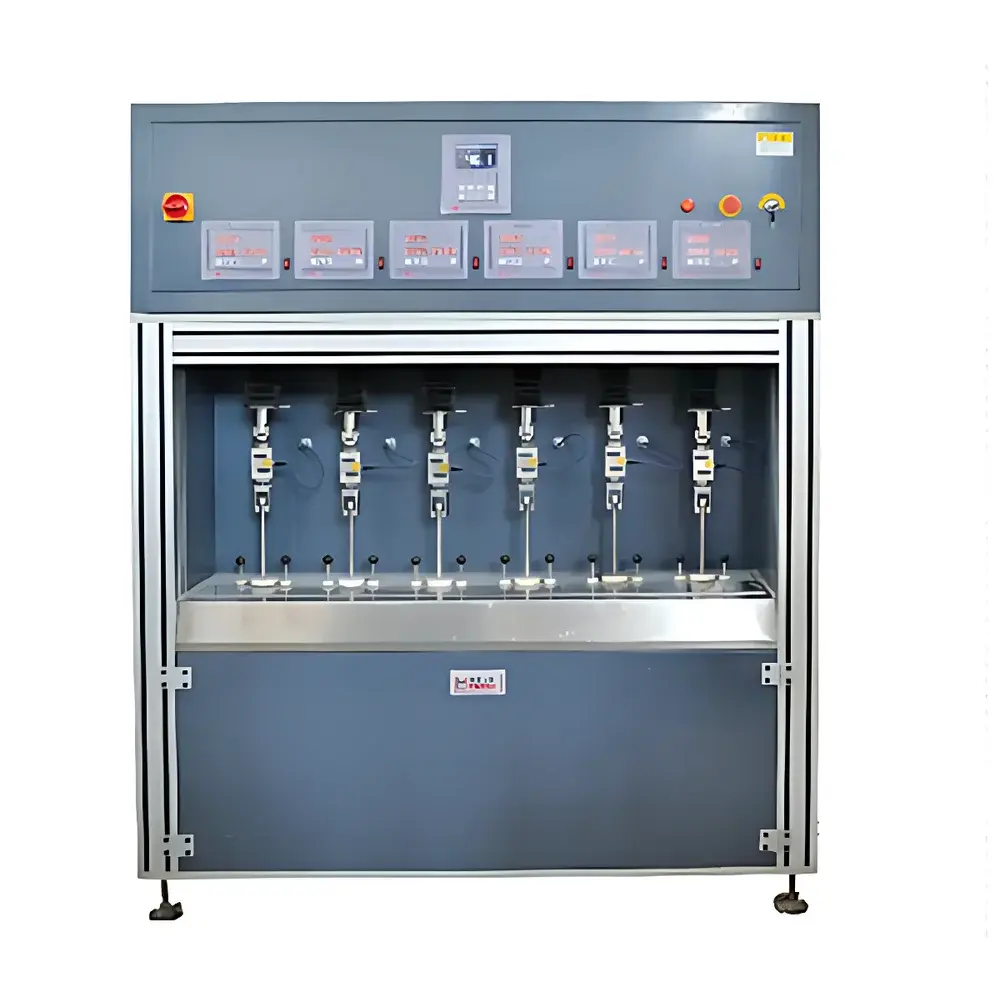
Hengyi HY-QKRB Full-Notch Creep Tester for Non-Metallic Materials
| Brand | Hengyi / Hengyitest |
|---|---|
| Origin | Shanghai, China |
| Manufacturer Type | Direct Manufacturer |
| Regional Category | Domestic (China) |
| Model | HY-QKRB-TYHH |
| Price | Upon Request |
| Load Capacity | 2000 N (interchangeable load cells available below 2000 N |
| Effective Force Measurement Range | 0.4%–99.999% of full scale |
| Test Width | 120 mm |
| Vertical Test Space | 200 mm |
| Speed Range | 0.001–100 mm/min (infinitely adjustable) |
| Speed Accuracy | ±1% of indicated value |
| Displacement & Strain Measurement Accuracy | ±1% of indicated value |
| Test Stations | 12 independent stations |
| Temperature Control Range (Constant-Temp Bath) | Ambient to 95 °C |
| Temperature Stability | ±0.5 °C |
| Control System | PC-based closed-loop control |
| Power Requirement | 220 V AC, 10 kW |
| Machine Weight | 850 kg |
| Dimensions (W×D×H) | 1620 × 850 × 1750 mm |
| Compliance | GB/T 15820–1995, GB/T 11546, GB/T 32682–2016, ISO 16770, ISO 899-1, ISO 3501 |
Overview
The Hengyi HY-QKRB Full-Notch Creep Tester is a purpose-built, multi-station mechanical testing system engineered for standardized evaluation of environmental stress cracking (ESC) and time-dependent deformation behavior in thermoplastic polymers—particularly polyethylene (PE) pipe materials, geomembranes, and fiber-reinforced composites. It implements the full-notch creep test (FNCT) method per ISO 16770 and GB/T 32682–2016, wherein pre-notched specimens are subjected to constant tensile load under controlled thermal and chemical environments (e.g., detergent solutions or distilled water at elevated temperatures). Unlike conventional uniaxial creep testers, the HY-QKRB integrates 12 independently actuated test stations with isolated elastic support structures, enabling statistically robust, parallelized failure-time analysis across replicate specimens without cross-talk or mechanical coupling. Its design adheres to fundamental principles of linear viscoelasticity and fracture mechanics, where crack propagation under sustained load is monitored as a function of stress intensity factor (KI) and environmental aggressivity—critical for predicting long-term service life of pressure piping systems and containment liners.
Key Features
- Twelve fully autonomous test stations with individual servo-controlled loading actuators and real-time force feedback loops—each station operates independently with no mechanical or thermal interference.
- Modular elastic suspension architecture ensures mechanical decoupling between stations, eliminating load redistribution artifacts and supporting high reproducibility (CV < 3% for time-to-failure across identical specimens).
- Integrated constant-temperature bath system (ambient to 95 °C) with ±0.5 °C stability, accommodating standardized immersion media per ISO 16770 (e.g., Igepal CO-630 surfactant solution) and enabling precise ESC acceleration studies.
- High-resolution force measurement using calibrated load cells (up to 2000 N capacity), with optional interchangeable sensors covering sub-10 N to 2000 N ranges—supporting ASTM D1782–99 and ISO 899-1 compliant low-load creep protocols.
- Computer-controlled displacement actuation (0.001–100 mm/min, ±1% speed accuracy) with synchronized data acquisition at ≥10 Hz sampling rate for displacement, load, and temperature—ensuring compliance with GLP audit requirements for raw data traceability.
- Comprehensive self-diagnostic firmware with hardware interlocks, over-travel protection, thermal runaway safeguards, and automatic emergency shutdown—certified for continuous unattended operation up to 10,000 hours.
Sample Compatibility & Compliance
The HY-QKRB accommodates standardized FNCT specimens per ISO 16770 (10 mm × 10 mm × 4 mm, with 0.3 mm deep notch) and tensile creep bars per ISO 899-1 (Type 1A, 80 mm gauge length). It supports both dry-air and liquid-immersion testing configurations, including aggressive surfactant media used in PE pipe qualification. The system is validated against national and international standards including GB/T 15820–1995 (PE pipe joint pull-out resistance), GB/T 11546 (plastic creep modulus determination), and ISO 3501 (reference method for ESC classification). All firmware and software modules comply with FDA 21 CFR Part 11 requirements for electronic records and signatures when configured with audit trail logging and user access controls.
Software & Data Management
The embedded Windows-based control suite (Hengyi TestMaster v4.2) provides bilingual (English/Chinese) interface navigation, real-time multi-channel visualization, and automated pass/fail logic based on user-defined failure criteria (e.g., specimen rupture, 5% strain deviation, or load drop >10%). Raw data—including force, displacement, temperature, and timestamp—are stored in vendor-neutral CSV and XML formats with embedded metadata (test ID, operator, calibration certificate ID, environmental conditions). Software includes built-in calculation engines for time-to-failure (TTF), creep compliance (J(t)), and master curve construction via time–temperature superposition (TTS). Exported datasets are compatible with third-party statistical packages (Minitab, JMP) and LIMS integration via ODBC drivers.
Applications
- Accelerated lifetime prediction of HDPE gas/water distribution pipes under soil stress and surfactant exposure.
- Comparative ESC resistance screening of PE resin grades during polymer development and supplier qualification.
- Validation of fusion joint integrity per ASTM F2620 and ISO 4427 for municipal infrastructure projects.
- Regulatory submission testing for CE marking (EN 1555 series) and NSF/ANSI 61 certification of potable water system components.
- Research into synergistic effects of temperature, oxidative aging, and mechanical loading on polymer fracture kinetics.
FAQ
What standards does the HY-QKRB explicitly support?
It is fully aligned with ISO 16770 (FNCT), ISO 899-1 (tensile creep), GB/T 32682–2016, GB/T 11546, and GB/T 15820–1995—including mandatory specimen geometry, loading protocol, and environmental conditioning requirements.
Can the system perform tests without immersion media?
Yes—dry-air creep and pull-out testing modes are supported via configurable environmental chamber options; liquid bath operation is optional but required for FNCT per ISO 16770.
Is multi-sensor calibration traceable to national metrology institutes?
All load cells ship with NIST-traceable calibration certificates (CNAS-accredited lab), and in-field recalibration routines maintain ISO/IEC 17025 compliance through documented uncertainty budgets.
How is data integrity ensured during long-duration tests (e.g., 1000+ hours)?
The system employs non-volatile memory buffering, redundant power-supply monitoring, and auto-resume functionality after unexpected power loss—preserving all timestamps and intermediate measurements without interpolation.
Does the software support 21 CFR Part 11 compliance for pharmaceutical or medical device applications?
Yes—when deployed with domain-authenticated Windows Active Directory, electronic signatures, and enabled audit trail logging, it satisfies predicate rule requirements for regulated GxP environments.



