
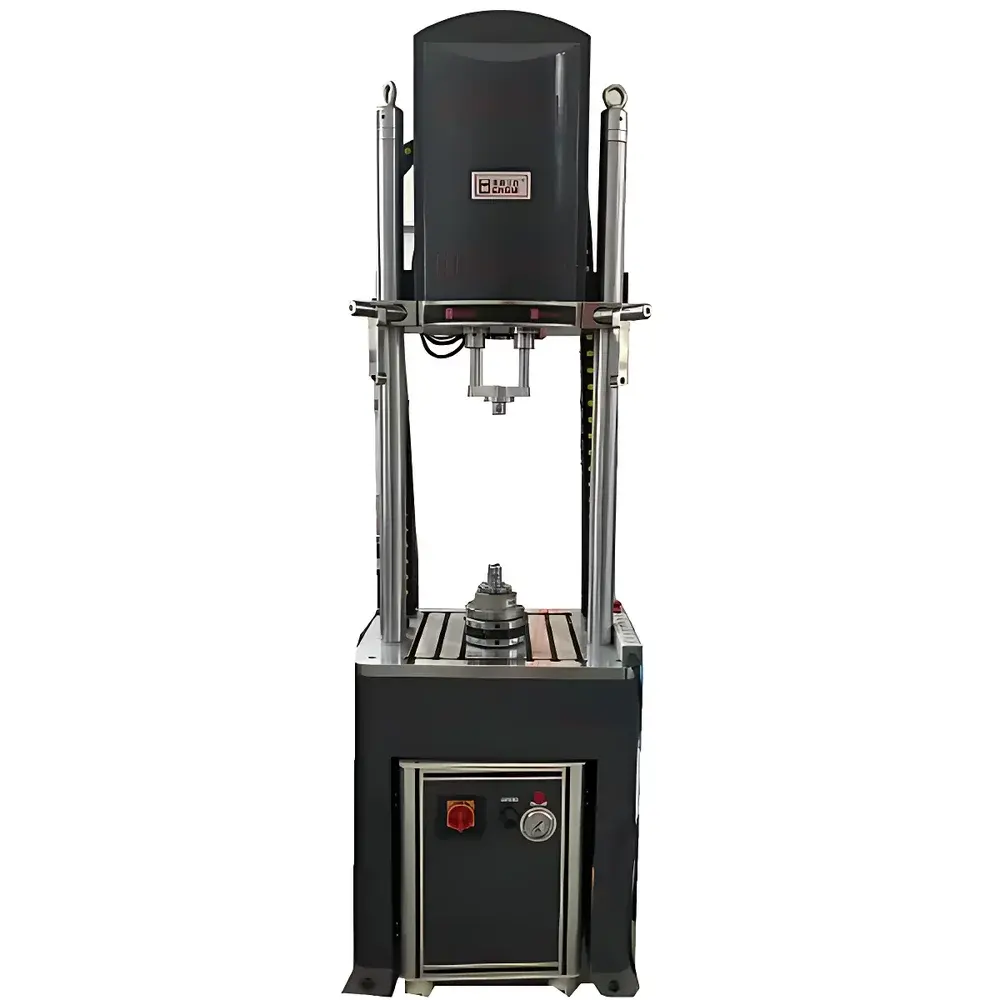
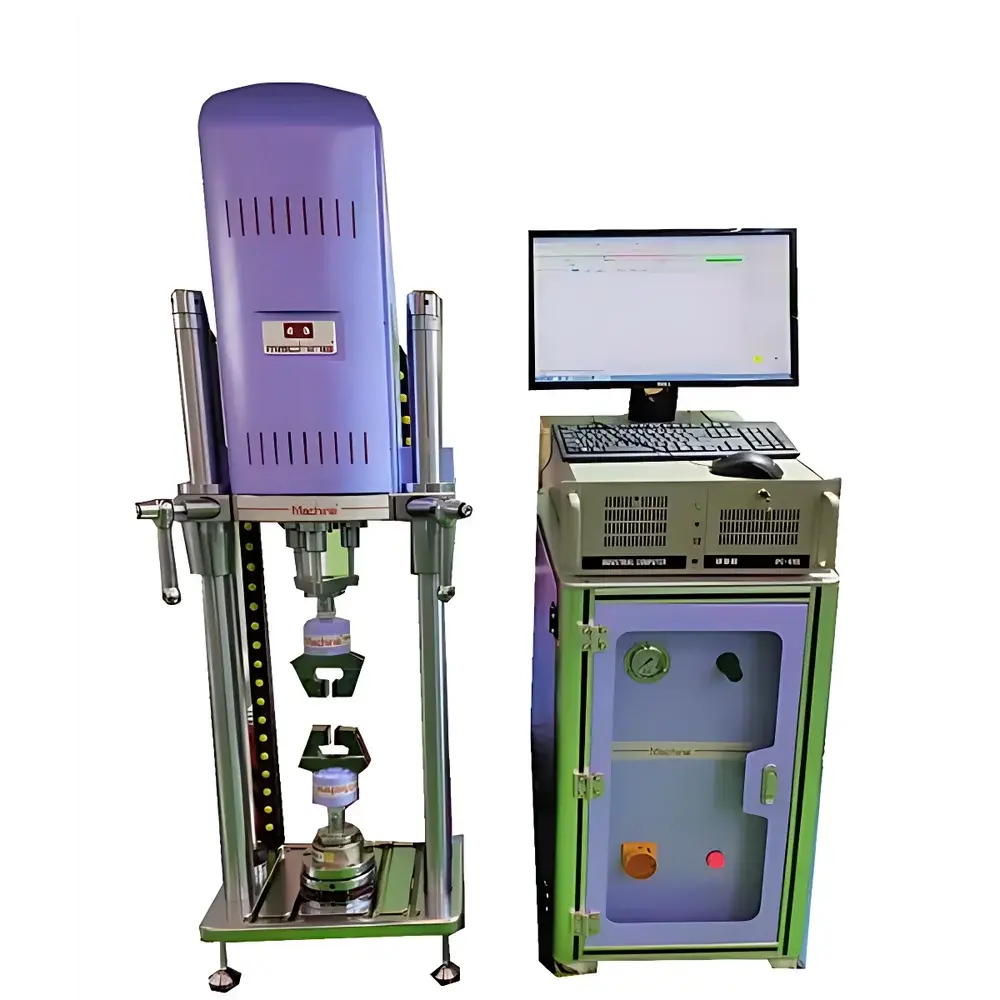
Hengyi HY(DP)502005 Medical Orthopedic Implant Fatigue Testing Machine
| Brand | Hengyi |
|---|---|
| Origin | Shanghai, China |
| Manufacturer Type | Direct Manufacturer |
| Product Category | Domestic |
| Model | HY(DP)502005 |
| Price Range | USD 42,000 – 70,000 (FOB Shanghai) |
| Instrument Type | High-Frequency Electromechanical Fatigue Testing System |
| Maximum Test Load | ±5000 N (Tension/Compression), ±50 N·m (Torque) |
| Frequency Range | 0.1–15 Hz |
| Actuator Stroke | ±100 mm (Linear), 0–1000° (Rotational) |
| Displacement Resolution | 0.01 mm |
| Torque Resolution | 0.01 N·m |
| Force Resolution | 0.01 N |
| Force Accuracy | Class 1 per ISO 7500-1 |
| Displacement Accuracy | Class 1 per ISO 9513 |
| Control Accuracy | ±1% of setpoint |
| Waveform Options | Sine, Cosine, Square, Triangle, Sawtooth |
| Test Space (Vertical) | 500 mm (Compression), 300 mm (Tension) |
| Horizontal Clearance (Between Columns) | 450 mm |
| Dimensions (L×W×H) | 680 × 700 × 2500 mm |
| Weight | 850 kg |
| Power Supply | 380 V AC, 3-phase, 8 kW |
Overview
The Hengyi HY(DP)502005 Medical Orthopedic Implant Fatigue Testing Machine is a fully programmable, electromechanical servo-controlled fatigue testing system engineered for the biomechanical evaluation of orthopedic implants—including intramedullary nails, spinal fixation rods, hip stems, knee tibial trays, and bone screws—under physiologically relevant cyclic loading conditions. It operates on the principle of closed-loop force, displacement, and torque control using high-bandwidth digital servo amplifiers and precision linear/rotary actuators. Designed in strict alignment with ASTM F2117 (Standard Practice for Cyclic Fatigue Testing of Spinal Implant Constructs), ISO 14879-1 (Fatigue Testing of Hip Joint Prostheses), and ISO 7206-4 (Fatigue Testing of Femoral Stems), the system enables controlled application of uniaxial tension-compression, torsional, or combined axial-torsional waveforms to replicate in vivo mechanical environments. Its modular architecture supports both static and dynamic test protocols, making it suitable for preclinical regulatory submissions under FDA 510(k), ISO 13485 quality system requirements, and Notified Body audit readiness.
Key Features
- Triple-mode actuation: Independent control of axial (±5000 N), torsional (±50 N·m), and combined loading paths via synchronized servo drives
- Real-time closed-loop control with ±1% setpoint accuracy across force, displacement, and angular position channels
- Class 1 force and displacement measurement compliance per ISO 7500-1 and ISO 9513, traceable to national metrology standards
- Programmable waveform generation: sine, cosine, square, triangle, and sawtooth profiles with user-defined amplitude, offset, frequency, and phase relationships
- High-resolution transduction: 0.01 N force resolution, 0.01 N·m torque resolution, and 0.01 mm linear displacement resolution
- Modular test space: 450 mm horizontal clearance between columns and 500 mm vertical stroke capacity, configurable for ASTM F2193 (Spinal Rod Fixation) or ISO 14879-2 (Cantilever Bending)
- Rugged cast-iron frame with vibration-damped base and reinforced load train, ensuring long-term stability during multi-million-cycle tests
- Integrated safety interlocks: over-travel limit switches, thermal overload protection, emergency stop circuitry compliant with IEC 60204-1
Sample Compatibility & Compliance
The HY(DP)502005 accommodates standard and custom implant fixtures per ISO 12189 (Test Fixtures for Orthopedic Implants) and ASTM F1717 (Spinal Implant Test Methods). Compatible specimen geometries include cylindrical rods (3–12 mm diameter), flat plates (up to 20 mm thickness), and complex contoured components mounted via standardized clamping interfaces. The system meets mechanical and documentation requirements for GLP-compliant fatigue data generation, including full audit trail logging, electronic signature support, and test method version control. All calibration certificates and uncertainty budgets are provided per ISO/IEC 17025 guidelines, supporting submissions to FDA, EMA, and PMDA regulatory pathways.
Software & Data Management
Control and analysis are performed via Hengyi’s proprietary WinTest Fatigue v4.2 software, a Windows-based platform compliant with FDA 21 CFR Part 11 for electronic records and signatures. The software provides real-time plot overlays of force vs. displacement, torque vs. angle, and cycle-counted hysteresis loops. Automated pass/fail criteria can be defined based on stiffness degradation, permanent deformation thresholds, or cycle-to-failure limits. Raw data exports are available in ASCII, CSV, and HDF5 formats; metadata includes test ID, operator, calibration status, environmental conditions (optional sensor integration), and full parameter history. Audit logs record all user actions—including method edits, calibration events, and result modifications—with timestamps and user IDs.
Applications
- Fatigue life assessment of metallic and polymer-based orthopedic implants per ISO 7206-4, ISO 14879-1, and ASTM F2117
- Cyclic bending and torsional endurance testing of spinal rod-screw constructs under simulated physiological loads
- Dynamic push-out and pull-out testing of cemented and uncemented acetabular cups and femoral stems
- Accelerated wear-fatigue interaction studies when coupled with optional saline bath or temperature-controlled chambers
- Verification of finite element model boundary conditions through experimental load-displacement validation
- Design verification and lot-release testing for ISO 13485-certified manufacturing facilities
FAQ
Is the HY(DP)502005 compliant with FDA 510(k) submission requirements for orthopedic device testing?
Yes—the system’s measurement traceability, software audit trail, and protocol documentation structure align with FDA guidance documents for nonclinical testing data, including “General Principles of Software Validation” and “Orthopedic Device Biocompatibility Guidance.”
Can the system perform combined axial-torsional fatigue tests simultaneously?
Yes—it supports synchronous or phase-shifted dual-axis control with independent setpoints for force and torque, enabling simulation of complex joint-level loading scenarios.
What calibration standards are used for force and torque sensors?
Force sensors are calibrated against deadweight standards traceable to NIM (China National Institute of Metrology); torque sensors use calibrated hydraulic torque calibrators certified to ISO 6789-2.
Does the software support automated reporting for ISO 14879-1 Annex A test summaries?
Yes—WinTest Fatigue v4.2 includes configurable report templates that auto-populate test parameters, failure definitions, statistical summaries, and graphical outputs required by ISO 14879-1 Annex A.
Is remote diagnostics and firmware update capability available?
Yes—via secure TLS-encrypted Ethernet connection; remote access requires prior customer authorization and complies with ISO/IEC 27001 information security controls.



