
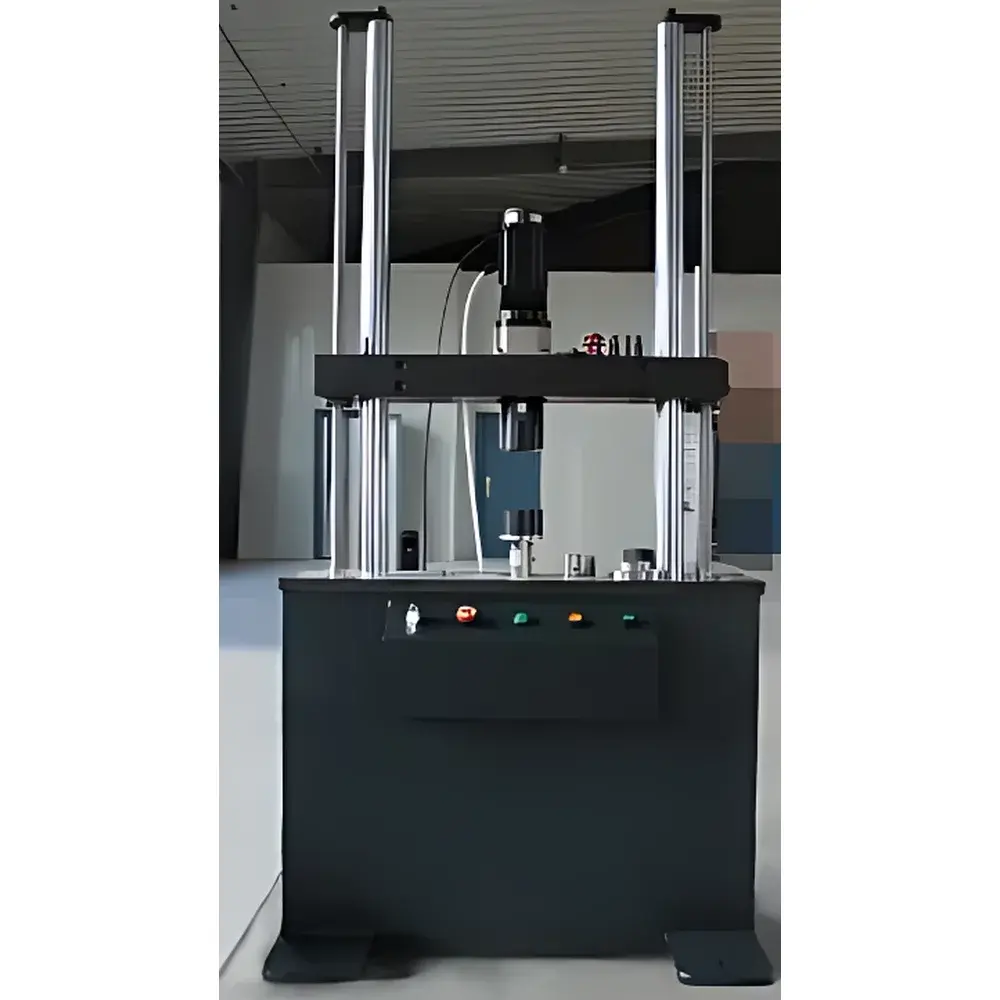
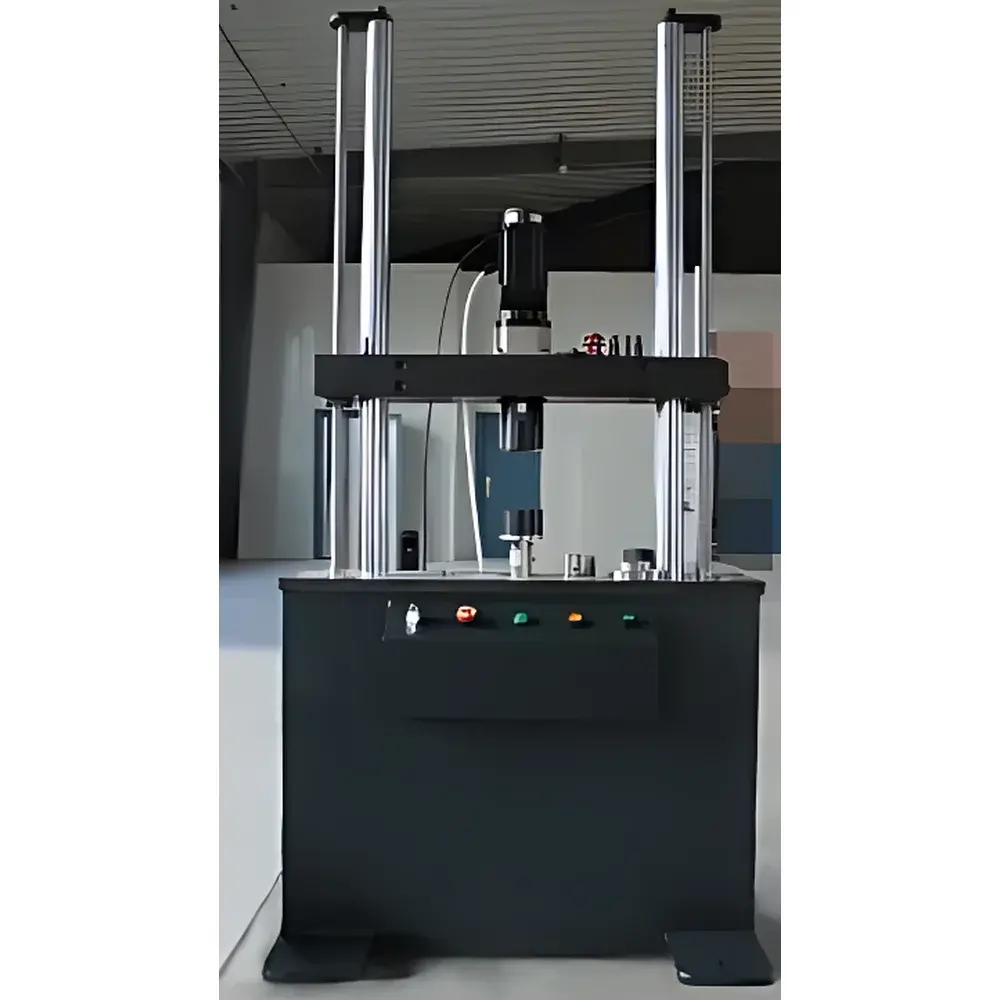
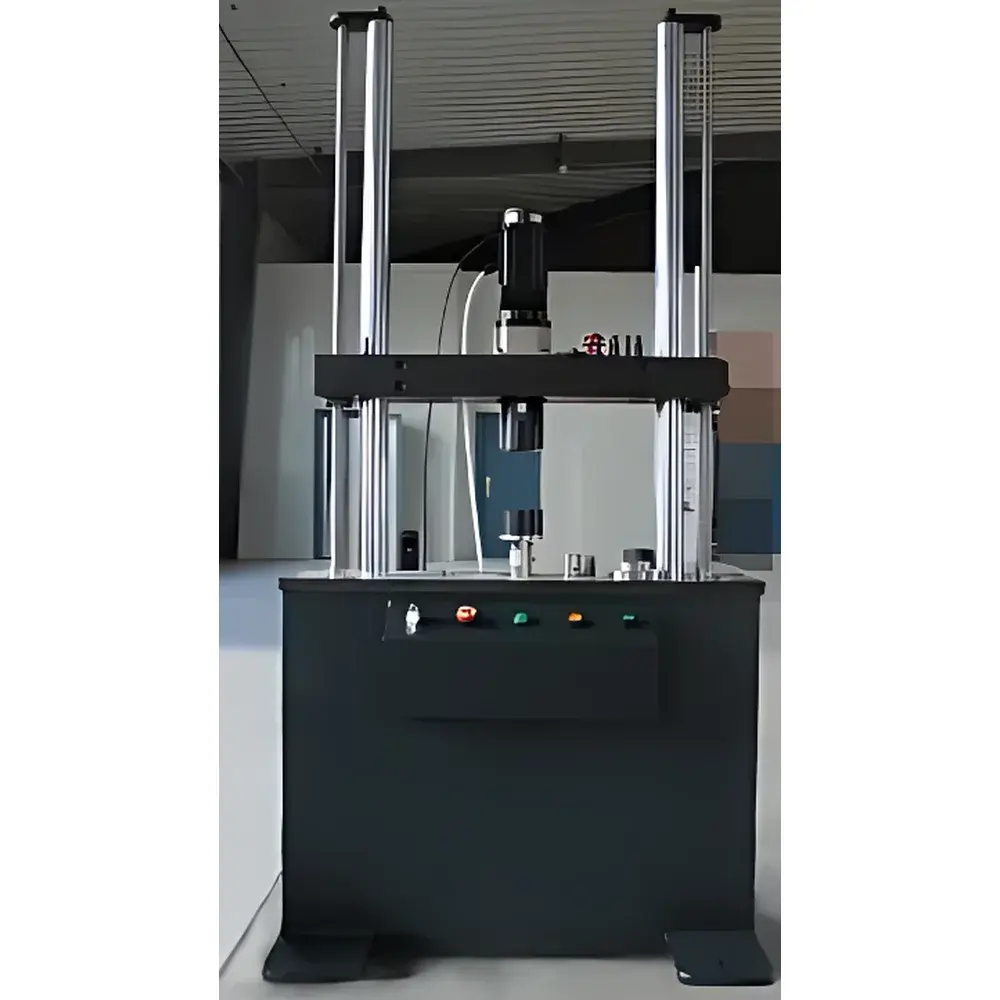
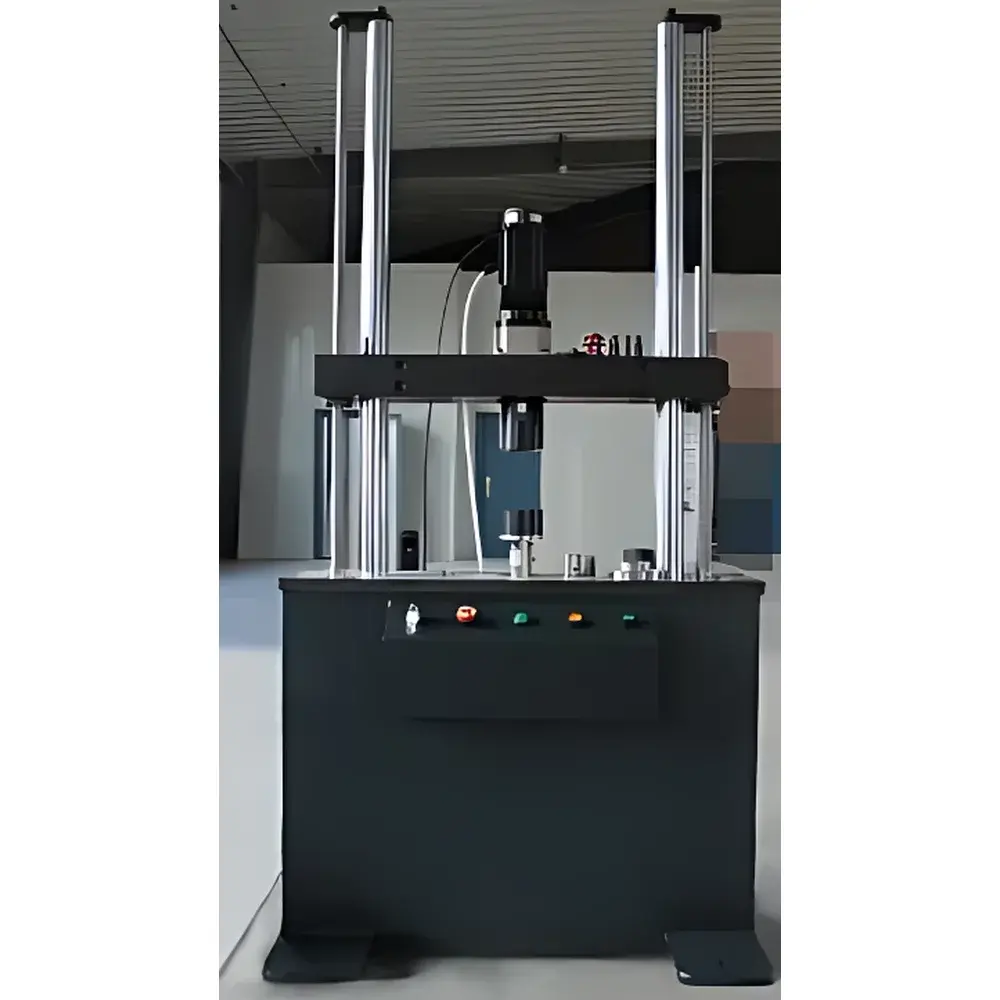
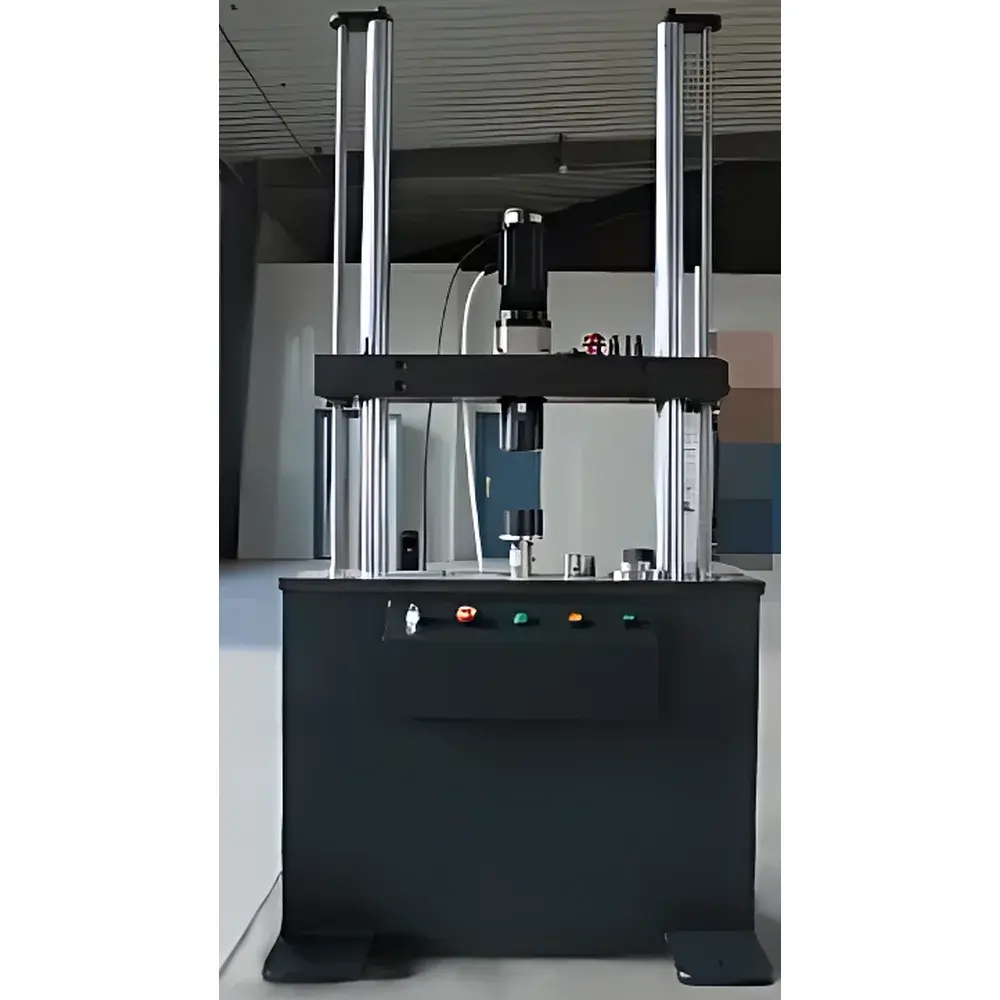
Hengyi HY(DZPL)-5KN Electromechanical Fatigue Testing Machine
| Brand | Hengyi |
|---|---|
| Origin | Shanghai, China |
| Manufacturer Type | Direct Manufacturer |
| Product Category | Domestic |
| Model | HY(DZPL)-5KN |
| Max Test Load | ±5000 N |
| Frequency Range | 10 Hz |
| Actuator Stroke | 100 mm |
| Adjustable Test Space | 500 mm |
| Dimensions (L×W×H) | 930 × 610 × 2000 mm |
| Machine Weight | 60 kg |
| Force Measurement Accuracy | ±1% |
| Control Accuracy | ±1% |
Overview
The Hengyi HY(DZPL)-5KN Electromechanical Fatigue Testing Machine is a precision-engineered, servo-controlled dynamic testing system designed for low-frequency, low-load fatigue characterization of metallic, polymeric, composite, and elastomeric materials. Operating on the principle of electromechanical actuation via a high-torque brushless servo motor and precision ball-screw transmission, the system delivers repeatable sinusoidal, triangular, or trapezoidal loading waveforms under closed-loop force or displacement control. With a maximum bidirectional test load capacity of ±5000 N and a controllable frequency range up to 10 Hz, this machine is optimized for high-fidelity cyclic loading applications where thermal stability, mechanical rigidity, and long-term signal fidelity are critical—such as R&D validation of medical device components, automotive gaskets, wire harnesses, and miniature structural joints.
Key Features
- Integrated electromechanical actuation architecture with zero hydraulic fluid dependency—eliminating maintenance overhead, leakage risks, and temperature-induced drift.
- Closed-loop digital control system enabling simultaneous real-time regulation of force, displacement, and cycle count with ±1% accuracy in both measurement and command tracking.
- Modular load frame design featuring rigid C-frame construction, preloaded linear guides, and adjustable crosshead positioning (500 mm vertical travel) to accommodate diverse specimen geometries and fixture configurations.
- Standard 100 mm stroke actuator with integrated high-resolution LVDT displacement feedback and S-type load cell (rated ±5000 N) calibrated per ISO 7500-1 Class 1 requirements.
- Front-accessible test zone with standardized M6/M8 threaded mounting surfaces for rapid interchange of tensile, compression, bending, and torsion fixtures—including ASTM E466-compliant dog-bone and threaded-end adapters.
- Compact footprint (930 × 610 × 2000 mm) and moderate mass (60 kg) enabling deployment in shared laboratory environments without structural reinforcement.
Sample Compatibility & Compliance
The HY(DZPL)-5KN supports specimens ranging from 5 mm diameter wires to 40 mm wide flat coupons, with thicknesses up to 15 mm. It is routinely applied in accordance with ASTM E466 (constant-amplitude axial fatigue testing), ASTM D3479 (tensile fatigue of plastics), and ISO 1099 (metallic materials — fatigue testing — axial force-controlled method). All hardware and firmware comply with CE machinery directive 2006/42/EC, and the control electronics meet IEC 61000-6-2/6-4 immunity and emission standards. While not inherently 21 CFR Part 11 compliant out-of-the-box, audit-ready data logging—including timestamped raw channel outputs, operator ID tagging, and electronic signature support—can be enabled via optional software modules aligned with GLP/GMP documentation workflows.
Software & Data Management
The system operates under Hengyi’s proprietary TestMaster v4.x software suite, a Windows-based platform supporting multi-channel synchronized acquisition at up to 1 kHz sampling rate. The interface provides intuitive waveform definition (sine, square, ramp, random spectrum), automated step-and-hold sequences, and real-time fatigue life prediction using Miner’s rule integration. All test data—including force-displacement hysteresis loops, cycle-by-cycle peak/valley statistics, and S-N curve generation—are exported in CSV, Excel, and universal HDF5 formats. Raw binary logs retain full resolution for post-processing in MATLAB, Python (via h5py), or third-party FEA correlation tools. Optional database integration enables centralized storage with role-based access control and versioned report archiving.
Applications
- High-cycle fatigue evaluation of miniature springs, MEMS packaging interconnects, and orthopedic implant fasteners.
- Thermo-mechanical fatigue screening of thermoplastic elastomers used in sealing systems under ambient and elevated-temperature conditions (when paired with environmental chamber).
- Quality assurance testing of solder joints, crimped terminals, and flexible printed circuit boards subjected to vibration-induced stress.
- Educational use in materials science laboratories for hands-on instruction in fracture mechanics, crack propagation thresholds (ΔKth), and fatigue limit determination per ASTM E337.
- Pre-compliance verification for ISO 14801 (dental implant fatigue) and ISO 5832-3 (titanium alloy implants) prior to certified third-party certification.
FAQ
What is the maximum achievable test frequency at full ±5000 N load?
At rated capacity, the system maintains stable sinusoidal output up to 10 Hz; frequency may be extended beyond 10 Hz only at reduced load amplitudes (e.g., ±500 N), subject to actuator thermal limits and controller bandwidth constraints.
Can the machine perform push-pull testing on threaded rods or bolts?
Yes—standard tensile-compression fixtures include adjustable threaded end grips compatible with ISO 898-1 M4–M12 fasteners; custom adapters are available for non-standard thread forms.
Is third-party calibration documentation included with shipment?
Each unit ships with a factory calibration certificate traceable to CNAS-accredited standards (equivalent to ISO/IEC 17025); full calibration reports—including load cell linearity, hysteresis, and repeatability data—are provided upon request.
Does the software support automated pass/fail criteria based on cycle count or energy dissipation?
Yes—TestMaster v4.x allows user-defined termination logic including maximum cycles, accumulated plastic strain threshold, stiffness degradation (%), or hysteretic energy per cycle deviation exceeding configurable limits.
What environmental conditions are recommended for optimal performance?
Operational ambient range: 10–35 °C, relative humidity ≤80% non-condensing; installation on vibration-isolated optical tables or reinforced concrete floors is advised for sub-0.1% noise floor integrity.



