
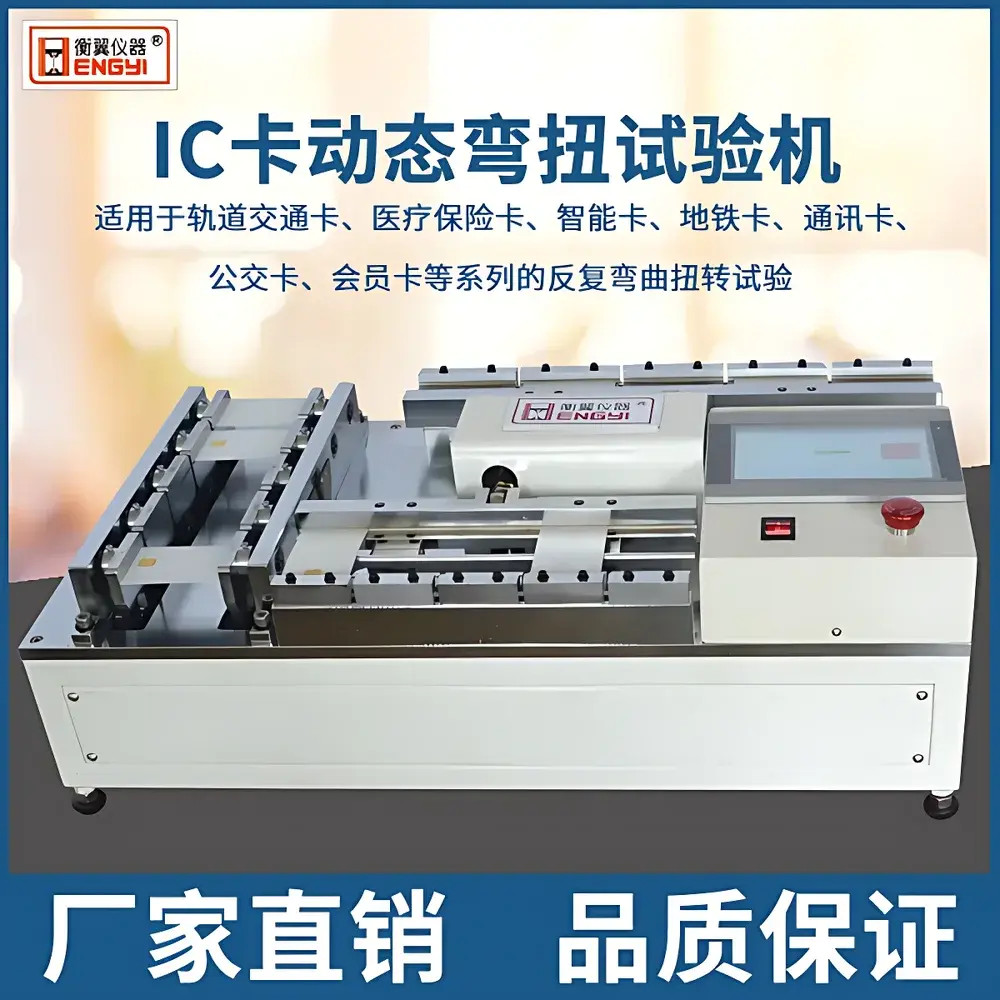
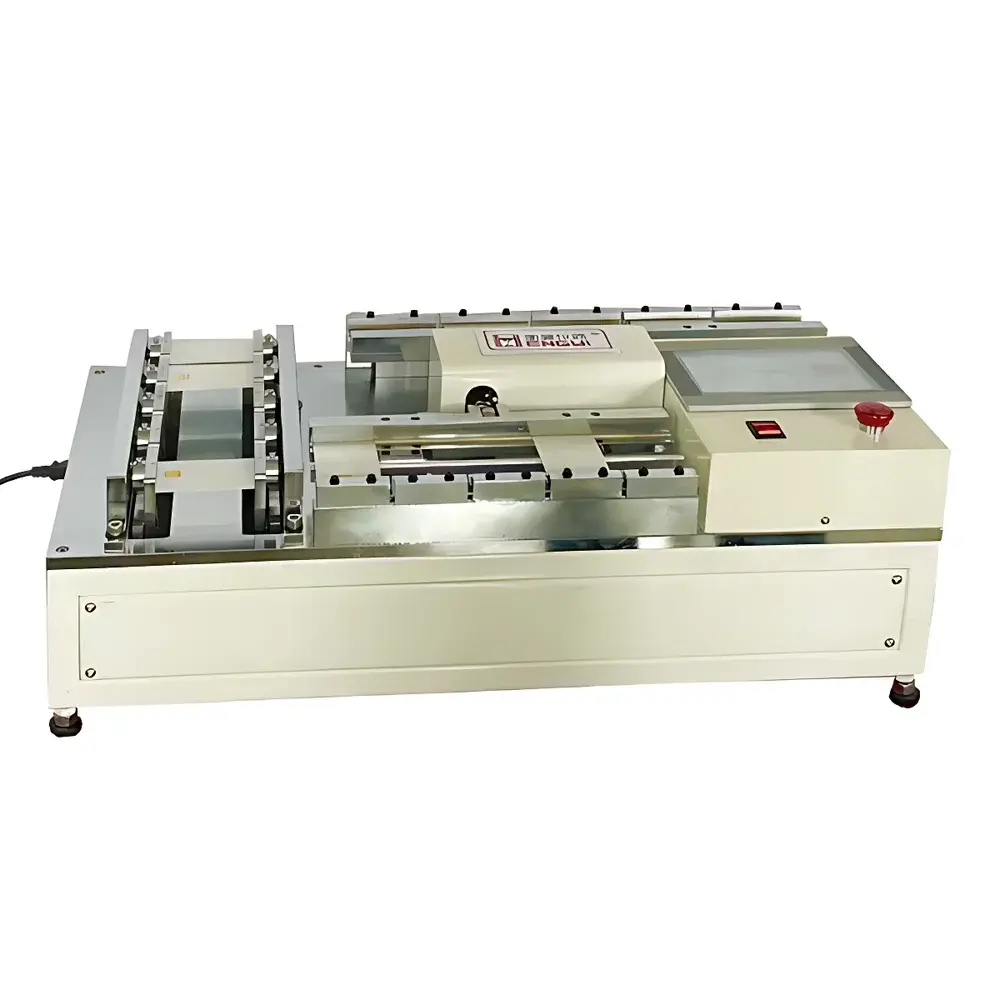
Hengyi HY(IC) Dynamic Bending and Torsion Fatigue Tester for Smart Cards
| Brand | Hengyi / Hengyitest |
|---|---|
| Origin | Shanghai, China |
| Manufacturer Type | Direct Manufacturer |
| Region of Origin | Domestic (China) |
| Model | HY(ICUIKK |
| Quotation | Upon Request |
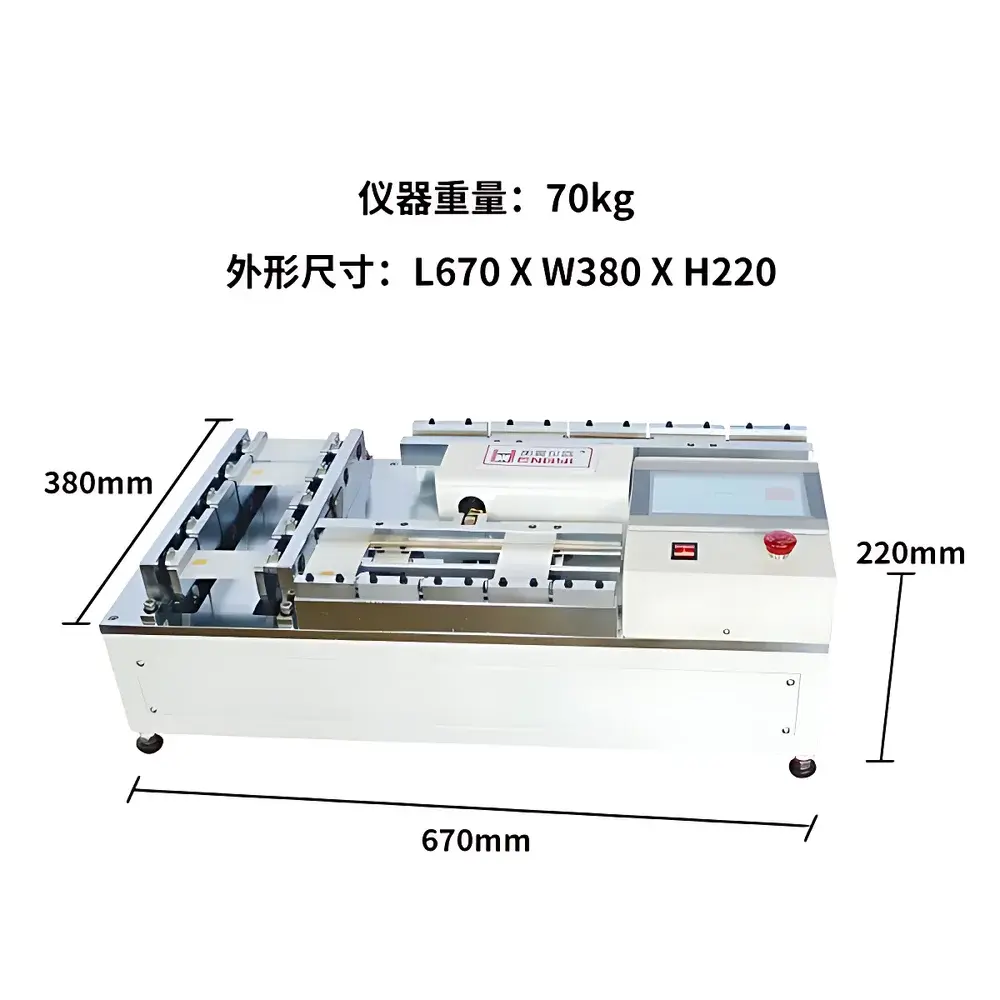
| Dimensions (L×W×H) | 670 × 380 × 220 mm |
| Weight | 70 kg |
| Power Supply | AC 220 V ±5% |
| Power Consumption | 35 W |
| Test Speed | Bending/Torsion: 30 rpm or 0.5 Hz |
| Cycle Count Range | 1–9999 cycles |
| Torsion Angle | ±15° ±1° (bidirectional, d = 86 mm |
| total angular displacement | 30°) |
| Long-Edge Displacement | Max 20 mm (0/−1 mm tolerance), Min 2 mm ±0.50 mm |
| Short-Edge Displacement | Max 10 mm (0/−1 mm tolerance), Min 1 mm ±0.50 mm |
| Fixture Mounting | Compliant with ISO/IEC 7816-1:2018 and GB/T 16649.1 |
| Counting Method | Non-contact optical encoder (zero mechanical switch failure rate) |
| Test Stations | 15 stations (5 long-edge bending, 5 short-edge bending, 5 torsion) |
Overview
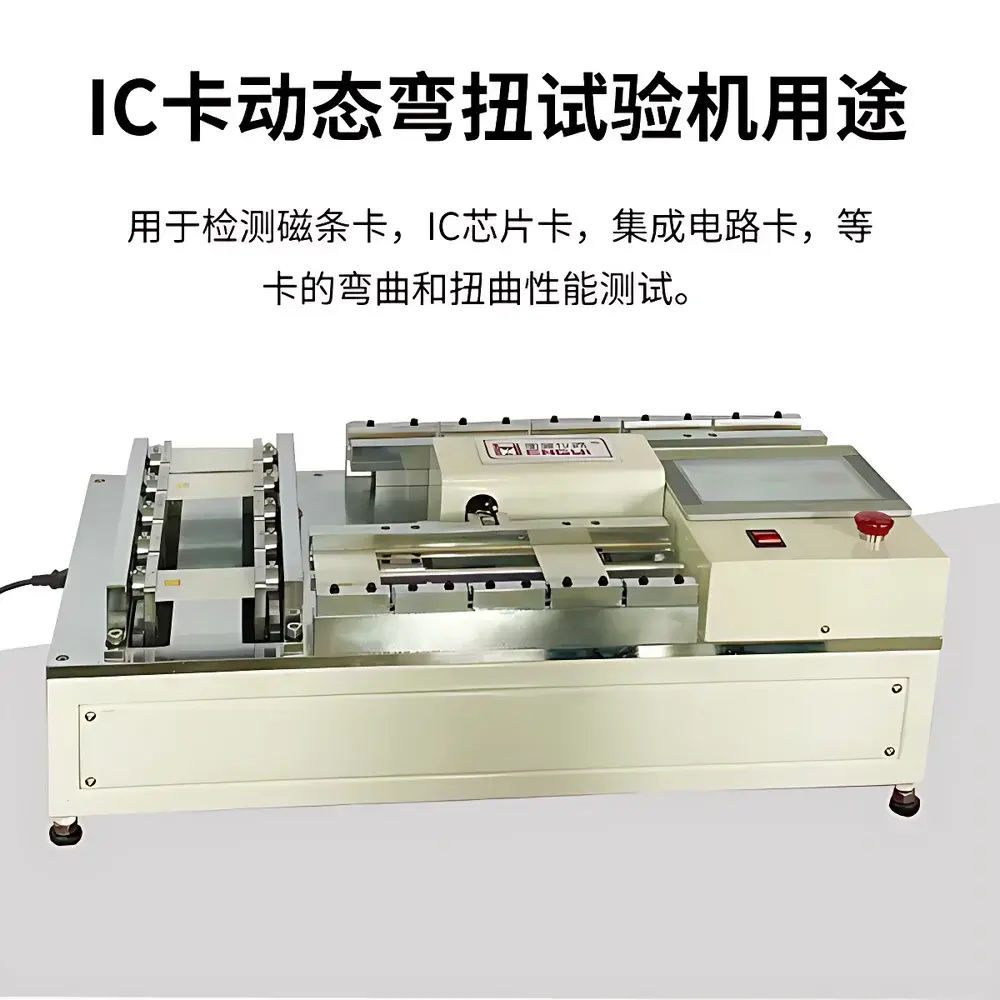
The Hengyi HY(IC) Dynamic Bending and Torsion Fatigue Tester is a precision-engineered electromechanical test system designed specifically for evaluating the mechanical endurance of contactless and contact smart cards under repeated flexural and torsional loading. It operates on the principle of controlled cyclic deformation—applying defined angular displacements and linear deflections at standardized frequencies—to simulate real-world handling stresses encountered during daily use in transportation, healthcare, financial, and identity verification systems. The instrument conforms to key international and national standards including ISO/IEC 7816-1:2018 (Identification cards — Integrated circuit cards — Part 1: Physical characteristics), ISO/IEC 10373-6:2015 (Test methods for identification cards — Part 6: Tests for contactless cards), GB/T 16649.1–2016 (Integrated circuit cards — Part 1: Physical characteristics), and GB/T 17554.1–2006 (Identification cards — Test methods — Part 1: Mechanical characteristics). Its architecture integrates high-fidelity motion control, non-contact cycle monitoring, and modular station configuration to ensure repeatability, traceability, and compliance-ready data acquisition.
Key Features
- Fifteen independent test stations: five configured for long-edge bending, five for short-edge bending, and five for torsional fatigue—enabling parallel evaluation across multiple card orientations and failure modes.
- Non-contact optical encoder-based cycle counting system eliminates mechanical switch wear and ensures zero-counting failure over extended operation, supporting up to 9999 programmable cycles per test sequence.
- Precisely adjustable displacement profiles: long-edge deflection range 2–20 mm (±0.50 mm resolution); short-edge deflection 1–10 mm (±0.50 mm); bidirectional torsion angle ±15° (±1° accuracy) around a fixed 86 mm diameter axis.
- Programmable test frequency: 0.5 Hz or 30 rpm, synchronized across all stations to maintain phase consistency during multi-axis stress application.
- STK AC variable-speed motor coupled with high-ratio gear reduction delivers stable torque output and low-vibration actuation, critical for maintaining dimensional fidelity during high-cycle testing.
- Fixture geometry strictly follows ISO/IEC 7816-1 Annex A and GB/T 16649.1 Clause 4.2 specifications—including card retention clamping force, support span, and pivot point alignment—to guarantee metrological equivalence with reference laboratories.
Sample Compatibility & Compliance
The HY(IC) tester accommodates standard ISO/IEC 7816-form factor cards (85.6 × 53.98 × 0.76 mm), including magnetic stripe cards, contact IC cards (e.g., EMV-compliant payment cards), contactless RFID cards (MIFARE, DESFire), transit fare cards, health insurance cards, telecom SIM cards, and university ID cards. All test configurations satisfy the mechanical test requirements outlined in ISO/IEC 10373-6:2015 Section 6.2 (Bending endurance) and Section 6.3 (Torsion endurance), as well as GB/T 17554.1–2006 Clauses 5.2 and 5.3. The system supports GLP-aligned documentation practices, with audit-trail-capable cycle logging and timestamped test records compatible with laboratory information management systems (LIMS).
Software & Data Management
While the HY(IC) operates via dedicated hardware control logic (no embedded PC or proprietary GUI), it outputs deterministic digital pulse signals from its optical encoder array—enabling seamless integration with external data acquisition platforms such as National Instruments LabVIEW, MATLAB Data Acquisition Toolbox, or custom Python-based DAQ scripts. Each station provides isolated TTL-level count pulses and status flags (start/stop/fault), allowing synchronization with environmental chambers, vision inspection systems, or electrical continuity monitors. Raw cycle counts are stored in volatile memory with battery-backed retention during power interruption. For regulated environments, users may implement 21 CFR Part 11-compliant electronic signatures and audit trails via third-party LIMS interfaces.
Applications
This tester serves quality assurance laboratories in smart card manufacturing, national metrology institutes validating conformance to ISO/IEC 7816, R&D departments developing next-generation flexible substrates or embedded antenna architectures, and certification bodies conducting type-approval testing for public transport ticketing schemes (e.g., ITSO, CIPURSE, Calypso). Typical use cases include comparative fatigue life assessment between PVC, PETG, and polycarbonate card bodies; validation of adhesive bond integrity in laminated chip modules; quantification of delamination onset under torsional shear; and correlation of mechanical degradation with RF performance loss in UHF/NFC antennas.
FAQ
Does the HY(IC) comply with ISO/IEC 7816-1:2018 mechanical test requirements?
Yes—the fixture geometry, support spans, deflection amplitudes, and angular limits are dimensionally aligned with Annex A of ISO/IEC 7816-1:2018 and verified against NIST-traceable calipers.
Can test parameters be customized for non-standard card formats?
Yes—mechanical fixtures are modular and user-replaceable; custom jigs for thicker cards (e.g., 1.0 mm polycarbonate) or dual-interface hybrid cards can be engineered per client specification.
Is calibration documentation provided with shipment?
Each unit ships with a factory verification report confirming displacement linearity (via dial indicator traceability), torsion angle accuracy (using autocollimator verification), and encoder resolution (pulse-per-cycle validation).
What maintenance intervals are recommended for long-term reliability?
Gearbox lubrication every 12 months; optical sensor cleaning quarterly; motor brush inspection at 5,000 operational hours. Spare parts—including encoder assemblies, motor controllers, and fixture sets—are stocked globally.
How is test failure defined and recorded?
Failure is determined externally by visual inspection or electrical continuity measurement post-test; the HY(IC) itself logs only mechanical cycle completion. Integration with automated optical inspection (AOI) or multimeter-triggered I/O enables closed-loop pass/fail classification.



