
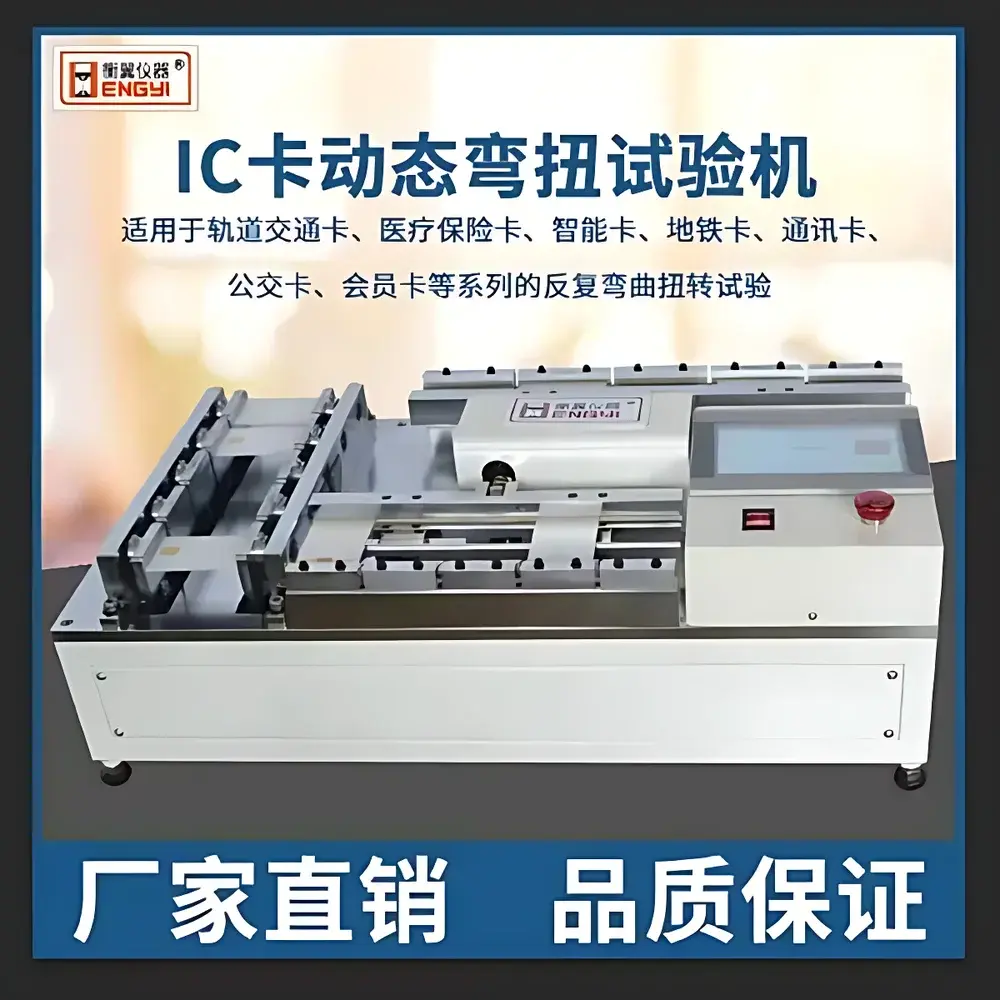
Hengyi HY(IC)RTYH Dynamic Bending-Torsion Fatigue Tester for Smart Cards
| Brand | Hengyi |
|---|---|
| Origin | Shanghai, China |
| Manufacturer Type | Direct Manufacturer |
| Country of Origin | China |
| Model | HY(IC)RTYH |
| Quotation | Upon Request |
| Bending Displacement (Long Edge) | ±20 mm (max) / ±2 mm (min) |
| Bending Displacement (Short Edge) | ±10 mm (max) / ±1 mm (min) |
| Torsion Angle | ±15° (±1° accuracy), total 30° bidirectional |
| Center Distance for Torsion (d) | 86 mm |
| Test Speed | 30 rpm (~0.5 Hz) |
| Cycle Count Range | 1–9999 (programmable, auto-stop) |
| Force Measurement Accuracy | ±2% FS |
| Displacement Measurement Accuracy | ±0.5% FS |
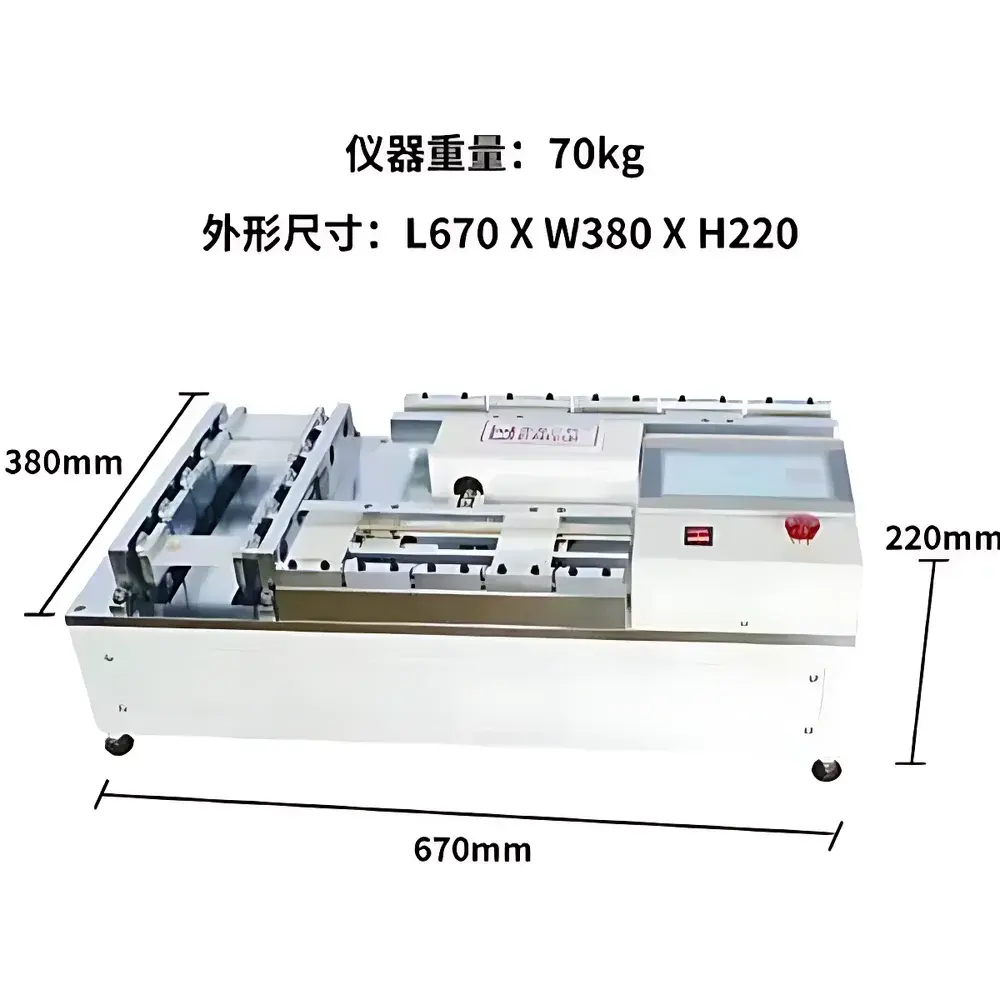
| Dimensions (L×W×H) | 670 × 380 × 220 mm |
| Weight | 70 kg |
| Power Supply | AC 220 V ±5% |
| Power Consumption | 35 W |
| Bending Stations (Long Edge) | 5 |
| Bending Stations (Short Edge) | 5 |
| Torsion Stations (Bidirectional) | 5 |
Overview
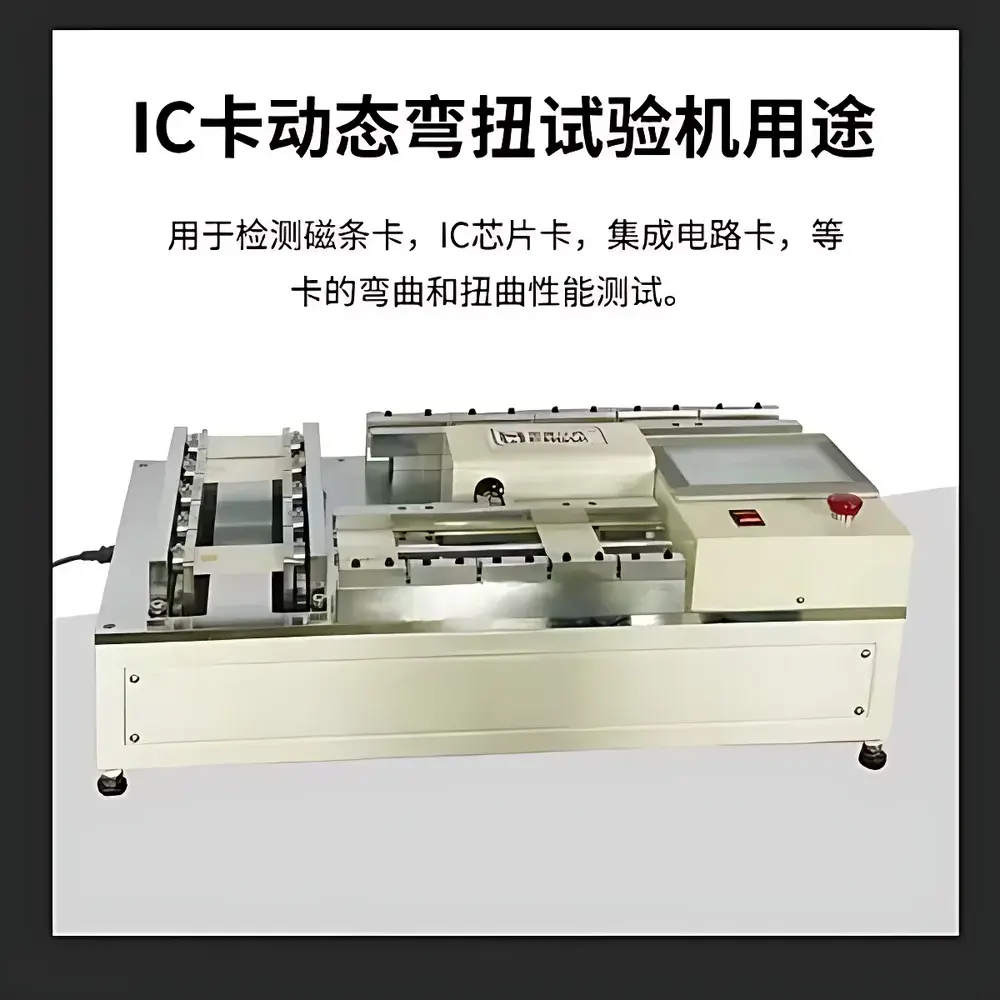
The Hengyi HY(IC)RTYH Dynamic Bending-Torsion Fatigue Tester is an engineered precision instrument designed to evaluate the mechanical durability and long-term reliability of contact-based and contactless smart cards under realistic usage conditions. It replicates the complex, coupled mechanical stresses—simultaneous bending along both long and short edges, combined with bidirectional torsion—that cards experience during daily handling: insertion into wallets, repeated flexing in pockets, mechanical loading in card readers, or accidental twisting during transit. The system operates on a deterministic kinematic principle, applying controlled, repeatable displacement and angular excursions to simulate cumulative fatigue damage mechanisms—including microcrack propagation in embedded IC chips, delamination at polymer–chip interfaces, solder joint fatigue at contact pads, and plastic deformation of PVC/PET substrates. Unlike static compliance testers, this device delivers dynamic, time-dependent mechanical loading aligned with standardized fatigue protocols defined in ISO/IEC 7810, ISO/IEC 10373-1, and GB/T 16649.1–17554.1.
Key Features
- Simultaneous dual-axis mechanical stress application: independent programmable control of long-edge bending (±20 mm), short-edge bending (±10 mm), and bidirectional torsion (±15°, 30° total swing) on five parallel test stations per mode.
- High-fidelity motion control architecture with stepper-motor-driven actuators and optical encoder feedback, ensuring repeatability of displacement (±0.5% FS) and angular positioning (±1°).
- Real-time force monitoring integrated into each station, with dynamic load sensing calibrated to ±2% full-scale accuracy—enabling correlation between mechanical input and structural response.
- Programmable cycle sequencing: user-defined test profiles support single-mode (bending-only or torsion-only) or composite-mode operation; cycle count range spans 1 to 9999 with automatic termination and pass/fail flagging.
- Compact benchtop design (670 × 380 × 220 mm) optimized for QC labs and R&D environments; low power consumption (35 W) enables continuous unattended operation without thermal drift concerns.
- Compliance-ready firmware architecture supporting audit trails and parameter locking—facilitating alignment with GLP and internal quality system requirements for traceability.
Sample Compatibility & Compliance
The HY(IC)RTYH accommodates standard ID-1 format smart cards (85.6 × 53.98 × 0.76 mm), including hybrid magnetic stripe + chip cards, contactless RFID cards (e.g., MIFARE DESFire, ISO 14443-A/B), EMV-compliant payment cards, transportation tickets, access control credentials, and industrial memory cards used in embedded systems. All test protocols are fully traceable to internationally recognized standards: ISO/IEC 7810 (physical characteristics), ISO/IEC 10373-1 (mechanical test methods), GB/T 16649.1 (contact IC card dimensions and interface), and GB/T 17554.1–2006 (test methodology for smart card reliability). The system’s mechanical boundary conditions—including 86 mm torsional center distance and ±15° angular limits—are derived directly from clause 6.3.2 and Annex D of ISO/IEC 10373-1, ensuring metrological equivalence across laboratories.
Software & Data Management
The embedded control interface provides intuitive menu navigation for test setup, real-time monitoring of cycle count, current displacement/torque status, and error logging. Raw sensor data—including force vs. time, position vs. cycle, and event-triggered anomaly flags—is exportable in CSV format for post-processing in MATLAB, Python (NumPy/Pandas), or statistical analysis platforms. While no proprietary software suite is bundled, the device supports RS-232 and USB virtual COM port communication, enabling integration into custom LabVIEW or Python-based automated test systems. For regulated environments, optional firmware upgrade paths include timestamped test logs with operator ID fields and basic electronic signature capability—serving as foundational elements for future 21 CFR Part 11 compliance readiness.
Applications
- Qualification testing of new card substrate materials (e.g., PET-G, polycarbonate laminates) for resistance to plastic deformation and interlayer adhesion loss.
- Validation of chip embedding processes—assessing die attach integrity and wire bond survivability after 5,000+ bending-torsion cycles.
- Comparative benchmarking of contact pad metallization schemes (e.g., NiAu vs. SnAgCu) under cyclic mechanical loading.
- Root cause analysis of field failures: correlating lab-induced fatigue cracks (visible via cross-section SEM) with real-world return rates.
- Pre-certification verification prior to formal submission to accredited bodies such as UL, TÜV Rheinland, or China Quality Certification Center (CQC).
FAQ
What standards does the HY(IC)RTYH explicitly support?
It implements mechanical test parameters and boundary conditions specified in ISO/IEC 10373-1 (Clause 6.3.2), ISO/IEC 7810, GB/T 16649.1, and GB/T 17554.1–2006.
Can the tester operate in standalone mode without a PC connection?
Yes—the front-panel keypad and LCD display enable full test initiation, monitoring, and result review without external computing hardware.
Is calibration documentation provided with shipment?
Each unit ships with a factory calibration certificate covering displacement encoders and load transducers, traceable to national metrology institutes via ISO/IEC 17025-accredited providers.
How is test consistency maintained across multiple stations?
All five stations share synchronized actuation timing and identical mechanical linkage geometry; inter-station deviation in displacement amplitude is ≤ ±0.3% as verified during production QA.
Does the system support custom test profiles beyond standard bending-torsion sequences?
Yes—users may define non-standard displacement amplitudes, angular ranges, and dwell times within the physical limits of the mechanism (e.g., reduced torsion to ±5° for ultra-thin flexible cards).



