
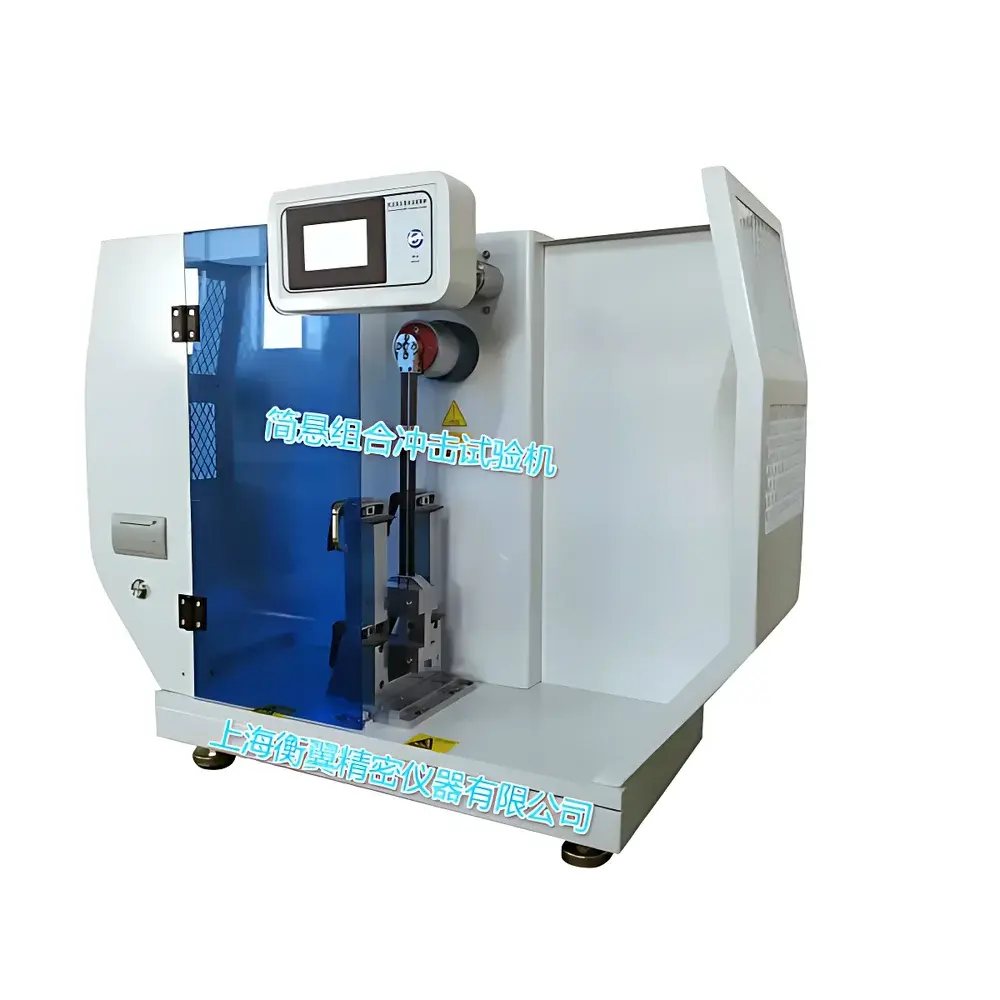
Hengyi HY(JX) Digital Display Cantilever & Simply-Supported Beam Combined Impact Testing Machine
| Brand | Hengyi |
|---|---|
| Origin | Shanghai, China |
| Manufacturer Type | Direct Manufacturer |
| Product Category | Domestic |
| Model | HY(JX) |
| Price Range | USD 2,800 – 7,000 (FOB Shanghai) |
| Instrument Type | Pendulum Impact Tester |
| Nominal Impact Energy | 50 J (max. pendulum capacity) |
| Impact Velocity | 3.8 m/s (simply-supported beam mode, high-energy configuration) |
| Pendulum Torque (Impact Constant) | 0.01 N·m/° |
| Load Cell Range | 100 N |
| Maximum Pendulum Lift Height | 3.8 m |
| Beam Support Span Options | 40, 60 (or 62), 70, 95 mm |
| Simply-Supported Beam Hammer Radius | R = 2.0 ± 0.5 mm |
| Hammer Angle | 30° ± 1° |
| Cantilever Beam Hammer Radius | R = 0.8 ± 0.2 mm |
| Clamp-to-Hammer Distance | 22.0 ± 0.05 mm |
| Pendulum Angles | 150° (pre-lift) |
| Encoder | Panasonic optical encoder |
| Control System | Integrated LCD-based pendulum control and measurement unit |
| Power Supply | AC 220 V ± 10 %, 50 Hz |
Overview
The Hengyi HY(JX) Digital Display Cantilever & Simply-Supported Beam Combined Impact Testing Machine is an engineered solution for standardized Charpy-type impact testing of non-metallic materials under controlled pendulum dynamics. Based on classical pendulum impact mechanics—where gravitational potential energy is converted into kinetic energy upon release—the HY(JX) delivers precise, repeatable measurements of impact resistance in accordance with ASTM D6110 (equivalent to ISO 179-1), ISO 180, ISO 9854-1, DIN 53453, and GB/T 1043. Its dual-beam architecture eliminates mechanical reconfiguration: users switch between cantilever (Izod) and simply-supported (Charpy) test modes via software-controlled fixture alignment and automated pendulum calibration—no manual disassembly or realignment of supports, clamps, or hammers is required. This design significantly reduces operator-induced variability and improves inter-laboratory reproducibility, particularly critical in QC environments governed by ISO/IEC 17025.
Key Features
- Integrated dual-beam test platform supporting both Izod (cantilever) and Charpy (simply-supported) configurations without hardware modification
- Digital display system with real-time energy readout, calibrated against traceable NIST-equivalent reference standards
- Panasonic optical encoder ensures angular resolution ≤ 0.1° and velocity accuracy within ±0.5% of nominal impact speed
- Modular pendulum set: selectable hammer energies—including 1 J, 2 J, 4 J, 5 J, 7.5 J, and 15 J for Charpy; 2.75 J, 5.5 J, and 11 J for Izod—enabling compliance across material thickness and brittleness ranges
- Adjustable support spans (40 mm, 60 mm / 62 mm, 70 mm, 95 mm) and precision-ground hammer geometries (R = 2.0 ± 0.5 mm for Charpy; R = 0.8 ± 0.2 mm for Izod) meet dimensional tolerances specified in ISO 179-2 and ISO 180-2
- Rigid cast-iron frame with vibration-damped base minimizes energy loss during impact event, contributing to measurement stability over extended operational cycles
- Compliant with mechanical safety requirements per EN ISO 12100 and equipped with interlocked guard door and emergency stop circuit
Sample Compatibility & Compliance
The HY(JX) is validated for rigid thermoplastic moldings and extrusions (e.g., ABS, PC, PP), thermosetting resins (e.g., phenolics, epoxies), and fiber-reinforced composites (including glass- and carbon-fiber laminates). Specimen dimensions adhere strictly to ISO 179-1 (80 × 10 × 4 mm for Charpy; 63.5 × 12.7 × 3.2 mm for Izod) and GB/T 1043. All test fixtures—including support anvils, clamping jaws, and alignment gauges—are manufactured to ±0.02 mm geometric tolerance. The instrument satisfies mandatory conformity assessment pathways for CE marking (under Machinery Directive 2006/42/EC) and supports audit readiness for GLP-compliant laboratories through documented calibration history, traceable to national metrology institutes. Routine verification follows ISO 148-2 procedures using certified reference specimens.
Software & Data Management
The embedded LCD control interface provides immediate display of impact energy (J), peak force (N), and calculated notched/unnotched impact strength (kJ/m²). Data export is supported via RS-232 serial output to external PCs running Windows-compatible lab management software. While the base system does not include full 21 CFR Part 11–compliant electronic records, it supports integration with third-party LIMS platforms capable of implementing audit trails, user authentication, and electronic signatures. Calibration certificates include uncertainty budgets per ISO/IEC 17025 Annex A.2, with annual recalibration recommended using certified reference pendulums and alignment verification kits.
Applications
This instrument serves routine quality assurance in polymer compounding plants, R&D labs evaluating toughening additives (e.g., elastomer modifiers, nanofillers), and certification bodies performing third-party validation for automotive interior components, electrical enclosures, and construction-grade composites. It is routinely deployed in academic settings for teaching fracture mechanics fundamentals—including crack propagation onset, ductile-to-brittle transition behavior, and temperature-dependent impact response (when paired with environmental chambers). Its dual-mode capability streamlines comparative studies between Izod and Charpy methodologies per ISO 899-1 Annex C guidance.
FAQ
What standards does the HY(JX) fully comply with for Charpy testing?
ISO 179-1, ISO 179-2, GB/T 1043, ASTM D6110, and DIN 53453.
Can the same specimen be tested in both cantilever and simply-supported modes without remachining?
No—specimen geometry differs per standard; separate specimens cut to ISO 180 (Izod) or ISO 179 (Charpy) dimensions are required.
Is the 50 J rating the maximum measurable energy or the maximum pendulum capacity?
It represents the maximum rated pendulum capacity; actual test energies are selected from the modular hammer set (up to 15 J for Charpy, 11 J for Izod) to ensure optimal signal-to-noise ratio and minimize over-ranging.
Does the system support low-temperature impact testing?
Yes—when integrated with externally controlled environmental chambers (–60 °C to +150 °C), provided specimen conditioning and transfer comply with ISO 179-2 Clause 6.
What maintenance intervals are recommended for long-term accuracy?
Biannual verification of pendulum center-of-rotation alignment, annual load cell calibration, and quarterly inspection of hammer edge wear per ISO 148-2 Annex B.



