
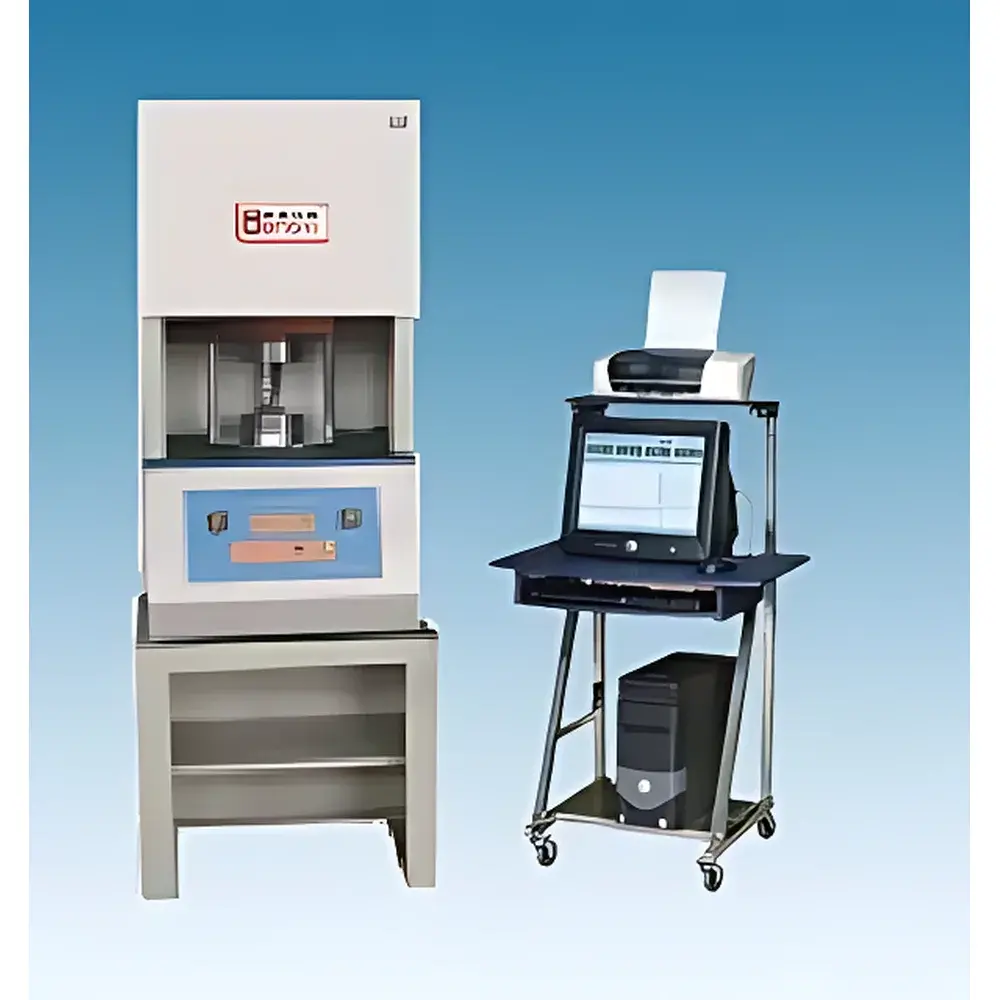
Hengyi HY(MN)A Mooney Viscometer
| Brand | Hengyi / Hengyitest |
|---|---|
| Origin | Shanghai, China |
| Manufacturer Type | Direct Manufacturer |
| Country of Origin | China |
| Model | HY(MN)A |
| Pricing | Available Upon Request |
| Temperature Range | 0–200 °C |
| Temperature Accuracy | ≤ ±0.3 °C |
| Temperature Control Stability | ≤ ±0.3 °C |
| Temperature Resolution | 0.1 °C |
| Torque Range | 0–100 Mooney Units (MU) |
| Calibration Accuracy | 100 ± 0.5 MU |
| Rotor Speed | 2.00 ± 0.02 rpm |
| Test Duration | 0–200 min (1 s resolution) |
| Ambient Operating Temperature | 0–35 °C |
| Relative Humidity | < 80% RH |
| Closing Force | 11.5 ± 0.5 kN |
| Compressed Air Supply | 0.45–0.6 MPa |
| Power Supply | AC 220 V, 1 kVA |
| Dimensions (W×D×H) | ≈ 660 × 570 × 1300 mm |
| Net Weight | ≈ 210 kg |
Overview
The Hengyi HY(MN)A Mooney Viscometer is a precision-engineered instrument designed for the standardized determination of Mooney viscosity, scorch time, and vulcanization characteristics of raw and compounded rubber materials. Based on the principle of rotational viscometry under controlled thermal and mechanical conditions—specifically, the measurement of torque resistance exerted on a standardized rotor rotating at 2 rpm within a heated cavity—the HY(MN)A complies with internationally recognized test methodologies including GB/T 1232, GB/T 1233, ISO 289, and ISO 667. Its robust architecture integrates a high-stability temperature control system, calibrated torque transduction, and pneumatically actuated die closure to ensure repeatable, traceable, and compliant measurements across laboratory and quality control environments.
Key Features
- Thermally isolated, dual-zone heating system with PID-controlled temperature regulation, maintaining ≤ ±0.3 °C accuracy and 0.1 °C resolution across the full 0–200 °C operating range.
- High-precision optical encoder and servo-controlled drive mechanism ensuring strict adherence to the standard rotor speed of 2.00 ± 0.02 rpm.
- Load cell-based torque sensing with full-scale range of 0–100 Mooney Units and calibration traceability to 100 ± 0.5 MU.
- Pneumatic die closure system delivering consistent and adjustable test pressure of 11.5 ± 0.5 kN, compatible with compressed air supply between 0.45–0.6 MPa.
- Integrated real-time data acquisition with 1-second time resolution over test durations up to 200 minutes.
- Stainless-steel cavity and rotor assembly conforming to ISO 289 geometry specifications, minimizing thermal drift and surface degradation during repeated use.
Sample Compatibility & Compliance
The HY(MN)A accommodates standard 47–48 g uncured rubber specimens in accordance with ISO and GB geometrical requirements. It supports testing of natural rubber (NR), synthetic elastomers (SBR, BR, EPDM, NBR), and masterbatch compounds. All operational parameters—including temperature ramp profiles, rotor engagement timing, and torque integration windows—are configurable to align with method-specific protocols. The instrument meets essential metrological and safety requirements for ISO/IEC 17025-accredited laboratories and supports audit-ready documentation for GLP and GMP-regulated rubber formulation development and release testing. While not inherently 21 CFR Part 11-compliant, its data export architecture facilitates integration into validated LIMS or ELN platforms when paired with appropriate software validation packages.
Software & Data Management
The HY(MN)A operates via embedded firmware with an intuitive LCD interface for manual test initiation, parameter entry, and real-time curve monitoring. Raw torque vs. time datasets are exported via USB to standard CSV format for post-processing in third-party statistical or rheological analysis tools. Optional PC-based software (sold separately) provides enhanced functionality including multi-curve overlay, automatic scorch onset detection (ts1, ts2, t5), ML/delta-M determination, and customizable report generation aligned with internal QA templates or customer-facing certification documents. All exported files retain embedded metadata—test ID, operator, date/time stamp, calibration status, and environmental logs—for full traceability.
Applications
- Quality assurance of incoming raw rubber lots against Mooney viscosity specifications (e.g., RSS, SMR, CR grades).
- Formulation optimization of sulfur-cure systems through scorch time (t5, t35) and minimum/maximum torque (ML, MH) analysis.
- Batch-to-batch consistency verification in tire tread, sidewall, and innerliner compound production.
- Accelerated aging studies evaluating viscosity drift after heat history exposure.
- Technical support for ASTM D1646 and ISO 289 interlaboratory round-robin participation.
- Process validation for continuous mixing lines where pre-vulcanization behavior directly impacts extrusion stability.
FAQ
What standards does the HY(MN)A comply with?
It conforms to GB/T 1232, GB/T 1233, ISO 289, and ISO 667 for Mooney viscosity and scorch testing.
Is the instrument suitable for regulatory submission data?
Yes—when operated under documented SOPs and maintained per calibration schedule, its outputs meet technical requirements for QC release and supplier qualification in automotive and industrial rubber supply chains.
Can the HY(MN)A be integrated into a networked lab environment?
Native Ethernet or Wi-Fi connectivity is not included; however, USB-exported data can be ingested into centralized LIMS or MES systems using standard automation scripts.
What maintenance is required to ensure long-term accuracy?
Annual recalibration of torque and temperature subsystems is recommended, along with routine cleaning of the die cavity and rotor surfaces using non-abrasive solvents and periodic verification of pneumatic pressure delivery.
Does the system support custom test protocols beyond standard Mooney tests?
The base firmware implements fixed-method execution; however, optional software enables user-defined time-temperature-torque sequences for research-grade kinetic modeling.



