
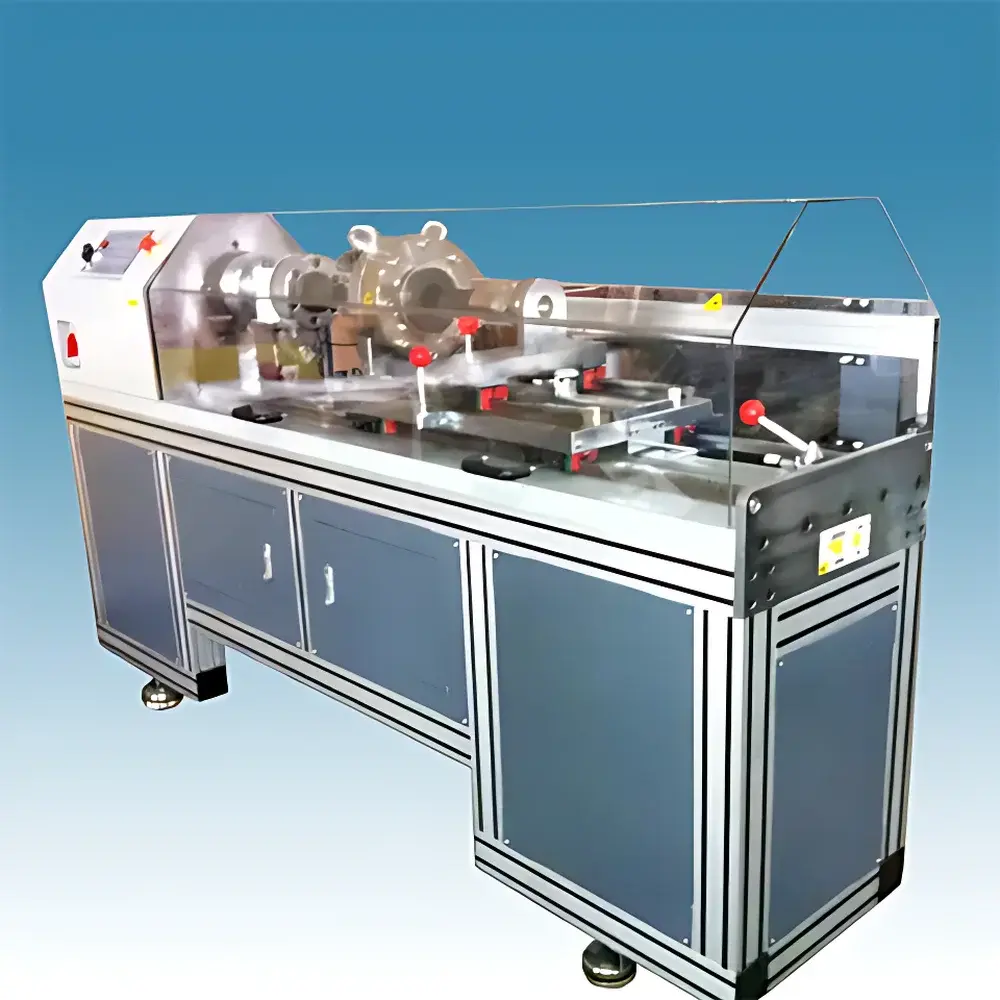
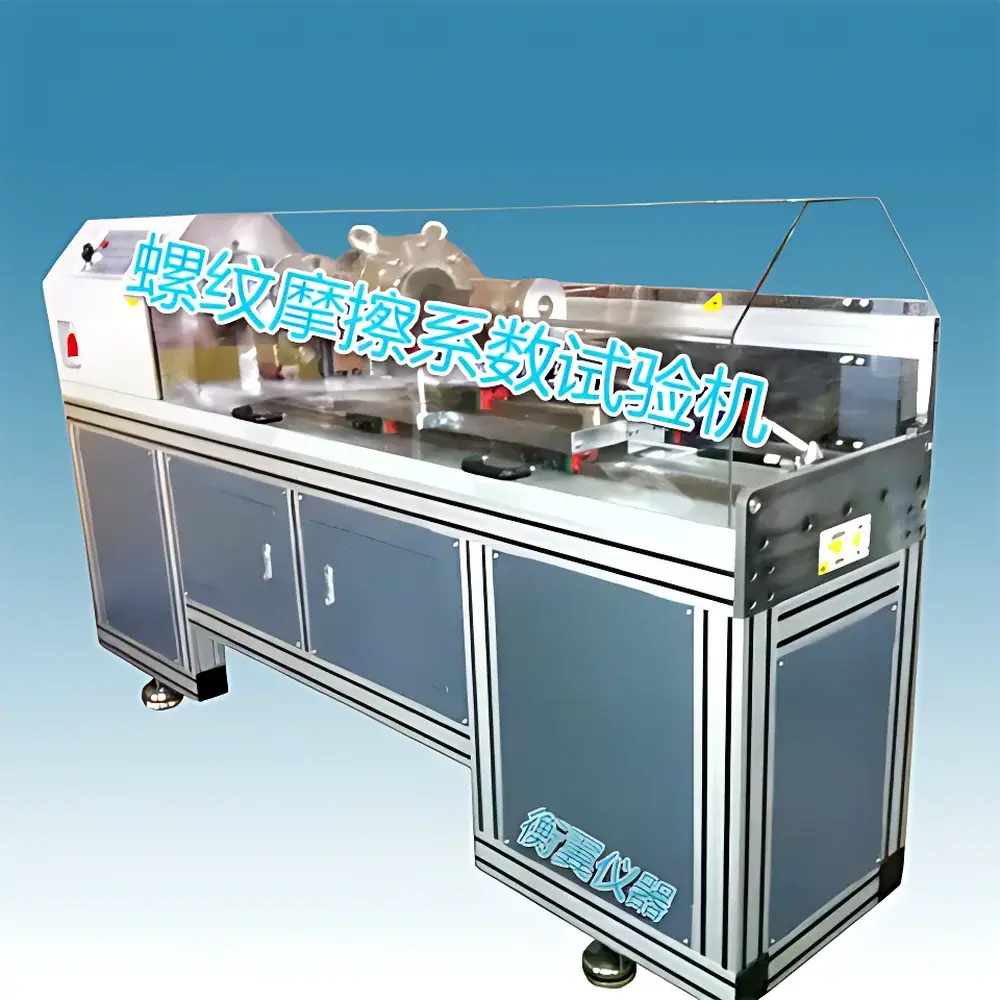
Hengyi HY(NJ)-2000N·m Bolt Tightening Analyzer
| Brand | Hengyi |
|---|---|
| Origin | Shanghai, China |
| Manufacturer Type | Direct Manufacturer |
| Product Category | Domestic |
| Model | HY(NJ)-2000N·mRTGV |
| Max Torque | 2000 N·m |
| Torque Measurement Range | 2–2000 N·m |
| Torque Resolution | 1/50000 |
| Torsion Angle Measurement Range | 0–100000° (full-scale) |
| Motor Power | 3 kW |
Overview
The Hengyi HY(NJ)-2000N·m Bolt Tightening Analyzer is a high-precision, horizontal floor-standing torsion testing system engineered for the quantitative evaluation of mechanical fastener performance under controlled torque and axial load conditions. It operates on the principle of coupled torsional–axial loading, enabling simultaneous real-time measurement of torque, axial force (tensile preload), angular displacement, and rotational speed during tightening, loosening, and breakaway cycles. Designed in strict compliance with international fastener testing standards—including ISO 16047, ASTM F2281, and DIN EN ISO 898-1—the instrument delivers traceable, repeatable data essential for validating bolted joint integrity in structural, energy, and heavy machinery applications. Its rigid cast-iron frame, precision-ground lead screws, and imported servo-motor–driven actuation system ensure long-term dimensional stability and minimal thermal drift, supporting GLP-compliant test execution across extended operational cycles.
Key Features
- Integrated dual-sensor architecture: High-accuracy torque transducer (±0.5% FS typical) and calibrated load cell (5–500 kN range, ±0.5% FS typical) enable synchronous acquisition of torque–axial force relationships.
- High-resolution angular measurement: Optical encoder with 0.0036° minimum resolution and full-scale range up to 100,000°, supporting both discrete step and continuous rotation protocols.
- Programmable torsion control: Closed-loop speed regulation from 0.1°/min to 1000°/min with ±0.5% speed accuracy; supports ramp-hold, cyclic torsion, and failure-triggered stop modes.
- Modular gripping system: Standardized hydraulic or mechanical chucks accommodating threaded fasteners from M10 to M27; custom jaw sets available for non-standard geometries (e.g., anchor bolts, shear connectors).
- Robust mechanical design: 2200 kg total mass, 2800 × 540 × 1250 mm footprint, and 1000 mm adjustable gauge length ensure minimal frame deflection under peak 2000 N·m loading.
- Industrial-grade controller: Hengyi HYtest digital measurement and control platform with embedded real-time OS, 1 kHz sampling rate, and hardware-based overload protection.
Sample Compatibility & Compliance
The analyzer accommodates standard and non-standard fasteners used in wind turbine towers, steel bridge connections, power transmission infrastructure, petrochemical flange assemblies, and construction-grade anchor systems. It supports testing per GB/T 1231–2006 (high-strength hex bolts for steel structures), GB/T 16823.3–2010 (torque–tension testing methodology), and ISO 898-2 (mechanical properties of fasteners). All torque and force channels are factory-calibrated against NIST-traceable reference standards, and system-level verification follows ISO/IEC 17025 requirements. Data audit trails comply with FDA 21 CFR Part 11 when operated with optional electronic signature modules.
Software & Data Management
The HYtest Control Suite provides intuitive test method configuration, real-time multi-channel visualization (torque vs. angle, axial force vs. time, torque coefficient K-curve), and automated report generation in PDF/Excel formats. Raw data export supports CSV and ASCII formats for third-party statistical analysis (e.g., Minitab, JMP). The software includes built-in calculation engines for torque coefficient (K = T / (F × d)), yield point detection (0.2% offset method), ultimate twist angle, and scatter band analysis per ISO 16047 Annex B. Audit logs record operator ID, timestamp, calibration status, and parameter changes—enabling full traceability for ISO 9001 and ASME BPVC Section VIII audits.
Applications
- Validation of torque–tension correlation for high-strength bolting in wind turbine nacelles and tower sections.
- Quality assurance of preloaded connections in overhead power line lattice towers and substation grounding systems.
- R&D characterization of frictional behavior in coated, lubricated, or galvanized fasteners under variable surface finish conditions.
- Failure mode analysis of bolt loosening, thread stripping, and shank yielding during dynamic service simulation.
- Third-party certification testing for EN 1090-2 compliance in fabricated steel construction components.
- Educational use in mechanical engineering laboratories for teaching bolt mechanics, joint stiffness, and preload loss mechanisms.
FAQ
What standards does this system support for bolt coefficient testing?
It fully implements GB/T 16823.3–2010, ISO 16047, ASTM F2281, and DIN EN ISO 898-1 for torque coefficient (K-value), proof load, and yield torque determination.
Can the system perform reverse-torque (loosening) tests?
Yes—bidirectional torque control allows automated tightening, dwell, loosening, and breakaway sequence programming with independent parameter definition for each phase.
Is axial force measurement traceable to national metrology institutes?
All load cells are calibrated using NIST-traceable deadweight machines; certificate of calibration includes uncertainty budget per ISO/IEC 17025.
What is the maximum sample length supported between chucks?
Standard gauge length is 1000 mm, adjustable within ±200 mm via motorized crosshead positioning.
Does the software support multi-user role-based access control?
Yes—administrator, operator, and reviewer roles can be assigned with configurable permissions for method editing, test execution, and report approval.



