
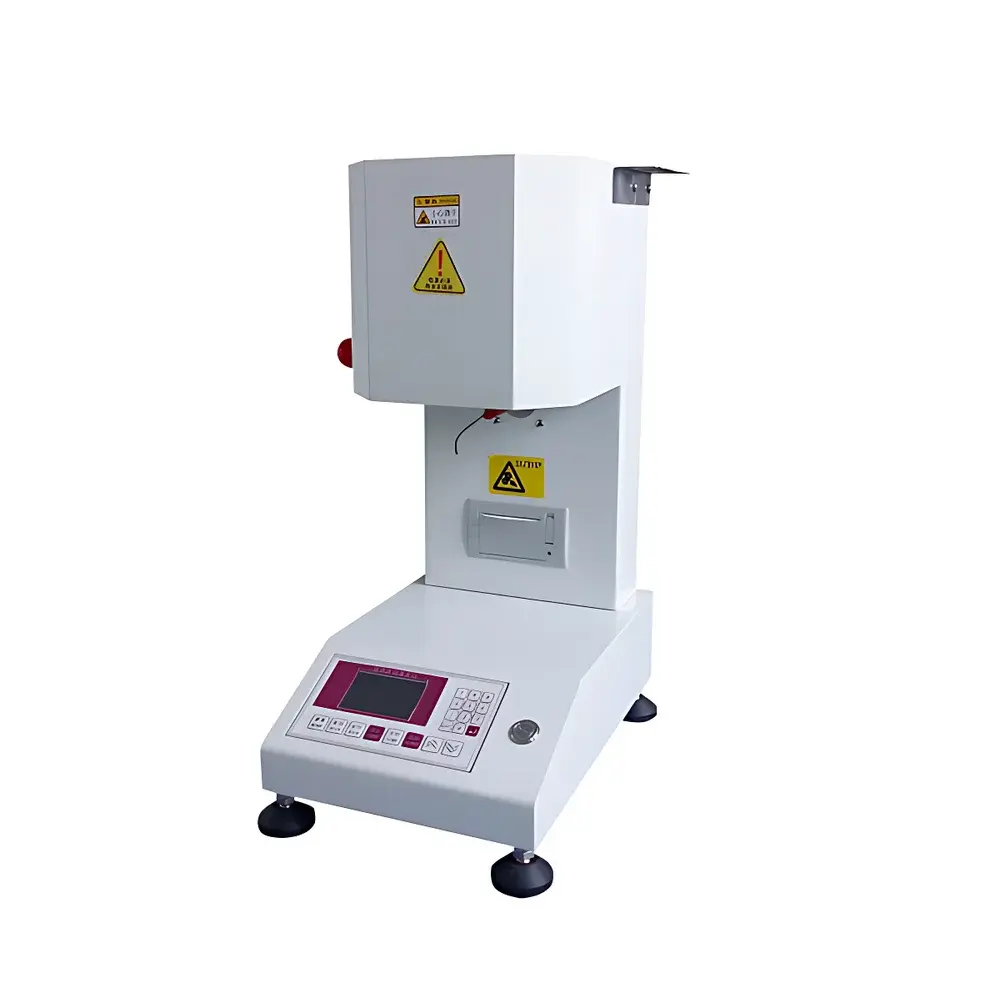
Hengyi HY(RZ) TGBVBN Fully Automated Melt Flow Rate Tester
| Brand | Hengyi / Hengyitest |
|---|---|
| Origin | Shanghai, China |
| Manufacturer Type | Direct Manufacturer |
| Product Origin | Domestic (China) |
| Model | HY(RZ) TGBVBN |
| Pricing | Upon Request |
| Standard Compliance | GB/T 3682–2018, JB/T 5456–2005 |
| Max Operating Temperature | ≥400 °C |
| Temperature Control Accuracy | ≤±0.2 °C |
| Temp. Stabilization Time (to max temp) | ≤30 min |
| Thermal Recovery Time (post-load) | 2–4 min |
| Timing Resolution | ≥0.1 s |
| Piston Displacement Resolution | ≥0.01 mm |
| Load Levels | 8 standard weights (0.325–21.600 kg |
| Die Dimensions | Ø2.095±0.005 mm × 8.000±0.025 mm |
| Barrel ID | Ø9.550±0.025 mm, Length: 152.0±0.1 mm |
| Piston Head OD | 9.475±0.015 mm, Length: 6.350±0.100 mm |
| Test Methods | Mass Flow Rate (MFR) and Volume Flow Rate (MVR) |
| Control Interface | Full-color PLC-based touchscreen HMI |
| Packaging Standard | GB/T 13384 |
| Transport Standards | GB/T 191, GB/T 6388 |
Overview
The Hengyi HY(RZ) TGBVBN Fully Automated Melt Flow Rate Tester is an ISO/IEC 17025-aligned instrument engineered for precise, repeatable determination of melt flow rate (MFR) and melt volume rate (MVR) of thermoplastic polymers under standardized load and temperature conditions. It operates on the principle of extrusion rheometry: a polymer sample is loaded into a heated barrel, melted under controlled temperature, and forced through a standardized capillary die under a defined gravitational load. The mass or volume of extrudate collected over a fixed time interval is used to calculate MFR (g/10 min) or MVR (cm³/10 min), providing critical processability data for quality control, material specification verification, and R&D screening.
Designed for compliance with GB/T 3682–2018 (equivalent in scope to ISO 1133–1:2011 and ASTM D1238–22), the system supports both single- and multi-load testing protocols across a wide thermal range (up to 400 °C), enabling characterization of conventional polyolefins (e.g., PE, PP), engineering thermoplastics (e.g., PC, PA6, ABS), and high-performance resins (e.g., POM, fluoropolymers). Its fully automated architecture eliminates manual timing and cutting errors, ensuring measurement reproducibility essential for GLP-compliant laboratories and production QA/QC environments.
Key Features
- Fully automated cutting mechanism with programmable cut intervals—enabling precise MFR and MVR determinations without operator intervention.
- High-stability temperature control system with ±0.2 °C accuracy across 40–400 °C range; achieves thermal equilibrium within ≤30 minutes and recovers to setpoint within 2–4 minutes after sample loading.
- Eight calibrated weight sets (0.325–21.600 kg; corresponding to 3.187–211.82 N) compliant with ISO 1133 Annex A and GB/T 3682 load classifications.
- Precision-machined die assembly: capillary diameter Ø2.095 ±0.005 mm, length 8.000 ±0.025 mm; barrel inner diameter Ø9.550 ±0.025 mm, length 152.0 ±0.1 mm; piston head Ø9.475 ±0.015 mm.
- PLC-based full-color touchscreen HMI with embedded real-time temperature curve visualization, parameter configuration, auto-calibration routines, and MFR/MVR result display.
- Integrated safety design: insulated high-temp zones with thermal shielding and anti-scald guards; modular wear components (die, barrel, piston) designed for rapid field replacement per JB/T 5456–2005 maintenance requirements.
Sample Compatibility & Compliance
The HY(RZ) TGBVBN accommodates granular, pelletized, or powder-form thermoplastic specimens—including polyethylene (PE), polypropylene (PP), polystyrene (PS), acrylonitrile-butadiene-styrene (ABS), polyoxymethylene (POM), polycarbonate (PC), polyamide (PA), and fluoropolymers such as PTFE and PVDF. All test configurations adhere strictly to GB/T 3682–2018, which aligns methodologically with ISO 1133–1 (determination of MFR/MVR by extrusion plastometer) and ASTM D1238 (standard test method for melt flow rates of thermoplastics). The instrument’s mechanical tolerances, thermal uniformity profile, and load application geometry satisfy metrological traceability requirements for accredited testing laboratories. Optional audit trail logging and user access control support FDA 21 CFR Part 11 readiness when integrated with validated LIMS or ELN platforms.
Software & Data Management
The embedded control firmware enables full test sequence automation: temperature ramping, dwell stabilization, load application, timed extrudate collection, and automatic calculation of MFR (g/10 min) and MVR (cm³/10 min) per ISO 1133–1 Annexes B and C. Real-time temperature curves are logged at 1 Hz resolution and exportable via USB to CSV format. System calibration parameters—including die constant, barrel volume, and piston displacement coefficient—are stored with version-stamped metadata. While the base unit does not include network connectivity, its data structure conforms to ASTM E1382–95 (Standard Guide for Computerizing Analytical Data) conventions, facilitating integration into enterprise-quality systems supporting ISO/IEC 17025 documentation workflows.
Applications
- Raw material acceptance testing per supplier specifications (e.g., PE resin grade verification against MFR 0.3–30 g/10 min).
- In-process monitoring during compounding and extrusion to detect batch-to-batch molecular weight distribution shifts.
- Stability assessment of polymer blends and filled systems (e.g., glass-filled nylon, carbon-black-loaded EPDM).
- Accelerated aging studies evaluating thermo-oxidative degradation via MFR drift over time at elevated temperatures.
- Regulatory submission support for medical-grade polymers (ISO 10993–12) and food-contact materials (FDA 21 CFR §177).
- Research correlation of MFR with rheological properties (e.g., zero-shear viscosity, polydispersity index) derived from rotational rheometry.
FAQ
Does the HY(RZ) TGBVBN comply with international standards beyond GB/T 3682?
Yes—it implements measurement principles and dimensional tolerances consistent with ISO 1133–1:2011 and ASTM D1238–22. Its load train, die geometry, and temperature uniformity meet the technical equivalency criteria referenced in ILAC-P10:2022 for cross-standard validation.
Can the system perform both MFR and MVR measurements without hardware modification?
Yes. Dual-mode operation is enabled by software-controlled piston displacement sensing and gravimetric collection logic. MVR calculation uses real-time piston travel (±0.01 mm resolution) and calibrated barrel/die geometry.
What maintenance intervals are recommended for the die and barrel assemblies?
Per JB/T 5456–2005, routine inspection is advised after every 50 test cycles; replacement is recommended after 200 cycles or upon visible wear (e.g., die bore ellipticity >0.003 mm, barrel ID deviation >0.020 mm). Spare parts kits are supplied with NIST-traceable calibration certificates.
Is third-party calibration certification available?
Yes. Hengyi partners with CNAS-accredited calibration labs in Shanghai and Suzhou to provide ISO/IEC 17025-compliant calibration reports covering temperature uniformity mapping, load verification, and dimensional metrology of critical components.
How is data integrity ensured during extended unattended operation?
The PLC controller logs all critical events (temperature deviations >0.5 °C, load application faults, cut timing anomalies) with timestamps. Power-fail recovery preserves last valid test state, and internal non-volatile memory retains ≥1,000 test records with full parameter audit trails.



