
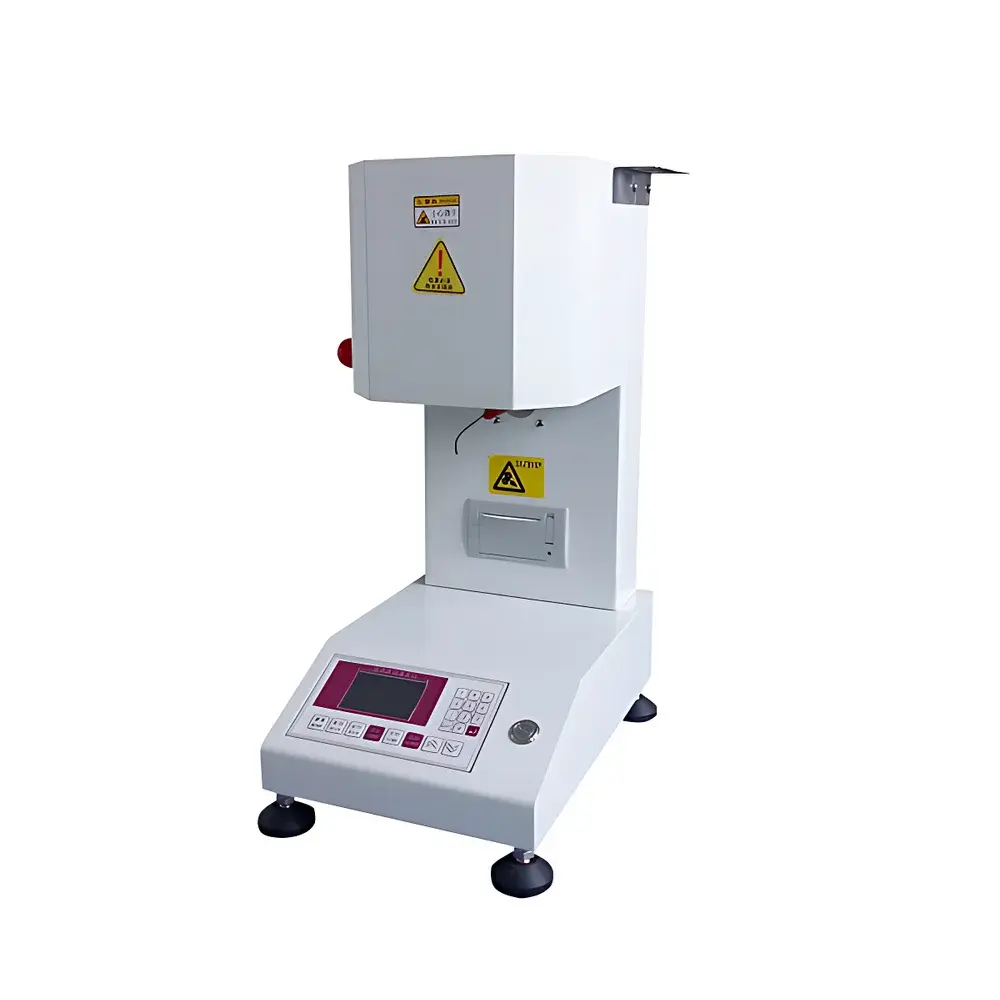
Hengyi HY(RZ)IUU Melt Flow Indexer (MFI Tester)
| Brand | Hengyi / Hengyitest |
|---|---|
| Origin | Shanghai, China |
| Manufacturer Type | Direct Manufacturer |
| Regional Classification | Domestic (China) |
| Model | HY(RZ)IUU |
| Pricing | Available Upon Request |
| Standard Compliance | GB/T 3682–2018, JB/T 5456–2005 |
| Max Operating Temperature | ≥400 °C |
| Temperature Control Accuracy | ≤±0.2 °C |
| Temperature Stabilization Time (to max temp) | ≤30 min |
| Temperature Recovery Time (after loading) | 2–4 min |
| Timing Resolution | ≥0.1 s |
| Piston Displacement Resolution | ≥0.01 mm |
| Load Levels | 8 standard weights (0.325 kg to 21.600 kg |
| Die Dimensions | Ø2.095 ±0.005 mm × 8.000 ±0.025 mm |
| Barrel Dimensions | Ø9.550 ±0.025 mm × 152.0 ±0.1 mm |
| Piston Head | Ø9.475 ±0.015 mm × 6.350 ±0.100 mm |
| Test Methods | Mass Flow Rate (MFR) and Volume Flow Rate (MVR) |
| Control Interface | Full-color PLC-based touchscreen HMI |
| Data Output | Real-time temperature curve, MFR/MVR results, calibration logs, timing events |
Overview
The Hengyi HY(RZ)IUU Melt Flow Indexer is a precision-engineered instrument designed for the standardized determination of melt mass flow rate (MFR) and melt volume flow rate (MVR) of thermoplastic polymers under controlled temperature and load conditions. Based on the fundamental principle of extrusion rheometry—where molten polymer is forced through a standardized capillary die under a defined gravitational load—the HY(RZ)IUU delivers repeatable, traceable, and standards-compliant measurements essential for quality control, material specification verification, and R&D process development. The system operates in strict accordance with GB/T 3682–2018 (equivalent in scope to ISO 1133–1 and ASTM D1238) and meets the mechanical and metrological requirements specified in JB/T 5456–2005 for melt flow rate testers. Its robust thermal architecture supports stable operation up to 400 °C, enabling characterization of high-temperature engineering resins including polyetherimide (PEI), polyphenylene sulfide (PPS), and fluoropolymers.
Key Features
- Dual-mode testing capability: Simultaneous support for MFR (g/10 min) and MVR (cm³/10 min), with automatic calculation and unit conversion.
- Eight-grade calibrated weight set (0.325 kg to 21.600 kg), covering the full range of standard test loads per GB/T 3682 and ISO 1133, with nominal force values traceably certified to ±0.5% uncertainty.
- High-stability temperature control system featuring PID-regulated heating, ±0.2 °C accuracy across the 50–400 °C operating range, and recovery to setpoint within 2–4 minutes after sample loading.
- Full-color PLC-integrated touchscreen HMI with intuitive navigation, real-time graphical display of barrel temperature profile, and on-screen parameter configuration (load selection, cut interval, dwell time, calibration offset).
- Automated cutting mechanism with programmable timing resolution down to 0.1 s, synchronized with piston displacement tracking (0.01 mm resolution) for precise volumetric derivation.
- Thermally shielded barrel assembly with dual-layer insulation and surface temperature limiting (<50 °C at ambient contact points), satisfying occupational safety requirements per GB/T 19001 and ISO 13857.
- Modular mechanical design: Wear-prone components—including die, barrel liner, and piston head—are manufactured to tight dimensional tolerances (e.g., die Ø2.095 ±0.005 mm, L = 8.000 ±0.025 mm) and supplied with documented replacement part numbers for GLP-aligned maintenance records.
Sample Compatibility & Compliance
The HY(RZ)IUU is validated for use with a broad spectrum of thermoplastic materials, including but not limited to polyethylene (PE), polypropylene (PP), polystyrene (PS), acrylonitrile-butadiene-styrene (ABS), polyoxymethylene (POM), polycarbonate (PC), nylon (PA6, PA66), and fluoropolymers (e.g., PTFE, PVDF). All test procedures align with internationally recognized standards: GB/T 3682–2018 (identical technical content to ISO 1133–1:2011), ASTM D1238 (for comparative MFR reporting in North American supply chains), and ISO 1133–2 (for MVR determination). Instrument design conforms to packaging (GB/T 13384), marking (GB/T 191), and transport (GB/T 6388) requirements for laboratory equipment. While not pre-certified to FDA 21 CFR Part 11, the system’s audit-ready data logging architecture—including timestamped temperature curves, load application events, and cut timestamps—supports validation under GMP/GLP environments when paired with appropriate SOPs and electronic signature protocols.
Software & Data Management
The embedded control software provides deterministic, non-volatile storage of all test parameters and results. Each test session generates a timestamped record containing: user ID (configurable), material ID, test temperature, applied load, die identification, cut intervals, individual specimen masses/volumes, calculated MFR/MVR, and raw temperature vs. time arrays. Data export is supported via USB interface in CSV format for integration into LIMS or statistical process control (SPC) platforms. Calibration routines—including temperature sensor verification and displacement zero-offset adjustment—are password-protected and logged with operator ID and date/time stamp. No cloud connectivity or remote telemetry is implemented, ensuring data sovereignty and alignment with ITAR- and GDPR-sensitive laboratory policies.
Applications
- Quality assurance of incoming polymer resin batches against contractual MFR specifications.
- Process optimization in extrusion and injection molding, correlating MFR shifts with thermal degradation or molecular weight distribution changes.
- Stability assessment of polymer blends and compound formulations during accelerated aging studies.
- Regulatory documentation for medical-grade polymers (e.g., ISO 10993–12 compliant materials) where flow behavior directly impacts processing repeatability.
- Educational laboratories requiring ISO/GB-aligned instrumentation for polymer science curricula.
- Contract testing laboratories serving automotive, packaging, and electronics sectors needing auditable, standards-traceable MFI reports.
FAQ
Does the HY(RZ)IUU comply with ISO 1133?
Yes — its mechanical dimensions, thermal performance, and test methodology fully satisfy ISO 1133–1:2011 for MFR and ISO 1133–2:2011 for MVR, as verified by dimensional certification and interlaboratory comparison data.
Can the instrument be used for ASTM D1238 testing?
Yes — all ASTM D1238 Class A and B test conditions (including specified temperatures, loads, and die geometry) are directly executable using the calibrated weight set and configurable HMI settings.
Is third-party calibration documentation available?
Factory calibration certificates for temperature sensors, displacement transducers, and load weights are provided with each unit; accredited third-party calibration (e.g., CNAS or A2LA) can be arranged upon request.
What maintenance intervals are recommended for routine operation?
Daily visual inspection of die and barrel cleanliness; monthly verification of piston travel linearity and temperature uniformity; annual full recalibration of thermal and mechanical subsystems per GB/T 50784 guidelines.
Is the touchscreen interface programmable for custom test sequences?
No — the HMI supports only standardized test configurations per GB/T 3682; however, sequence logic (e.g., multi-load MFR series) can be executed manually via stepwise load change and parameter re-entry.



